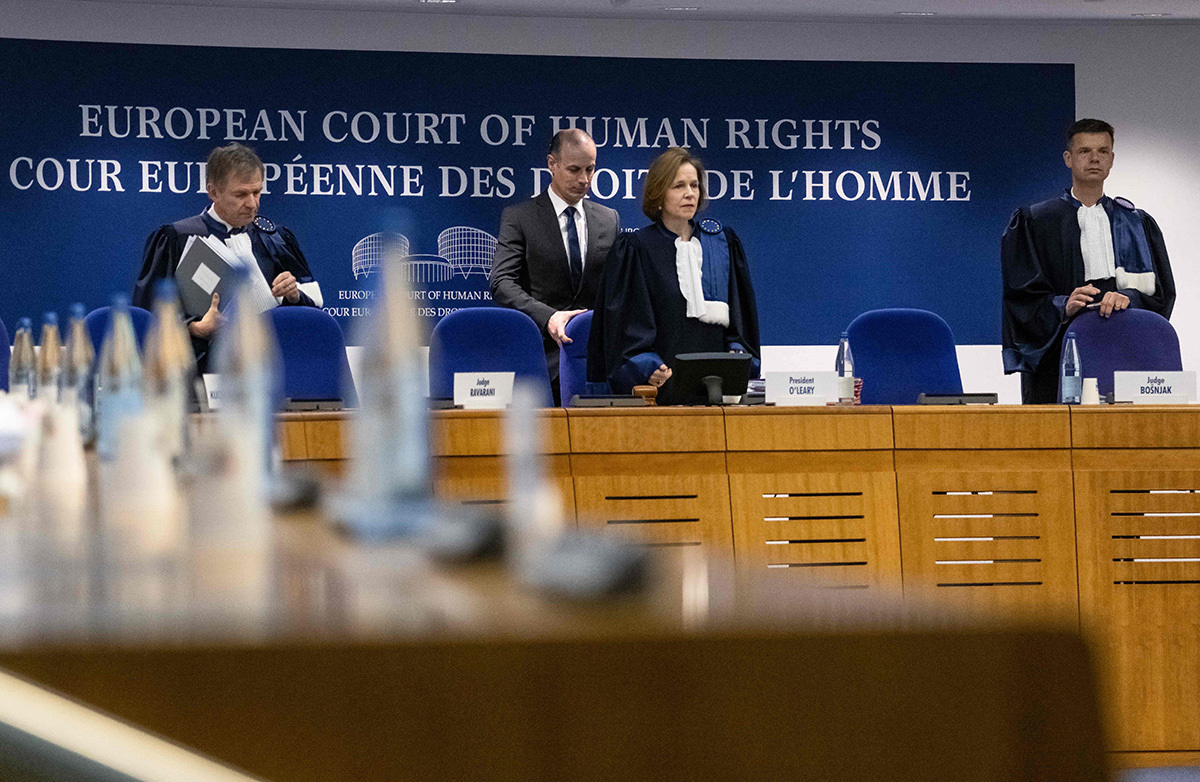
The European Court of Human Rights is reviewing a case that could determine whether religious symbols may be displayed in courtrooms and other public buildings. The case arises from complaints by Greek atheists who say the presence of Christian icons violated their right to a fair trial and religious freedom.
The legal challenge involves two separate hearings held in 2018 and 2019 in the Greek Supreme Administrative Court. In both cases, the applicants requested the removal of a Christian Orthodox icon of Jesus Christ from the courtroom, arguing that its display breached Article 6 and Article 9 of the European Convention on Human Rights, which guarantee the right to a fair trial and freedom of religion, respectively, according to the legal advocacy group ADF International.
The Greek court rejected both requests and allowed the religious symbol to remain in place, according to the case summary published by the European Court.
In the 2018 case, the Union of Atheists challenged ministerial decisions relating to religious education. The group claimed that the presence of the icon in the courtroom during a hearing on Sept. 21 that year, which included Christian Orthodox interveners such as the Church of Greece, compromised the court’s objectivity.
The court dismissed their application on Oct. 11, 2019, finding the icon request inadmissible and rejecting the argument that the religious imagery affected fairness.
The second case, heard in May 2019, involved two individuals who opposed recording religious affiliation on school documents. They also asked for the removal of the icon, citing similar concerns about neutrality.
The court granted their main request, annulling the ministerial order, but dismissed the icon complaint as unfounded. It cited Greece’s Orthodox Christian tradition and long-standing custom as the basis for permitting religious imagery in courtrooms.
The applicants claim that these dismissals violated their rights as non-religious citizens. They argue that the court failed to meet its duty of neutrality and that Greece lacks a legal basis for permitting religious symbols in judicial settings. They further assert that most Council of Europe member states do not allow religious icons in courtrooms.
The European Court has formally asked the Greek government to respond to three questions: whether the presence of religious symbols undermined the applicants’ right to an impartial tribunal, whether it interfered with their freedom of religion, and whether the practice amounted to discrimination under Article 14 of the convention.
ADF International submitted a third-party intervention in support of Greece, arguing that removing religious symbols is based on a flawed reading of human rights law. The group said the European Court has consistently affirmed a state’s right to reflect cultural and religious heritage in public spaces, according to ADF Senior Counsel Adina Portaru.
“The display of religious symbols in public spaces is in no way incompatible with human rights law,” Portaru said in a statement. “Public spaces should not be stripped of crosses, icons or other symbols with religious, cultural, and historical significance in the name of pluralism.”
In its legal brief, ADF stated that no law guarantees a right to avoid offense from religious imagery and that a symbol alone does not infringe belief or fairness. It pointed to the court’s previous decision in Lautsi v. Italy (2011), which held that crucifixes in classrooms did not violate human rights. That case also featured an ADF intervention.
The ADF brief noted that religious symbols are common across Europe, citing crucifixes in Italian state offices, religious artwork in court buildings in Austria and Spain, and crosses in Bavarian government offices. It also referenced French rulings that permit religious imagery where it holds cultural or historical value.