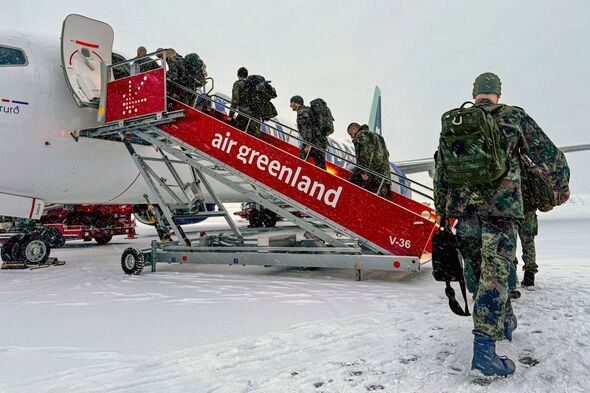
There appears to be an emerging consensus that a response is required from the affected countries (Image: Getty)
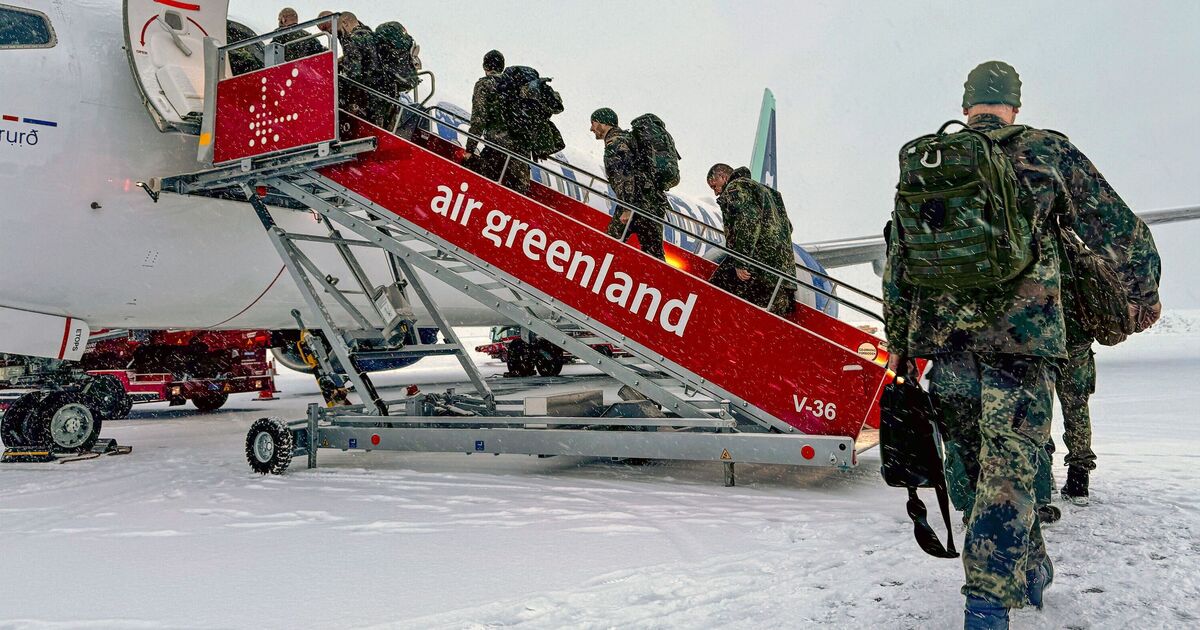
After President Trump threatened to impose additional tariffs on eight Nato allies that oppose a US takeover of Greenland, there has been a palpable shift in tone from Europe’s leaders, reports The Times.
Ulf Kristersson, the Swedish prime minister, said: “We will not let ourselves be blackmailed”, while Giorgia Meloni, the Italian prime minister and the only European head of government invited to Trump’s inauguration, called the move a “mistake.”
Even Alexander Stubb, the Finnish president, who prides himself on his rhetorical restraint and has played golf with the US president, warned of a “harmful spiral” that would damage the transatlantic axis.
There appears to be an emerging consensus that a response is required from the affected countries — which besides Britain are Denmark, France, Finland, Germany, the Netherlands, Norway and Sweden — even if it is only a token and painstakingly calibrated gesture. But what?
Read more: Greenland spat most recent disagreement between US and EU
Read more: Canada vows to defend Greenland against the US if Trump invades
Weaponising America’s dependencies on European countries
In recent days there has been much speculation about the possibility of weaponising America’s dependencies on European countries. Officials in Berlin looked aghast at reports that suggested they might turf out the US military from some of the mega-bases on German soil, such as Ramstein and Stuttgart, which are essential for Washington to project force into Africa and the Middle East. One source denied that this was on the cards but said it was possible that Germany might significantly increase the rent it charges on these facilities. Yougov conducted a poll on the issue which found 47 percent of Germans supported US troops withdrawing from the country.
However, Germany’s defense minister warned Wednesday that any US move to annex Greenland would endanger NATO’s existence. In a guest article for the Die Zeit newspaper, Boris Pistorius said, “Going it alone represents a worse alternative and endangers NATO’s continued existence as a North Atlantic defense alliance.”
EU to push back against Trump trade deal
It remains improbable that individual European countries would block American access to the crown jewels of their economies, such as Denmark’s insulin, Finland’s icebreakers or the Netherlands’ chipmaking technology. However, momentum has been building behind one simple and broad countermeasure. It appears that a majority of MEPs are prepared to stall the ratification of the one-sided trade deal that Brussels struck with Trump last summer, in which the Europeans agreed to swallow 15 per cent American tariffs while levying none of their own.
Europe has plenty of other instruments at its disposal to exploit what Tobias Gehrke, a geo-economics analyst at the European Council on Foreign Relations think tank, has called “mutually asymmetric dependence”: the areas where the Americans may need the Europeans more than the Europeans need the Americans.
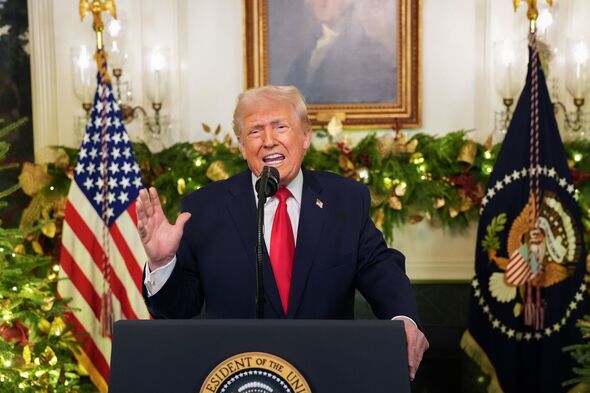
President Trump threatened to impose additional tariffs on eight Nato allies (Image: Getty)
Reciprocal tariffs
The most obvious tool is the reciprocal tariff: mirroring the US numbers, tit for tat. This can be augmented with the old EU tactic of selectively targeting certain exports that matter to Trump’s base: bourbon from Kentucky, for example. On Sunday President Macron joined other prominent figures in suggesting the time had come for the EU to deploy its anti-coercion instrument, a “last resort” package of tariffs and other sweeping trade measures that was originally developed to deter China from bullying individual states.
Another option highlighted by Gehrke is the export tax, where the Europeans effectively impose tariffs on their goods in specific areas where the US cannot easily find substitutes, such as specialised industrial machinery. The logic is that driving up the prices would result in political pain for Trump. However, as Gehrke points out, it is a highly risky strategy that would disproportionately harm parts of European industry.
Regulatory tookit
Brussels could also harness its sprawling regulatory apparatus and turn it against the US, changing the rules to exclude American products. That could be especially effective in the food and farming sector. Finally, European leaders could informally encourage their citizens to join boycotts of US goods. This has already happened in Canada and in some European countries. One Nordic official said their family had stopped buying Sun-Pat peanut butter as a symbolic gesture of exasperation.
The EU has some of the most highly developed and restrictive technology and data regulations on the planet. It has already begun to act more aggressively on this front, most notably fining X, Elon Musk‘s social media platform, €120 million for various breaches of the Digital Services Act.
Gehrke notes that Brussels has the power to levy fines of up to 10 per cent of a Silicon Valley company’s global turnover, to ban services that violate EU rules and even to stop the transfer of data across the Atlantic, although this would wreak havoc on large parts of Europe’s own IT infrastructure.
Denmark protest: Anger at Donald Trump’s Greenland stance
Targeting US financial sector, energy, defence procurement
The EU has a big toolbox of regulations that it could use to target parts of the US financial sector, allowing for a flexible and fine-tuned counterattack, but again the risks of spiralling measures and countermeasures are considerable. It is possible to exclude the Americans from other areas of the European economy, from hydrocarbons to artificial intelligence.
The EU buys about half of the liquefied natural gas and crude oil that the US exports. Imposing tariffs on these fuels would inflict tremendous pain on many member states in the short to medium term, and devastate Germany’s already hard-pressed industrial base in particular. It would also hammer the American energy industry. In the long term, it could ultimately be a prelude to a wholesale rebalancing of Europe’s energy supply.
American arms manufacturers could be shut out of European defence procurement, which would turn up the pressure on Trump, but it is difficult to envisage a readiness in the EU to forgo world-leading US-made weapons systems such as the F-35 fighter jet or Patriot air defence batteries. Much the same is true of Starlink, Musk’s satellite communications network.
There is no such thing as pain-free retaliation against the US. Some of these measures would involve decoupling the fundamental infrastructure of the West. All those involved risk triggering a crushing act of revenge from Trump.
However, as the Europeans are learning, inaction bears a price tag of its own.