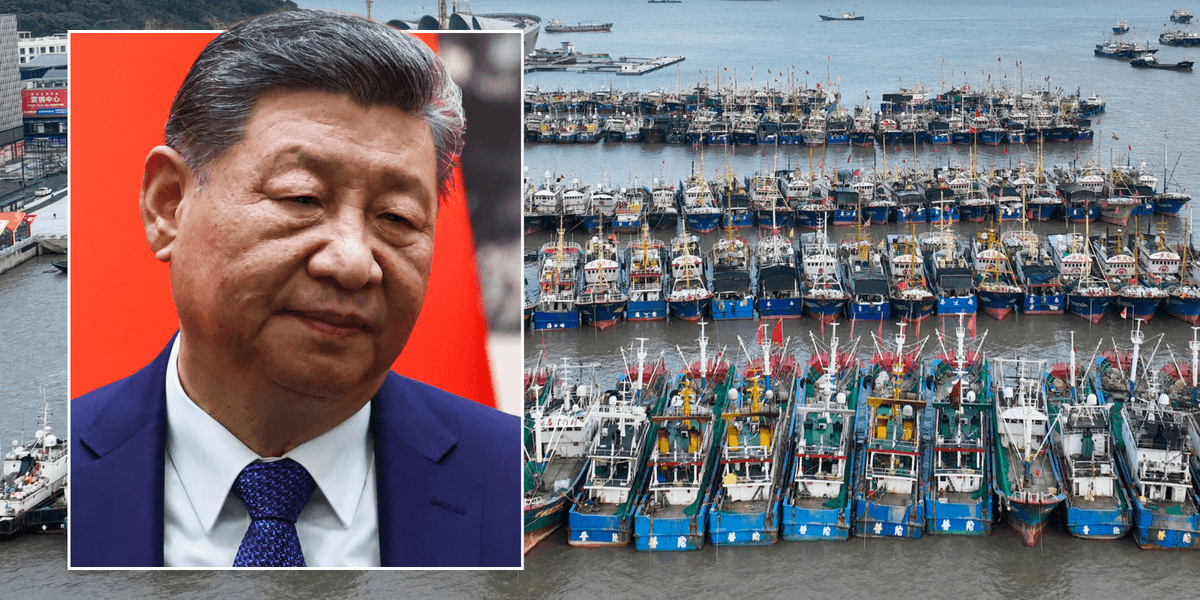
China has deployed thousands of fishing vessels to create 200-mile-long floating walls across the East China Sea.
The operations went largely undetected until ship-tracking data analysis revealed their scale.
Around 1,400 Chinese vessels suddenly abandoned fishing or left port to gather in the East China Sea last week.
By January 11, they had formed a dense rectangle over 200 miles long.
Some cargo ships had to navigate around the formation or try to weave through it.
A similar operation was launched on Christmas Day, when roughly 2,000 boats assembled in two parallel lines spanning 290 miles each, creating a reverse L shape.
Maritime and military experts said the manoeuvres indicate Beijing is bolstering its maritime militia, a force of civilian fishing boats trained to participate in a potential war.
Jason Wang, chief operating officer of ingeniSPACE, first spotted the unusual formations.

Data obtained by the NYT shows how the ships had formed a dense rectangle over 200 miles long
|
GB NEWS
“I was thinking to myself: ‘This is not right,'” he said, describing his response when he spotted the fishing boats on Christmas Day.
“I’ve seen like a couple hundred – let’s say high hundreds,” he said, referring to Chinese boats he has previously tracked, “but nothing of this scale or of this distinctive formation.”
Mark Douglas, an analyst at Starboard Maritime Intelligence, said he and his colleagues had “never seen a formation of this size and discipline before.”
“The level of coordination to get that many vessels into a formation like this is significant,” he told the New York Times.
Gregory Poling, director of the Asia Maritime Transparency Initiative at the Center for Strategic and International Studies, said the boats were almost certainly not fishing.
CHINA AT SEA – READ MORE:

As many as 1,400 Chinese vessels suddenly abandoned fishing to line up in a 200-mile-long wall (file photo)
|
GETTY
“They are almost certainly not fishing, and I can’t think of any explanation that isn’t state-directed,” he wrote.
“My best guess is this was an exercise to see how the civilians would do if told to muster at scale in a future contingency, perhaps in support of quarantine, blockade, or other pressure tactics against Taiwan,” Mr. Poling wrote.
The January manoeuvres came shortly after Beijing conducted two days of mass drills around Taiwan, practising naval blockade tactics.
Beijing claims Taiwan as its territory and is locked in a dispute with Japan over its support for the island.

China is ‘preparing for a conflict or crisis, e.g. over Taiwan or the South China Sea’, Michael Kovrig said
|
GETTY
The smaller vessels could hinder American warship movements, according to Lonnie Henley, a former US intelligence officer who has studied China’s maritime militia.
Thomas Shugart, a former US naval officer now at the Center for a New American Security, said the masses of boats could also act “as missile and torpedo decoys, overwhelming radars or drone sensors with too many targets.”
The recent gatherings suggest maritime militia units now have better navigation and communications technology.
“It does mark an improvement in their ability to marshal and control a large number of militia vessels,” said Mr Henley, now a non-resident senior fellow at the Foreign Policy Research Institute.
And Michael Kovrig of the International Crisis Group said the formations “look like raining manoeuvres by the PRC maritime militia”.
He warned China was “preparing for a conflict or crisis, e.g. over Taiwan or the South China Sea, in which thousands of vessels could assert sovereignty, obstruct sea lanes and complicate enemy military operations and supply lines”.
“As Thomas A. Callaghan Jr said, quantity has a quality of its own,” Mr Kovrig added.