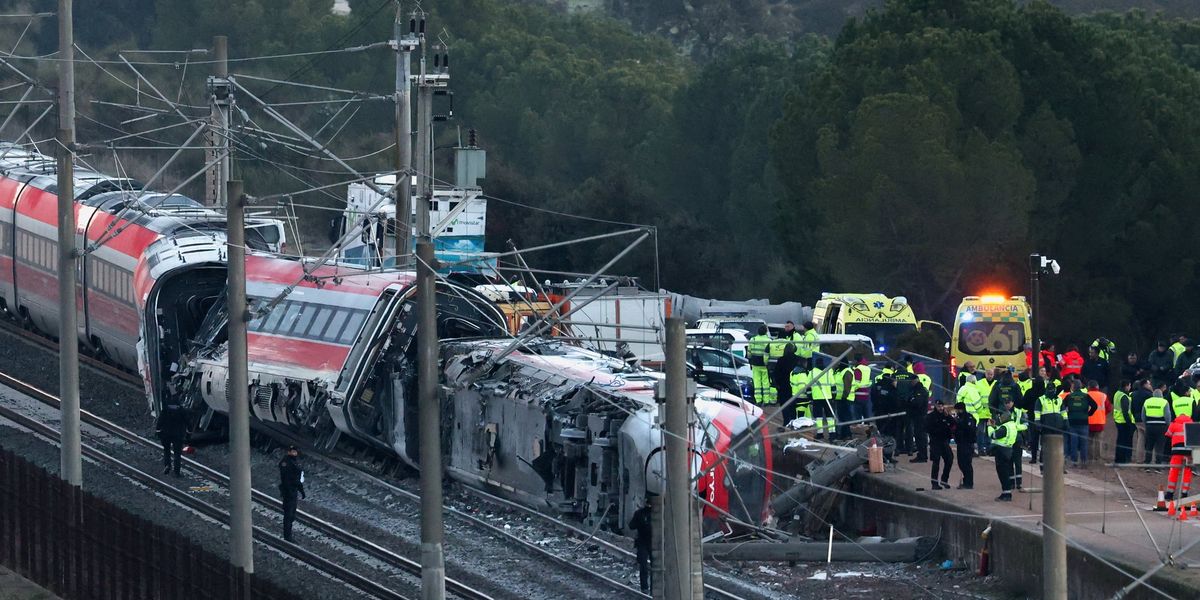
The high-speed train crash that killed at least 40 people and left dozens more injured could have been caused by a significant gap found in the tracks, investigators have found.
The back end of a train heading from Malaga to Madrid derailed at 7.45pm on Sunday evening, before being smashed into by an oncoming high-speed train moments later.
The incident occurred near the city of Cordoba, but investigators at the scene have found wear on the joint between sections of the rail.
A source told Reuters this faulty joint created a gap between the rail sections, which was widening as trains continued to travel over the track.
According to the source, this problem had been there for some time, despite the track being renovated as part of a £608million project in May last year.
Investigators believe this gap could be key to identifying the cause of the crash – Spain’s most deadly train incident in over a decade – the source added.
At around 7.45pm, after the first seven carriages of the train operated by Iryo drove over the gap rails, the eighth derailed, bringing with it carriages six and seven.
Within 20 seconds, an oncoming train, operated by Renfe, collided with the derailed carriages, causing the front of the train to leave the track and fall into an embankment.

The high-speed train crash that killed at least 40 people and left dozens more injured could have been caused by a significant gap found in the tracks
|
REUTERS
Authorities say that the driver of the second train – who was killed in the crash – simply had no time to react.
Spain’s Transport Minister Oscar Puente has since described the tragedy as “extremely strange”, adding that all railway experts consulted by government officials were “extremely baffled by the accident”.
The President of Renfe, Spain’s state-owned rail operator, said he “discarded” the idea that the incident occurred due to human error or high speed.
The speed limit on those tracks is 250km/h (149mph). The trains were travelling at 210km/h and 205km/h respectively when they collided.

The two trains collided near the city of Cordoba
|
GETTY

The trains were believed to be travelling at 210km/h and 205km/h respectively, lower than the speed limit for those tracks
|
REUTERS
In the months leading up to the crash, the company that manages Spain’s railway infrastructure warned of at least eight technical incidents on the high-speed line.
Most of the issues reported were due to failure in the signalling system, though some problems with overhead power lines and other infrastructure had also been noted.
The Government confirmed it had addressed two “technical incidents affecting the signalling systems”.
According to a statement from Renfe, the two trains were carrying a total of 400 passengers and staff.
So far, 40 people have been confirmed dead, but authorities worry that there could be more. It remains unclear whether there are people still trapped inside the carriages.

Rescue teams are currently working to recover any further bodies from the wreckage
|
RUETERS
Mr Puente confirmed that the death toll is “not yet final”.
“The problem is that the carriages are twisted, so the metal is twisted with the people inside,” Francisco Carmona, head of firefighters in Cordoba, told Spanish public broadcaster RTVE.
“We have even had to remove a dead person to be able to reach someone alive. It is hard, tricky work.”
The President of the Andalusian regional government, Juanma Moreno, told Spanish outlet Canal Sur that they require “heavy machinery” to lift parts of the second train, which has “taken the worst part” of the accident.
“Until the heavy machinery can do its job and free the wagons from the track”, emergency services will not be able to start “searching and identifying”, he said.