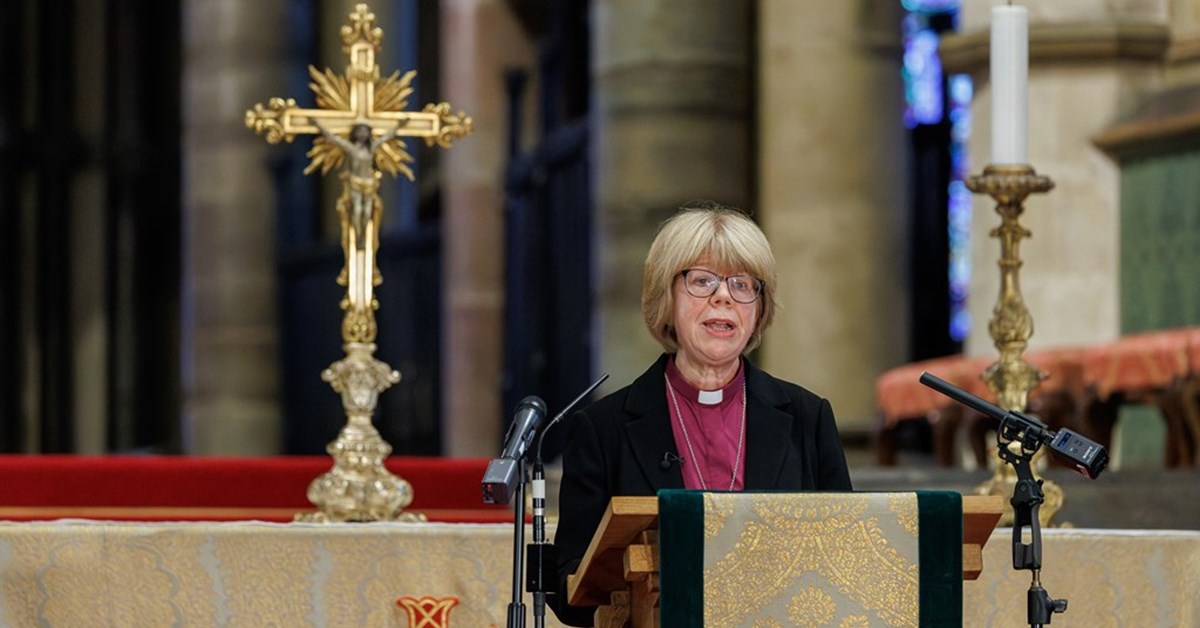
THE £100-million Fund for Healing, Repair and Justice, set up by the Church Commissioners to benefit communities affected by the historic transatlantic slave trade, has been defended by the Archbishop of Canterbury-elect as a response to a “Gospel imperative”.
Last month, 24 Conservative MPs and four members of the House of Lords wrote to Bishop Mullally setting out their concerns about Project Spire. The Conservative MP for Weald of Kent, Katie Lam, who coordinated the letter, wrote that the project rested “on highly contested interpretations of history” and would set a “worrying precedent” for other institutions.
By law, the Church Commissioners’ endowment “must be used to support parish ministry, maintain church buildings, and care for the Church’s historic records”, she wrote. “At a moment when churches across the country are struggling to keep their doors open — many even falling into disrepair — it’s wrong to try and justify diverting £100 million to a project entirely separate from those core obligations.”
Last September, the Church Commissioners agreed at a board meeting to make an application to the Charity Commission to authorise an ex-gratia payment under section 106 of the Charities Act 2011 on the basis of a moral obligation. Such payments were “never intended for this scale or purpose” and none had “ever approached anything remotely comparable to £100 million”, Ms Lam wrote.
“If a charity can simply establish a new entity with wholly different objectives and transfer vast sums to it, then the principle that charitable funds must be used for the purpose for which donors gave them begins to erode. That principle protects not only donors but the integrity of the charitable sector itself.”
In her response, published on Monday, Bishop Mullally said that Project Spire “does not diminish the Church’s support of or investment in parish ministry or clergy”. She cited the £1.6 million set to be distributed by the Church Commissioners in the current triennium (News, 13 June 2025).
“Our calling to confront historic injustice and our commitment to sustaining parish life therefore both flow from the same Gospel imperative: to love our neighbour as ourselves and to enable all to flourish.”
In a separate reply, the three Church Estates Commissioners and the chief executive of the Commissioners defended the work of historians and auditors, which underpins. “The Church Commissioners’ historic links to Transatlantic Chattel Enslavement have been demonstrated,” they wrote.
The work of Project Spire was “aligned with best practice for top tier responsible investors with long horizons, such as Lloyds of London and several banks and universities, some of which have already taken action”.
It “reflects our long-standing commitment to risk management (by interrogating historical data to understand present and future risks) and responsible investment. . . Moreover, as responsible asset owners, the Church Commissioners hold ourselves to the same high standards of professionalism and ethics that we expect from the companies in which we invest.”
In a list of Frequently Asked Questions, published online, the Commissioners argue: “We believe that by addressing our past transparently, particularly this part of our past, the Church and its teachings will be more relevant to more people. We see our response as an important missional activity that will support the work and ministry of the Church of England in England.”
The research underpinning Project Spire has been the subject of intense debate among historians (News, 11 July 2025; 6 June 2025).
Among the signatories of the letter is Lord Biggar of Castle Douglas, Emeritus Regius Professor of Moral Theology at the University of Oxford, who argues in his book Reparations that the Project “runs out way ahead of evidence and reason and implies a shocking lack of due diligence” (Books, 3 October 2025).