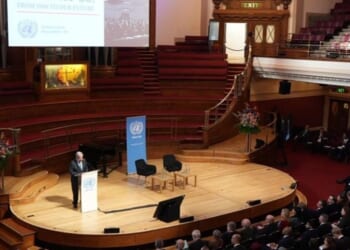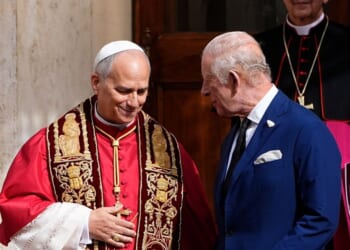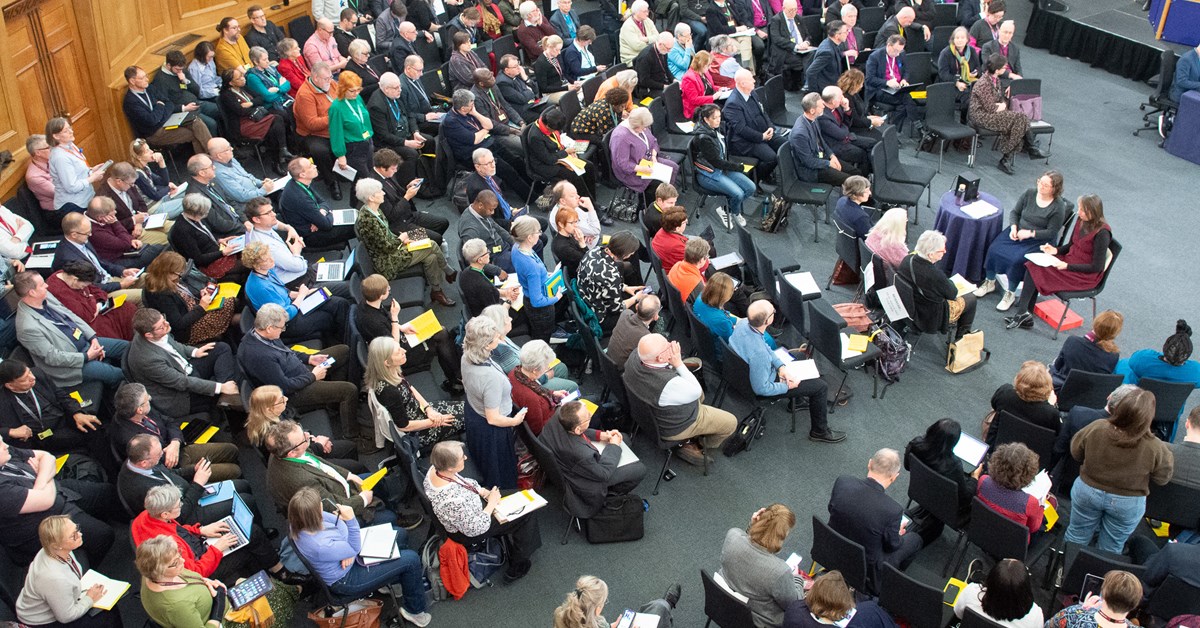
A NEW model for quasi-independent safeguarding is on the General Synod’s agenda next month, as are urban poverty and the parliamentary ping-pong about the Clergy Conduct Measure.
Much of the debate in the build-up to the meeting, to be held in Church House, Westminster, from 9 to 13 February, has focused on the House of Bishops’ decision to bring the Living in Love and Faith programme to a formal end (News, 16 January). A motion of endorsement is to be debated on the Thursday (12 February).
Other business includes proposals to outsource Church of England safeguarding to a new independent body, which were approved in principle last February (News, 14 February 2025); but implementing that decision has not been straightforward.
The plan originally approved last year called for the National Safeguarding Team (NST) to be transferred to a new independent charity, and a second outside organisation to be set up to scrutinise all church safeguarding. Diocesan and cathedral safeguarding teams would remain employed by their respective dioceses and cathedrals.
Since, then, however, the working group has concluded that this would require years of ponderous legislative processes. Survivors and others wish to move faster, and so a new model has been drawn up, a Synod paper explains.
One new independent body would be created — provisionally titled the Church of England Independent Safeguarding Authority (ISA). It would be overseen by a board, which would have a majority of non-church members.
The ISA would take on the functions of the current NST, handling national casework and drawing up policies, led by a new official, the Chief Safeguarding Officer. Local teams would be supervised but not directly managed by the ISA.
For further independence, the operational casework led by the Chief Safeguarding Officer would not be accountable to the ISA’s board, but to another external regulatory body. “In this way, the charity would secure independence of safeguarding judgements whilst retaining proper oversight of the efficiency and effectiveness of safeguarding operations,” the paper says.
Finally, a new ombudsman-style service would be set up separately, as the final port of call for complaints about how a safeguarding case had been handled, either by local teams or the new ISA.
This new model would deliver “in a timely fashion” both “robust independence” and continuity with existing church safeguarding, the paper concludes.
In its debate last year, the Synod voted down a more far-reaching model of independence which would also have transferred all diocesan and cathedral safeguarding officers into the new external charity. The Synod’s decision was condemned by survivors, but William Nye, the Synod’s secretary-general, said at a Church House press conference on Wednesday that the new approach had been shared with many victims and survivors.
“They don’t all speak with one mind, but the safeguarding structures board which is responsible for developing these ideas has a number of survivors on it and we will need to engage with other survivors more widely.”
Mr Nye also said that several elements of the new plan could be implemented without primary legislation and so much quicker — as soon as later this year. But other parts of the package would still have to go through the usual synodical stages over several years.
One reform that the Synod had thought was complete has returned to the agenda, after Parliament’s Ecclesiastical Committee refused to approve the Clergy Conduct Measure (CCM) (News, 31 October 2025). The replacement for the discredited Clergy Discipline Measure, this was given final approval by an overwhelming majority last February.
In the autumn, however, parliamentarians objected to the way in which the CCM made disciplinary tribunal hearings private by default, and Ecclesiastical Committee returned the business to the Synod as “not expedient”: the first occurrence of this since 2002, the C of E’s Chief Legal Adviser, the Revd Alexander McGregor, said.
In response, the Synod will be invited to amend the legislation along the lines directed by the Ecclesiastical Committee.
Mr Nye told the press conference that this process would delay the CCM’s implementation by about six months.
A previous amendment for hearings by default fell, and it was, in theory, possible for the Synod’s Legislative Committee to return an unchanged CCM to both Houses of Parliament again. But the Synod paper explains that they consider this to be highly risky and have taken the more conciliatory approach of amendment in the Synod.
The document says that a second Measure, to reform of the national Church’s governance and institutions, has also been provisionally rejected by the Ecclesiastical Committee. So a similar amendment process (or showdown with Parliament) may be discussed at a later Synod meeting.
Last year, the Synod was supposed to debate a motion supported by the Church Urban Fund (CUF) to mark the passage of 40 years since the report on urban priority areas, Faith in the City. It was dropped for lack of time, and reappears on next month’s agenda.
It gives thanks for all those across the Church working to relieve poverty and recommits the Church to the goal of “ending poverty in all its forms and manifestations, whilst asking questions of ourselves, our political, society and business leaders about the unjust structures and decisions which cause and exacerbate poverty”.
Speaking at the press conference, the Group CEO of CUF, the Rt Revd Rob Wickham, said that the Church’s social action and outreach had been estimated as worth £55 billion a year to society.
And yet “deep poverty” was increasing in Britain today, he said, as well as stark inequality between wealthy and deprived areas. Volunteers, often working unseen and unappreciated, were tackling this, offering “the possibility of healing [which] lies in small acts of kindness and love”.
He hoped that the overdue Synod debate on the Thursday would be an opportunity to tell stories of redemption and challenges across the Church. “This debate will shape the Church’s mission in serving in challenging unjust structures and ultimately shaping the world as God intends it to be,” he concluded.
First, however, members will hear the first ever presidential address by a woman. The Bishop of London, the Rt Revd Sarah Mullally, is expected to have been confirmed as Archbishop of Canterbury two weeks previously (28 January). She will speak on the Tuesday morning (10 February).
Later, she will introduce a debate on reimagining care, asking members to endorse the report of the Archbishops’ Commission on the subject published three years ago (News, 24 January 2023). The motion also calls on the Government to draw on the Commission’s recommendations as it sets up its own National Care Service (promised in the Labour Party’s election manifesto).
The following day, on the Wednesday (11 February), the Chair of the House of Laity, Jamie Harrison, is to lead a debate on mental health, in particular asking dioceses to ensure that mental-health training is offered to all the clergy. If his motion is carried, church schools are also to be offered resources on responding to mental-health challenges for children, and the Liturgical Commission is to be urged to take into account, when drafting texts, the needs of people experiencing mental ill-health.
Other debates will include an update on working-class ministry, after a motion was carried unanimously a year ago; and a new code of practice for safeguarding in new mission initiatives, such as Bishops’ Mission Orders. This follows the Scolding review of the Mike Pilavachi scandal at Soul Survivor.
A diocesan motion from Worcester will be discussed on the Thursday, promoting the use of seasonal and fully biodegradable flowers in church. There is also liturgical business, including the revision stage for the proposed Festival of God the Creator and the commemoration of the Twenty-One Martyrs of Libya. The Synod will also revise regulations to facilitate the increase in clergy pensions agreed last summer.
Synod decisions not now to be implemented include a regional trial of abolishing wedding fees, which has been scrapped as unfeasible. In a separate item, the Synod will be asked to approve a one-off increase of £1000 in parochial burial fees, more than trebling the fee overnight. This is argued to be a necessity to bring them into line with other cemetery providers and to help parishes struggling to maintain their churchyards by voluntary efforts only.
A motion carried in July 2025 to increase the statutory entitlement for clergy rest to 36 hours a week has also been abandoned as too blunt an instrument, given the wide variety of clerical working patterns. Instead, the recommendation is to invest in changing the culture of overwork and unrealistic expectations, so that clergy can give themselves more permission to take time off.