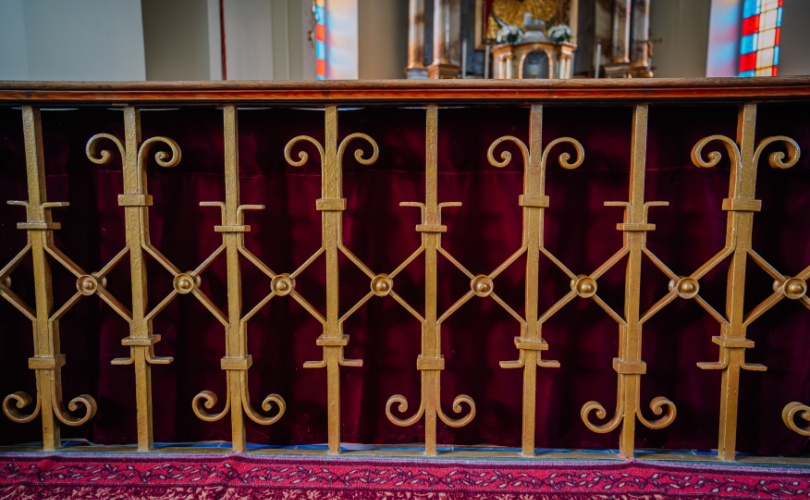
CHARLOTTE, North Carolina (LifeSiteNews) — Catholics in the Diocese of Charlotte have opened up about the hurt and tension caused by Bishop Michael Martin’s command to remove altar rails and kneelers that took effect on Friday.
St. Thomas Aquinas Parish parishioner Aloonsri Montgomery described the directive to The Catholic Herald as “almost abusive in the spiritual sense, as I am trying to say to my bishop this hurts us. Spiritually, in my soul, what you’re doing is hurting me.” She noted that diocese responses to laity concerns over the bishop’s orders are “nonexistent.”
Martin ordered in December that churches remove all “temporary or movable fixtures used for kneeling” for Holy Communion by January 16 in accordance with the bishop’s antagonism toward traditional liturgical practices. Last year, he enacted sweeping bans on the traditional Mass, and also saw a draft instruction leaked in which he condemned the use of Latin and priests praying before and after Mass, along with kneeling for Holy Communion.
A considerable number of pastors have taken issue with the decision, with 30 priests having gone so far as to question the Vatican regarding Martin’s ban on the use of altar rails and kneelers, as well as his leaked letter condemning other traditional practices.
Some pastors are reportedly awaiting a response to their dubia from the Vatican before removing movable kneelers. The dubia notes that the General Instruction of the Roman Missal (GIRM) states that the sanctuary “should be appropriately marked off from the body of the church either by its being somewhat elevated or by a particular structure and ornamentation,” (GIRM 295) typically an altar rail.
LifeSiteNews has independently confirmed that, so far, an altar rail at St. Mark’s donated by a family there in honor of their late son has been removed, causing them such grief that they cried throughout Sunday’s Mass there.
According to Jason Murphy, co-founder and leader of the Catholic Men’s Conference of the Carolinas, the ban on the use of altar rails has a concrete impact on the reverence given toward Jesus Christ in the Blessed Sacrament.
When altar rails were restored under Father Christopher Roux, the rector, at the Cathedral of St. Patrick in Charlotte, “people started to give more reverence to the Blessed Sacrament,” Murphy said. “You just noticed that even people who might not typically kneel would still receive on the tongue.” He explained this was because of the principle of lex orandi, lex credendi:“The way you pray is the way you believe.” Without rails, “most people aren’t going to kneel” because of “herd mentality,” he added.
Murphy further lamented that over 30 priests felt forced to submit dubia to the Vatican over the situation. “I think that overall, it was really a sense of sadness that it had to be escalated to that, because several priests met with him individually and as small groups, especially the ones who were celebrating the Latin Mass,” he said.
Murphy described those priests as “some of the holiest, humblest, quietest, respectful men and priests that you might encounter.” He finds the lack of response “really concerning” and “kind of scary in a sense.”
Bredon Kimel, a former Marine and current airline pilot who now attends St. Thomas Aquinas, condemned Martin’s decision to ban altar rails as unfounded and even illegitimate.
“To me, altar rails evoke reverence, beauty and tradition. Reverence because of the kneeling and the separation of the sanctuary, beauty because of the aesthetic, and tradition because this is how it’s been done for ages,” Kimel told The Catholic Herald. “I’ve heard no good or even coherent reasons for discontinuing it.”
“The fact that so many parishes in his diocese are strongly traditional, and that many of the laity find in it a source of spiritual foundation and zeal, from which so many vocations have come, shows what kind of zealot he is that he would seek to ban immediately the things so many have come to rely upon in their spiritual life. This is not a legitimate use of his authority,” he concluded.
Dominican Fr. Pius Pietrzyk, a canon lawyer in Washington, D.C., agrees. “When the Mass gives options, the universal authority has vested those options not in the bishop but in the priest celebrant,” he told the National Catholic Register, adding that the document “lacks some of the indicia one would normally expect of a legislative act.” He believes Martin’s order is an expression of the bishop’s personal preference rather than a legitimate exercise of authority.
An anonymous woman who attends St Ann’s told the Register, “As someone who cannot kneel without the assistance of the rail, it was very upsetting.” She pointed out that she has fallen before trying to kneel to receive Our Lord in the Eucharist.
She described Martin’s actions as “retaliatory and divisive from the beginning,” alleging that priests and employees are “scared to death,” that tithing has declined, and that the pain inflicted by his actions “may be irreversible without reparation.”
One anonymous diocesan staff member who “prefers the Novus Ordo,” according to the Register, rebuked Martin’s order as “a grave offense against charity and justice.”
The staffer maintained that removing “acceptable aids for allowing people to receive the way that they wish to receive” is “contrary to justice” and “contrary to charity.”
The bishop has fostered confusion and tension on top of it all, according to the staffer, who said the atmosphere in the diocese “is like walking on eggshells in your own home.” Turnover has ratcheted up, with “people jumping ship left and right.”
“We are growing more and more anxious by the minute at times,” the staffer said, especially after assurances “not to change things that we love, that we have a right to per either the rubrics or the laws of the Church” have been violated.
Joshua Anderson, a former parishioner of the Diocese of Charlotte and Catholic convert from Presbyterianism, said Martin’s orders have led him to feel “saddened and enraged at alternate times,” and even “a sense of betrayal.”
Liturgist Dr. Peter Kwasniewski recently affirmed that “even according to the rules that govern the Novus Ordo, there is absolutely no basis for a bishop to oppose the use or the construction of altar rails in churches.” He shared a catechesis on altar rails showing that they “have a basis in the historical and theological dimensions of the Mass, and may be utilized and even promoted, in light of recent legislation.”
Most important, Scripture itself highlights bending of the knee as a gesture of reverence proper to Our Lord Jesus Christ.
“That in the name of Jesus every knee should bow, of those that are in heaven, on earth, and under the earth,” St. Paul wrote in the Letter to the Philippians (2:10).