Acres of bad op-eds and half of Aaron Sorkin’s career notwithstanding, political speeches, even of the highly anticipated variety, almost never matter and are typically forgotten by light of morning.
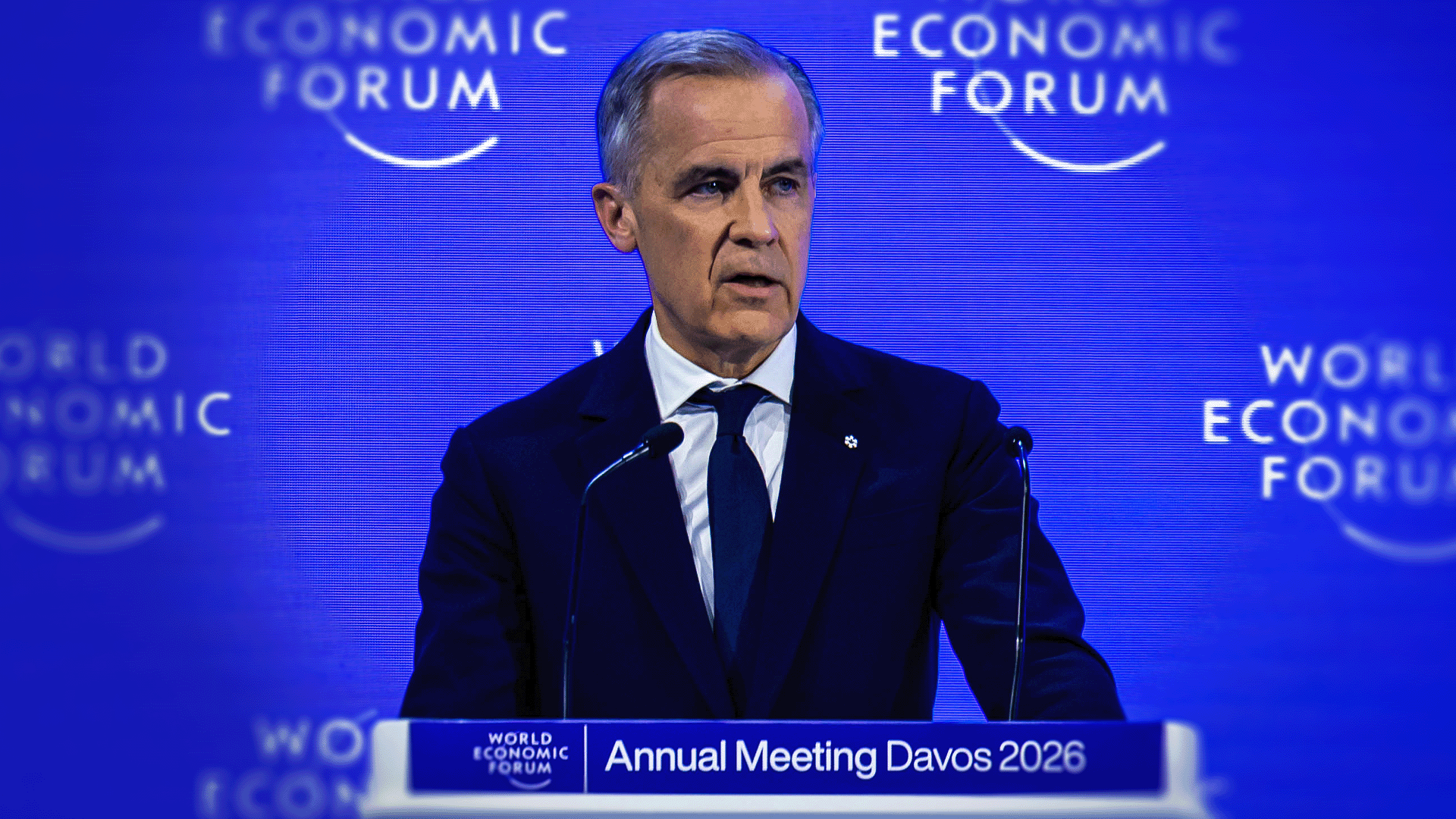
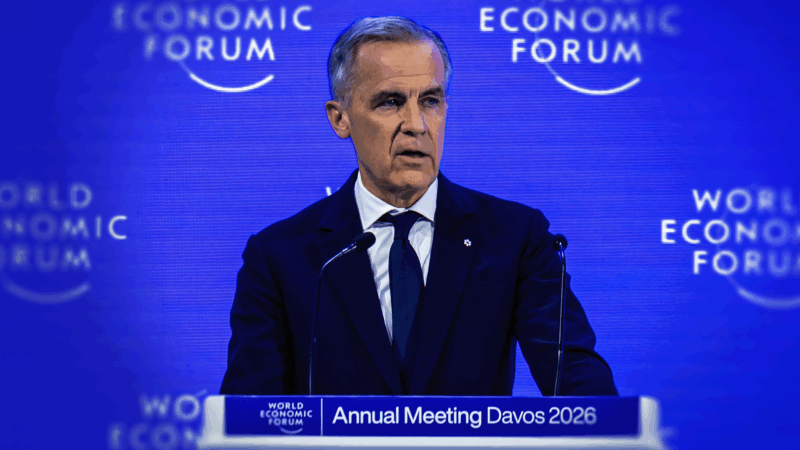
Not so Tuesday’s Davos downer from Canadian Prime Minister Mark Carney. With the ashen-faced delivery of an insurance adjuster explaining why a claim can’t be paid, Carney, the Liberal successor to Justin Trudeau, pronounced that the entire America-led post-World War II international system was experiencing a “rupture, not a transition,” and that we’d best get on with it.
“The old order is not coming back,” the P.M. intoned. “We shouldn’t mourn it. Nostalgia is not a strategy.”
Greeted as it was like a blunt rebuke to the erratic, bullying transactionalism of President Donald Trump, whose threat to seize Greenland from NATO ally Denmark hung over the proceedings like a giant cloud of farts, Carney’s diagnosis nevertheless contained some similarities with the American delegation’s message at the World Economic Forum.
“Globalization has FAILED,” the United States Commerce Department triumphantly tweeted Tuesday, sharing a clip from Secretary Howard Lutnick claiming, with gross numerical inaccuracy, that the decades-long project of multilateral tariff reduction “has left America behind, [and] left American workers behind.”
Sounds like the two sides are heading toward an amicable, grown-up divorce, right? Ha ha, have you met Donald Trump?
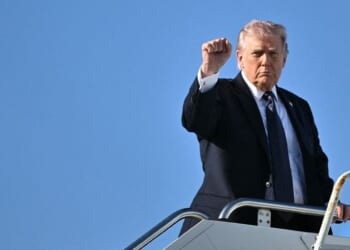
“Canada gets a lot of freebies from us, by the way,” the president said in his meandering remarks Wednesday. “They should be grateful also, but they’re not. I watched your Prime Minister yesterday, he wasn’t so grateful. They should be grateful to U.S., Canada. Canada lives because of the United States. Remember that Mark, the next time you make your statements.”
There are important lessons to be learned, and pitfalls to avoid, on both sides of the 49th parallel (as well as the Atlantic), about the difficult-to-contain emotions of dissolution, and the unforeseen geopolitics of institutional destruction.
Carney, to his credit, is attempting to sketch out a vision of what comes next for “middle powers” like Canada that have heretofore benefited both from hard U.S. military protection and the softer, trust-enhancing predictabilities of the World Trade Organization and suchlike.
“We are rapidly diversifying abroad,” he said. “We have agreed [on] a comprehensive strategic partnership with the EU, including joining SAFE, the European defense procurement arrangements. We have signed 12 other trade and security deals on four continents in six months. The past few days, we’ve concluded new strategic partnerships with China and Qatar. We’re negotiating free trade pacts with India, ASEAN [Association of Southeast Asian Nations], Thailand, Philippines and Mercosur….We’re pursuing variable geometry, in other words, different coalitions for different issues based on common values and interests.”
The Canuck’s perhaps melodramatic pitch: “The middle powers must act together, because if we’re not at the table, we’re on the menu….[The] great powers can afford for now to go it alone. They have the market size, the military capacity and the leverage to dictate terms. Middle powers do not. But when we only negotiate bilaterally with a hegemon, we negotiate from weakness. We accept what’s offered. We compete with each other to be the most accommodating. This is not sovereignty. It’s the performance of sovereignty while accepting subordination.”
Trump, even more than a decade into what has been the most geopolitically significant American political career since at least Ronald Reagan, is comparatively thinner on the non-insignificant question of what replaces the international superstructure his movement arose to cast off. His new National Security Strategy, a dog’s breakfast of a document unveiled last month, is riddled with contradictions, not least of which is that the president’s favorite diplomatic and economic tool of tariffs is somehow compatible with sweet-talking the Western hemisphere into buying American and rejecting Chinese investment and aid. Neighborhood bullies shouldn’t be surprised when rattled kids seek protection elsewhere.
The real Trump foreign policy dissonance comes from its lopsided ire toward America’s oldest allies. After serially stressing a spheres-of-influence view of the planet, rejecting Washington’s “misguided experiment with hectoring” Middle Eastern countries “into abandoning their traditions and historic forms of government,” and declaring that “the affairs of other countries are our concern only if their activities directly threaten our interests,” the National Security Strategy goes hog-wild against the European Union. The E.U.’s “economic decline,” the white paper posits, “is eclipsed by the real and more stark prospect of civilizational erasure.”
Far from the hands-off posture toward Arab-world dictatorships, Trump et al. vowed to encourage “patriotic European [political] parties” and cultivate “resistance to Europe’s current trajectory within European nations,” so that “the character of these countries” remains majority European, and therefore will “view their place in the world, or their alliance with the United States, in the same way as those who signed the NATO charter.”
But a funny, if wholly predictable, thing happened along the way to a new Nationalist Internationale: Trump’s belligerent nationalism toward the sovereignty of an allied partner governed by a political party that largely agrees with his views on immigration turned out to be wildly unpopular among the very European populists he aims to cultivate. From The Washington Post:
In France, Jordan Bardella, leader of the far-right National Rally party, denounced Trump’s “threats against the sovereignty of a state” as “intolerable.” In Britain, Reform UK leader Nigel Farage called Trump’s tariff threat “a very hostile act.” And Italy’s conservative prime minister, Giorgia Meloni, called the tariff proposal a “mistake.”
Mattias Karlsson, a member of parliament in Sweden and former leader of the right-wing, nationalist Sweden Democrats, perhaps put it most memorably. “Trump increasingly resembles a reverse King Midas. Everything he touches turns to [feces],” Karlsson posted on X, using a more plainspoken term.
Mark Carney’s whole prime ministerhood, it has been plausibly argued, owes its existence to voter backlash over Trump imposing emergency tariffs and referring to our northern neighbor as “the 51st state,” contributing to a late-breaking collapse of Pierre Poilievre’s Conservative Party.
Canadians and other inhabitants of middle powers are deluding themselves if they think tweaking Trump and stroking China is a substitute for real security and predictability. Trump, like his original predecessor Barack Obama, chafed at what is some very real European free-riding under America’s vast defensive umbrella.
One of the main reasons Carney’s speech landed with such force was his strategic framing device of Václav Havel’s classic 1978 anti-totalitarian essay, “The Power of the Powerless.” But Havel’s post-communist career contains contemporary lessons as well, above all regarding a word and notion that too many American allies have long since let slip: Responsibility.
“For many years, Czechoslovakia, as someone’s meaningless satellite, has refused to face up honestly to its co-responsibility for the world. It has a lot to make up for,” Havel told a joint session of Congress in February 1990, just three months after the Velvet Revolution. “If I dwell on this and so many important things, it is only because I feel, along with my fellow citizens, a sense of culpability for our former reprehensible passivity and a rather ordinary sense of indebtedness.”
Havel, back then, wanted something that Donald Trump no doubt wants now: A Europe responsible for Europe.
“For another hundred years, American soldiers shouldn’t have to be separated from their mothers just because Europe is incapable of being a guarantor of world peace, which it ought to be in order to make some amends, at least, for having given the world two world wars,” he said. “Sooner or later, Europe must recover and come into its own and decide for itself how many of whose soldiers it needs so that its own security, and all the wider implications of that security, may radiate peace into the whole world.”
It is appalling that 36 years after those words, nearly a dozen into the Age of Trump, and almost four since Russia began pulverizing Ukraine, Europe and other NATO allies have not yet taken that responsibility to heart. Carney’s speech, if it is to last into next week, let alone next month or year, should be the first steps of a toddler learning to walk, rather than yet another tantrum from an understandably irritated baby.
The post The West's Already-Messy Divorce appeared first on Reason.com.