(LifeSiteNews) — “Go into the whole world and proclaim the gospel to every creature. Whoever believes and is baptized will be saved; whoever does not believe will be condemned” (Mark 16:15-16). Christ’s missionary mandate to His Apostles before ascending into heaven was clear, and Tradition has always understood it as extending to the whole Church and, consequently, to all the faithful of all times.
The missionary duty of the Church is shared by each individual person. We must recognize, however, that there exists a “variety of missionary charisms and a diversity of circumstances and peoples,” as affirmed by Pope Saint John Paul II in the encyclical Redemptoris Missio.
The variety of missionary charisms is clearly illustrated by the example of the two Patrons of Missions in the Church, Saint Francis Xavier and Saint Therese of the Child Jesus, most distinct from one another. This fact itself seems to offer a catechetical lesson: that the mission of evangelization—the call to preach “the acceptance of the truth revealed by the One and Triune God” (declaration Dominus Iesus)—is both plural and universal, entrusted to all the faithful.
Saint Francis Xavier, made Patron of the Missions by the will of Pope Saint Pius X, was a missionary in lands far from his place of origin and of peoples still unfamiliar with the Gospel. In a titanic missionary endeavor, over the course of only ten years he evangelized vast regions of Asia, stretching from present-day India to Japan. Five centuries ago, the converted Spanish priest—co-founder of the Jesuits and known as the Apostle of the East—left Europe to proclaim the Gospel with fearless zeal that drove him to, among other heroic acts, baptize as many as 10,000 people in a single month.
Saint Therese of the Child Jesus, in turn, named Patroness of the Missions by the will of Pope Pius XI, carried out her missionary vocation within the walls of the Carmel. The “Little Way” of the Flower of Lisieux was itself missionary, for it was wholly oriented toward the good of others, and there is no greater good than the faith revealed by Christ. Pope Francis summarized the missionary character of the Flower of Lisieux in the apostolic exhortation C’est La Confiance: “In a word, she did not view her consecration to God apart from the pursuit of the good of her brothers and sisters. She shared the merciful love of the Father for his sinful son and the love of the Good Shepherd for the sheep who were lost, astray and wounded. For this reason, Therese is the Patroness of the missions and a model of evangelization.”
The different circumstances and peoples addressed by Christ’s missionary mandate are divided into three situations, according to Pope Saint John Paul II in Redemptoris Missio:
- The mission ad gentes, the mission in its strictest meaning, in which the “Church’s missionary activity addresses: peoples, groups, and socio-cultural contexts in which Christ and his Gospel are not known, or which lack Christian communities sufficiently mature to be able to incarnate the faith in their own environment and proclaim it to other groups. … The specific nature of this mission ad gentes consists in its being addressed to ‘non-Christians’.”
- The mission of nurturing the faith of “Christian communities with adequate and solid ecclesial structures. They are fervent in their faith and in Christian living. They bear witness to the Gospel in their surroundings and have a sense of commitment to the universal mission.”
- The mission of new-evangelization or re-evangelization, “an intermediate situation, particularly in countries with ancient Christian roots, and occasionally in the younger Churches as well, where entire groups of the baptized have lost a living sense of the faith, or even no longer consider themselves members of the Church, and live a life far removed from Christ and his Gospel.”
In line with the same Redemptoris Missio, that states “the boundaries between pastoral care of the faithful, new evangelization and specific missionary activity are not clearly definable.” There is a situation that amalgamates those three, or maybe forms a distinct fourth situation: the mission of evangelizing those who remain faithful but who, for a long time, have lived without spiritual support and thus grow distant from the life of the Church. This is a form of mission that is to some extent ad gentes, as well partly a mission of nurturing the faith, while especially akin to re-evangelization. Let us consider an example.
Brazil is home to approximately 13 percent of the world’s Catholics, making it the country with the strongest Catholic presence worldwide. One of the most Catholic regions in the nation is the state of Minas Gerais, where 63.5 percent of the population identifies as Catholic—and nearly 85 percent as Christian overall—according to the 2022 census published by the Brazilian Institute of Geography and Statistics (IBGE). Despite this apparently solid Catholic environment, however, in the Diocese of Luz there is a small town named Pimenta where fewer than 9,000 inhabitants span a vast, mainly rural area slightly larger than Denver, Colorado, that is served by a single parish.

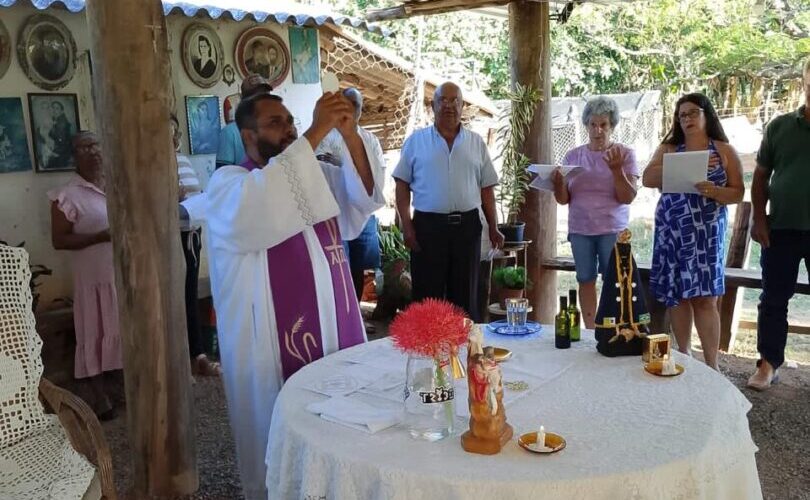
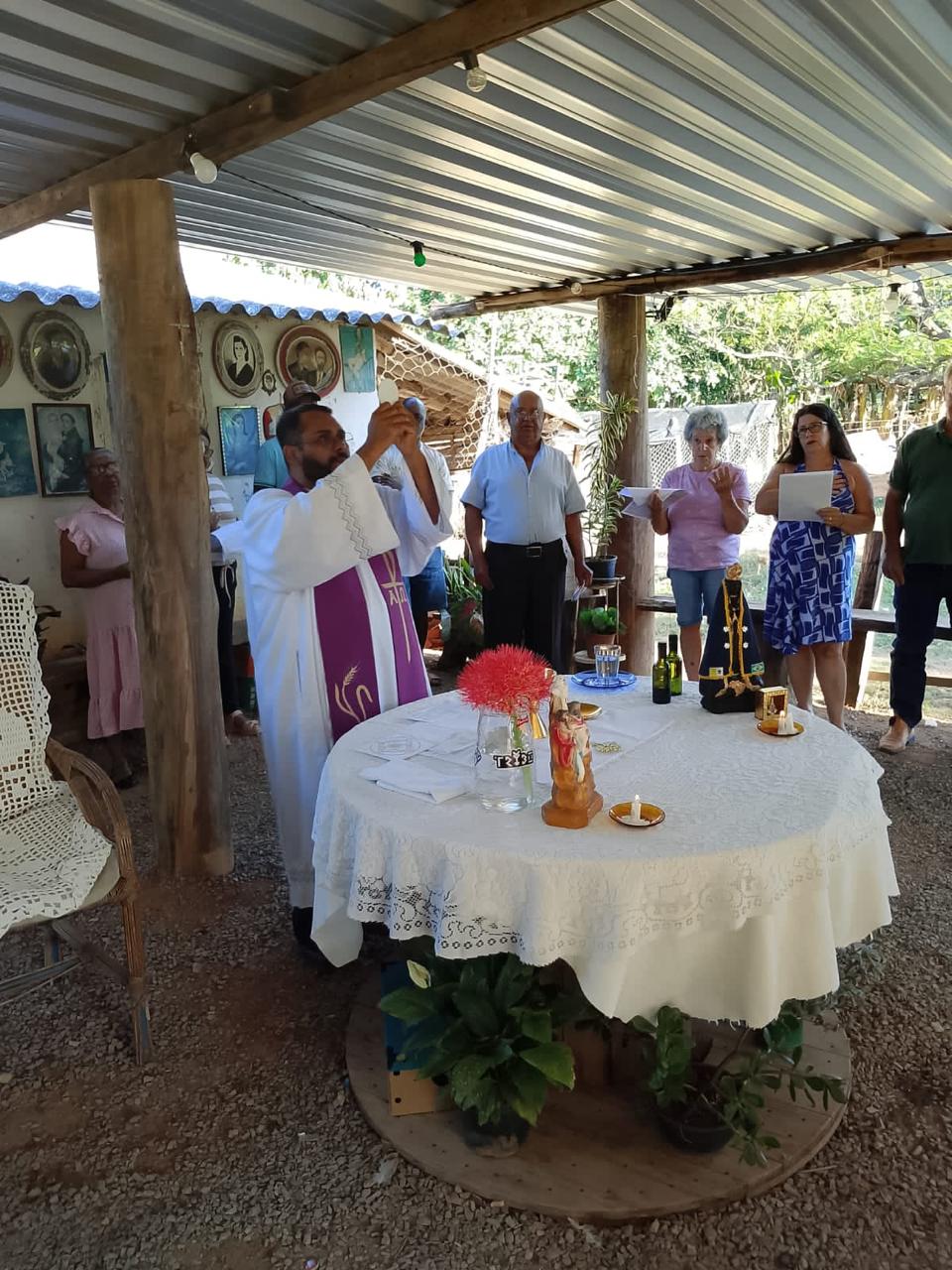
Father Patriky Batista, the town’s parish priest, discovered at the beginning of 2025 that a community located along the border with neighboring municipalities was within his parish territory. It was the community of Cruz, made up of 14 families and situated more than 31 miles from the parish church, whose access via dirt roads becomes almost impossible during periods of heavy rain. In March of that year, he visited the community to celebrate the first Holy Mass.
What the priest found there was something we could call a numb faith: existing but hardened and apathetic. It was not a strict case of re-evangelization, i.e., a group of baptized that lost a sense of faith or no longer even regarded themselves as members of the Church, but faithful that did not have spiritual assistance—naturally, it led to the faith growing dim, but it was there. The oldest knew prayers, but the youngest were already ignorant in faith matters. He testified: “Some of the youngest didn’t even know to make the sign of the cross!”; at the same time “some there travel on foot or horseback to the nearest city to have their children baptized.”
The community does not have a chapel. The Masses, which started to be celebrated there every four or more weeks, are held at people’s houses. The presence of the priest and the celebration of the Mass awakened the faith of those who at some point were evangelized but did not have the presence of the Church.
“After we started to celebrate Mass there, some living together but not married expressed the desire to get married in the Church, for example. Also one man offered me right away part of his property to build a chapel, but I said it was not that easy to do it (for financial and bureaucratic reasons),” said Father Batista.
The community of Cruz represents a situation that may be rare in communities yet not uncommon in individual lives of those people who encounter the Gospel in childhood—perhaps in a Catholic school, or later in life, through a retreat or an intimate conversation with a friend—but whose faith is insufficiently nourished and who are therefore drawn away from the Church by habits and circumstances. They are people who desire faith yet end up finding greater support in other Christian denominations or in other social groups. They are distant from the Church more by circumstance than by deliberate choice, like boats without anchors carried by the current, slowly drifting away but not sunk by violent waves.
Isn’t it compelling to think about how many individuals—and perhaps entire communities—that already heard of Our Lord are only a visit from a priest, or a single courageous word from a friend, away from coming definitively to the true faith? The Church needs to be present, and we are the Church: bishops, priests, consecrated ones and all the laity. We are all the Church.
Evangelization in its many forms and needs is still urgently necessary, not only in distant lands but in places and for people we assume are already sufficiently evangelized. Let us remember, with Saint John Paul II: “The number of those awaiting Christ is still immense: the human and cultural groups not yet reached by the Gospel, or for whom the Church is scarcely present, are so widespread as to require the uniting of all the Church’s resources. … We cannot be content when we consider the millions of our brothers and sisters, who like us have been redeemed by the blood of Christ, but who live in ignorance of the love of God. For each believer, as for the entire Church, the missionary task must remain foremost, for it concerns the eternal destiny of humanity and corresponds to God’s mysterious and merciful plan.”