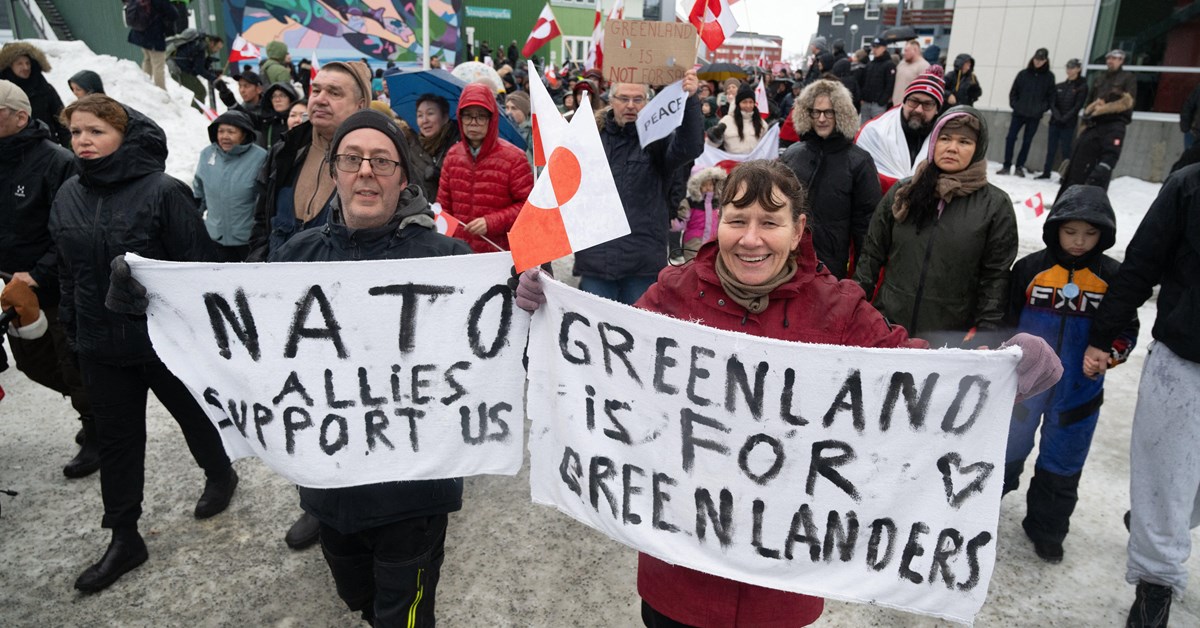
PRESIDENT TRUMP’s push to take over Greenland — and his threat of economic sanctions on NATO allies who refuse to support him — feels like a turning point. Leading politicians are openly calling him a bully, a mafia gangster, or a spiteful despot. His behaviour is being compared to an abusive husband’s or to that of a petulant child throwing its toys out of the pram. European leaders have responded with calls for “unflinching, united, and proportional” retaliatory tariffs and cries that the time for appeasement of the American autocrat is over.
Such rhetoric offers an understandable emotional release. But it provides no practical guide as to how the British Government should best deal with what could easily develop into a threat to a NATO alliance that has kept a dangerous world stable for more than 80 years. If the United States can openly blackmail its allies over territory, NATO’s founding principle — that security rests on partnership, not pressure — comes under existential threat.
The economic consequences are already visible. Markets dipped sharply after President Trump renewed his tariff threats, with global stocks sliding on fears of a fresh trade war. Britain would be among the losers. As Sir Keir Starmer has acknowledged, a tariff war with the US would cause “huge damage” to the UK economy. Unlike Brussels, which can plausibly threaten serious reprisals, London has far less leverage. The US is not especially reliant on Britain for anything apart from military intelligence.
As the Cabinet minister Douglas Alexander has noted, there are two traditions in European diplomacy dating back to the Second World War. One was de Gaulle’s declaratory defiance; the other was Churchill’s painstaking behind-the-scenes courtship of Roosevelt, which eventually brought the US into the war as a crucial ally.
Perhaps the sabre-rattling noises of France, Belgium, and the European Union are necessary to show Mr Trump that the US does not automatically have what geopolitical strategists call “escalation dominance” here. “It’s time for the Government to stand up to Trump; appeasing a bully never works,” the leader of the Liberal Democrats, Sir Ed Davey, has declared.
There is a difference between appeasement and restraint. Mr Trump’s manoeuvrings have drawn Sir Keir’s most strongly worded criticisms of the US President to date. But the British Prime Minister has opted for private diplomacy over extravagant public rhetoric. Such realism has previously paid dividends. The PM’s efforts to court Mr Trump successfully diminished the level of the original “Liberation Day” tariffs that Washington imposed on Britain six months ago.
Sir Keir’s instinct here seems well-judged. The real risk is an escalation driven as much by Mr Trump’s ego as by US interests. The answer is not to appease — but not to grandstand either. The task is to channel Mr Trump into the space for creative negotiated solutions, not to provoke him into theatrical retaliation. That means persuading Washington that Europe does indeed see Chinese and Russian interest in northern sea routes as a real and growing strategic challenge — but also that co-operation within NATO serves US concerns better than coercion.
Calm negotiation is not weakness: it is risk management. With NATO’s credibility and the global economy on the line, Britain’s job is not to vent outrage: it is to prevent an escalatory spiral that could all too easily get out of control.