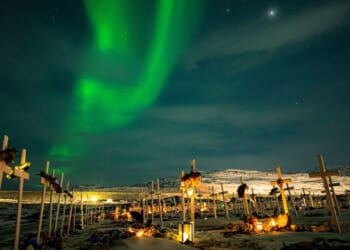
A HERD of reindeer separates me from Sennalandet Chapel in Finnmark, in the northernmost, remote reaches of Norway. Despite the magnificent beasts, it’s the wooden church, amid an expanse of meadow below the Áisaroaivi mountains, that I can’t take my eyes off. It is surrounded by stripes of June snow and cocooned by a blanket of steely blue cloud.
Usually drawn to taking photos of wild landscapes and wildlife, it is not for any great religious fervour that I make a beeline to a succession of churches on my road trip through Scandinavia, but the pull of their unique architecture and settings.
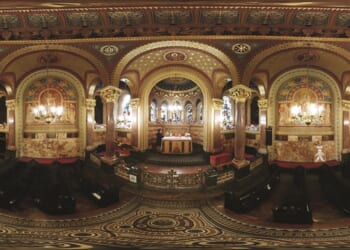
Indeed, there is only one initial destination that I have planned to visit: Nordkapp, in northern Norway, to see the Midnight Sun. It’s a glory of the natural world, watching sunbeams across the Arctic Ocean from the Cape, and there is something deeply spiritual about the place. More so, there is St Johannes Kapell, a tiny ecumenical chapel — the world’s northernmost — carved into the cliff rock under the glass-fronted North Cape Hall tourist centre. Created in 1990, the intimate chapel seats only 15 people.
My route for this road-trip involves travelling north through Sweden, along the E4, and through Sápmi (the traditional home of the Sámi people) towards the Cape, and a return drive south through Norway, mostly along the E6 — which stretches the length of the country and beyond, along the west coast of Sweden.
With no other itinerary in mind, but for a detour of Norway’s Lofoten Islands, I am free to stop at any church that arrests my eyes. And the first, Uppsala Cathedral, in Stockholm, draws me for a repeat visit after almost two decades.
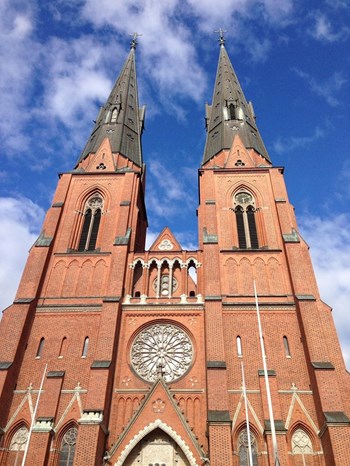 PixabayThe striking red-brick towers of Uppsala Cathedral, in Sweden
Externally, it’s the twin brick spires that are striking on the 750-year-old-cathedral, started in 1207 but only consecrated in 1435, and renovated in the 19th century with a neo-Gothic style. Royal coronations, historic burials, and significant moments in the history of Sweden have been celebrated here. Inside, mural ceilings, the country’s largest stained-glass window, a medieval altarpiece, glamorous chandeliers, and modern artworks, are just some of what is promised, as well as a shrine containing relics of St Erik, the patron saint of Sweden.
Carl Linnaeus, the founder of the modern botanical system of naming species, is also buried in the cathedral. It is possible to visit his 17th-century farmhouse, Hammerby, where he lived and worked, eight miles south-east of the city, by walking the Dannmark Trail between the pair.
As I travel on north through Sweden, at the north-west tip of the Gulf of Bothnia, I stop at Gammelstad — its church, Nederluleå, is a relatively ordinary looking parish church. But Gammelstad is no ordinary town: it is more like a historic holiday camp for churchgoers. The UNESCO World Heritage Site is one of Sweden’s last remaining and best-preserved “church towns”, its 400 or so cottages built historically for farmers living remotely, to use on visits to the church and during church holidays.
The town, which dates to the early 1600s (although its church was built in 1492), is striking for the uniform nature of the almost all red-and-white wooden buildings.
CONTINUING into Norway on my way to Nordkapp, in Karasjok, capital of the indigenous Sámi people of Sápmi, it is not so much the city’s churches that are conspicuous as the Sámi parliament, which was built to represent a traditional lavvu tent used by Sámi reindeer herders.
The adjacent Sápmi Park provides good insight into Sámi traditions — something not lost on me when I later witness parishioners in traditional dress of brightly coloured skirts and bodices attending a wedding in pretty Honnigsvåg Church. Or the moment I spotted Sennalandet Chapel among the reindeer. The humble wooden chapel was built in 1961 for the region’s reindeer herders, by the Norwegian Sámi Mission, publishers of Sámi-language Bibles.
When I arrive in Alta, Finnmark, it is the golden spiral belfry of the impressive Northern Lights Cathedral that I notice first. Its contemporary structure was consecrated in 2013. When I first see the tower, I take it to be a Winter Olympics stadium, but Sunday morning bells affirm my mistake.
I visit Nidaros Cathedral, in Trondheim, too, regarded as the most important church in Norway, since it holds the relic of St Olav, the patron saint of Norway. The cathedral is where Norwegian kings and queens have been crowned for centuries. The jewelled royal regalia is displayed within the adjacent Archbishop’s Palace, along with a superb collection of stone sculptures relocated from the cathedral, and the Archbishop’s AD 1500 mint, discovered during renovations in the 1990s.
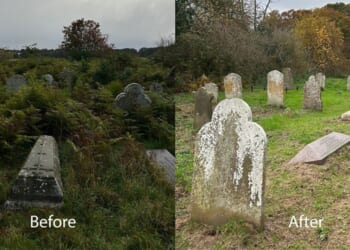
Nidaros offers all the decorative mastery of a royal church. It has its own restoration workshops, restoring damaged stonework and creating new stone carvings to replace badly weathered stones for the building. There is a long tradition in the workshops that allows stonemasons to use the faces of living persons as models for new stone carvings — which means visitors should keep an eye out for the facial features of Bob Dylan and Dolly Parton gazing from cathedral plinths.
Nidaros Cathedral Restoration Workshop, which can be visited by guided tour, as can the cathedral itself, also incorporates the National Pilgrim Centre, which is responsible for maintaining Norway’s historic pilgrim routes and St Olav’s Ways, nine historic pilgrim paths converging on Trondheim.
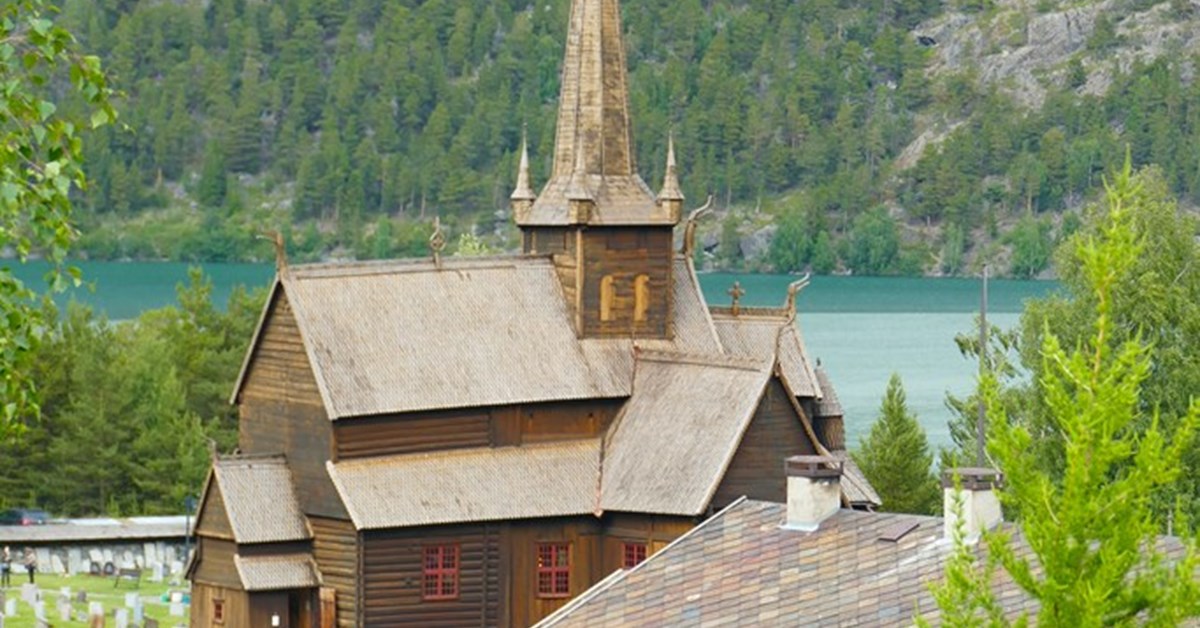
NORWAY is well known for its historic timber stave churches, of course, and I visit Lom (to the west of the E6, in the Ottadalen valley). The town sits at a crossroads tucked among soaring mountains and between three national parks. Lom is the second oldest and second largest of the 28 stave churches remaining in Norway. Many are now merely museums, but, at Lom, the building remains in use as the parish church. Guided tours for tourists run from June to September only.
Lom originates from the middle of the 12th century. Its roof looks like a Viking ship keel, as the same timber construction methods were used for both. I enjoy its humble cosiness, its extraordinary frescoed ceiling, decorated with biblical texts above the choir, and its collection of paintings with a style similar to naïve art, mostly created by Eggert Munch, a relative of the famous artist Edvard Munch.
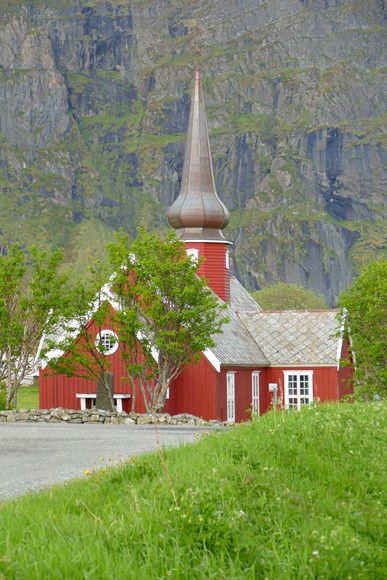 Caroline MillsThe parish church at Flakstad, on Flakstadøya, one of the outermost Lofoten islands, Norway
But I don’t regard any of these churches as my favourite. That accolade goes to the tiny Flakstad Church, on Flakstadøya, one of the outermost islands of Lofoten. Here, sited beside the beach and an azure sea, and with towering mountains as its backdrop, sits the prettiest rust-red timber church.
The parish church, completed in 1780 after a storm destroyed the previous church on that site, was built using wood from Russia, and features a stone baptismal font from the original church, dating back to 1250-1300, as well as other original features such as a circular altarpiece. It is listed with the Norwegian Directorate for Cultural Heritage, which means that it is defined as holding national value and so worthy of preservation.
Little wonder: its modest simplicity and out-of-this-world setting are “just so”, and worth a long journey — one I’d be prepared to make again, ideally with a month of Sundays to spend there. I’ll pack my bags, ready.
Travel details
CAROLINE MILLS travelled in her campervan by ferry with Scandlines (scandlines.com) from Germany (Puttgarden) to Denmark (Rødby), with direct road access thereafter to Sweden and Norway.
For ease of travelling, sign up for Epass24 (epass24.com) in advance, which automatically takes road tolls, and is required when using the many ferries that cross Norwegian fjords. The Lofoten Islands can be reached by road when approached from the north of Norway, using the E10, where it joins the E6 at Bjerkvik.
Both Sweden and Norway have an excellent network of campsites, often in outstanding settings, and, similarly, inexpensive family hostels.