BEFORE you read on, make a list in your head of all the British pilgrimage sites you can think of. I’m guessing that Canterbury was probably in there. Holy Island and Iona perhaps. Maybe Holywell and St Davids. But did you include Reading?
The abbey in Britain’s largest town was once one of the wealthiest in the land, and, as home to the withered hand of St James the Apostle, one of the most important pilgrimage sites in England. A ruin since Henry VIII did for it, the abbey is now close to the starting point of another pilgrimage route — St James’s Way, the only British section of the world-renowned Camino de Santiago.
And so, after a quick visit to the excellent Reading Museum for a look at its intricate model of the abbey, I headed, one summer’s day, for the town’s medieval Abbey Quarter and St James’s, a Roman Catholic church from which pilgrims begin their quest.
Armed with a guidebook to the route and my pilgrim’s passport — essential for picking up those all-important Camino stamps along the way — I set off, paying my respects to the remains of the neighbouring abbey before heading out of town by a wonderfully peaceful back way: a footpath along the banks of the River Kennet.
Before me lay 68.5 miles (110km) and five days of mostly easy walking across Berkshire and Hampshire countryside.
Launched in 2022 by a pilgrimage association, the Confraternity of St James UK, the St James’s Way follows a likely route that medieval pilgrims would have taken down to Southampton. From there, they would have put their lives into the hands of boat skippers, who would attempt to ferry them safely across the unpredictable Bay of Biscay to the north coast of Spain, for their final leg to Santiago de Compostela.
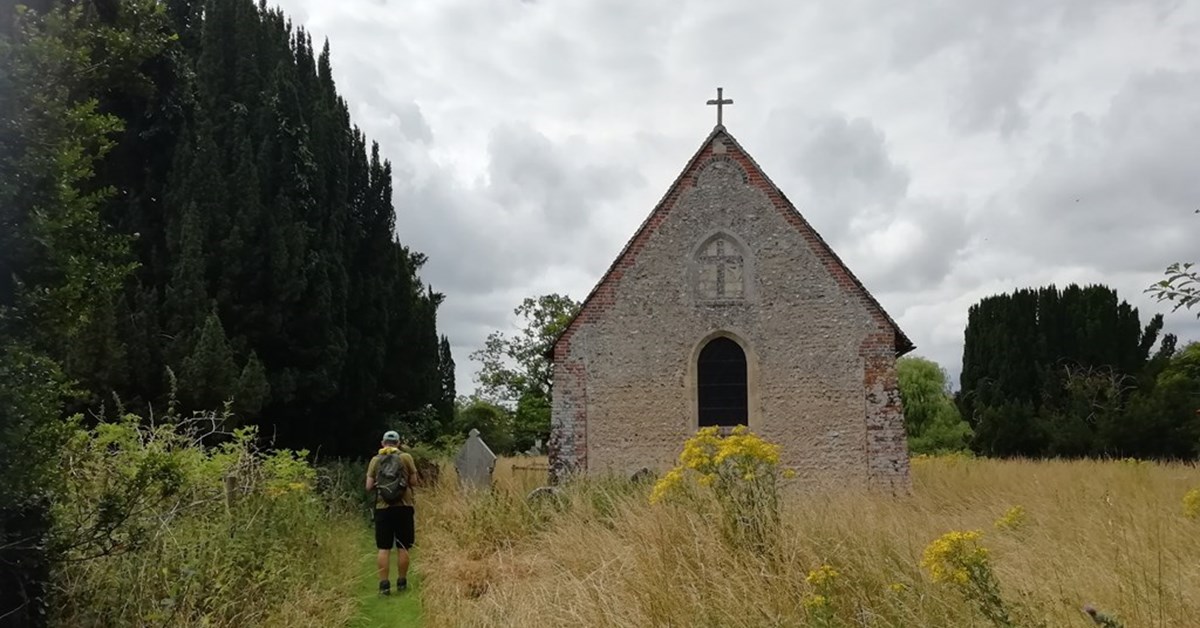
Following the Camino’s famous scallop-shell waymarkers, I was quickly out of town and heading across fields between “kissing gates”. The previous week, I’d contacted a charming man, Anthony Peabody, who has invited St James’s pilgrims to stop by St Mary’s, Sulhamstead Abbots, to ring the bell (Mr Peabody’s details are in the guidebook — see below). After several inexpert tugs at the rope, the clapper finally hit the dome somewhere up above me, and my presence on the pilgrims’ path sounded out across the fields. A prayer from Mr Peabody later, and I was on my way.
Although I was to stay in B&Bs and inns most of the way, my first night would be spent in a church hall near the village of Bramley. Along the lines of the albergues (hostels) that accommodate pilgrims in Spain, the hall at St James’s offers pilgrims a place to lay a sleeping bag, a very well-equipped kitchen, and a lavatory.
The Confraternity’s dream is to establish other basic, clean, and safe sanctuaries along the whole route, all for a recommended minimum donation of £10 per night per pilgrim. And, since my walk, two others have opened up: a village hall at Sulhamstead, in west Berkshire, and a camping space in a private garden in the village of Preston Candover, in Hampshire.
As the days passed, my pilgrim’s passport began filling up with stamps secured in wayside churches, pubs, and the occasional shop. One such is Preston Candover’s community store, a welcome source of victuals and friendly human interaction on my extremely rural third day, walking from the Hampshire village of Dummer to the attractive market town of New Alresford.
I was surprised at how bucolic my journey was, giving me plenty of peace and quiet to reflect on life as I amble along. Footpaths, bridleways, and short stretches of country lanes ushered me through calm seas of green, sliding craftily around the edge of Basingstoke, before picking up the River Itchen, my companion for the last two days of tramping. Swans and greylag geese paddled about, red kites patrolled the skies, and Muntjac deer roamed through fields of bright mauve fiddlenecks.
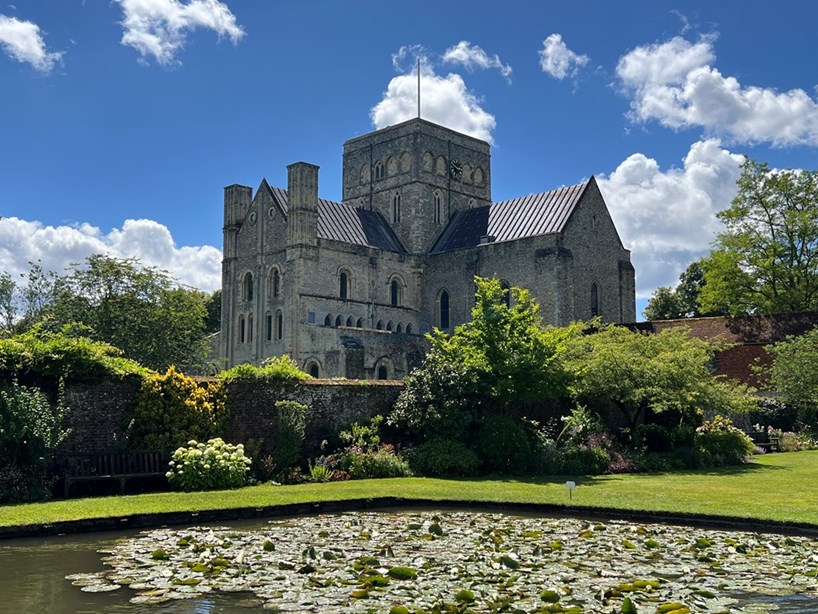 istock The Church of St Cross at the Hospital of St Cross and Almshouse of Noble Poverty, in Winchester
So, entering a bustling Winchester, right past its mighty cathedral, came as something of a shock. I hurried on to the outskirts of the city and the Hospital of St Cross, one of the oldest continuing almshouses in England. Founded in 1136 by the Bishop of Winchester, the almshouse has spent the past 900 years offering a home to a small number of men (currently 25), known as Hospitallers, and provender to anyone who requests it.
“May I have the wayfarer’s dole?” I asked Brother Tony, one of the Hospitallers.
“Of course,” he replied, with a smile, and enquired how my pilgrimage was going. He handed me the “dole” (from which we get the expression “on the dole”) — a chunk of bread and a small cup of locally brewed beer — before saying a prayer to bless my journey.
But it was only on my final day that I felt that I earned my pilgrims’ colours: trudging 14 miles through pouring rain until the broadening Itchen dropped my bedraggled body off in Southampton.
My goal was God’s House Tower, a museum and art space. Once a strikingly unpleasant prison, it is part of the medieval city wall, and overlooks the shoreline that would have been the last taste of land for the more unfortunate pilgrims of yore. The venue manager, Hannah Preston, congratulated me, stamped the final stamp in my passport, handed me my pilgrim’s certificate, and alerted me to the welcome existence of the venue’s café, where rest came at last.
If you’re still wondering about the withered hand of St James, it does still exist, and now resides at the Roman Catholic church in Marlow, Buckinghamshire. Sadly, recent carbon testing has dated it to not the first century, but the tenth. Heigh-ho.
Travel details
THE route’s start and finish are a short walk from Reading and Southampton Central stations respectively. The informative and extremely useful A Pilgrim Guide to St James’ Way (£12) can be purchased from the Confraternity of St James (csj.org.uk). Information on booking sanctuaries along the route is available from the British Pilgrimage Trust (britishpilgrimage.org/portfolio/st-james-way). The Pilgrim Passport can be bought in advance from the CSJ website, or from Reading Museum.
TRAVEL AND RETREATS is edited by Christine Miles. Tours and holidays advertised are not guaranteed or underwritten by the Church Times or Hymns A&M. Readers should check for ATOL/ABTA guarantees and take out insurance. Details are correct at the time of publication. See also www.gov.uk/foreign-travel-advice