IT CAN be hard for someone to realise when a well-nigh religious passion tips over into obsessional behaviour. This is the gauntlet that H is for Hawk (Cert. 12A) throws down.
Based on Helen Macdonald’s 2014 memoir, it charts the emotional decline that the death of her beloved father, Alisdair, occasions. The pair are played by Claire Foy (The Crown) and Brendan Gleeson (Calvary), respectively, and there’s an ongoing conversation between the living and the dead. The question which is which for Helen does little more than barely exist, whereas Ali seemingly continues his zest for life in all its fullness. He had been a greatly admired photojournalist for the Daily Mirror, capturing on camera, among other subjects, his love of the natural world. Be a watcher, he had counselled Helen: using a viewfinder will keep fear at bay.
As the film opens, Helen is doing just that, surveying the skies for predators. Initially, she is quite sociable, dragooning her Cambridge students to the pub for a seminar. We soon recognise, however, the tendency to keep others at arm’s length, including her mother (Lindsay Duncan) and a constant friend, Christina (Denise Gough doing a very credible Australian accent).
Helen retreats increasingly into her flat, which degenerates into little more than a squat. This is despite, or perhaps because, of resuming an interest in adopting a goshawk. A fellow enthusiast warns her that it is the most murderous of all raptors, never happier than when killing. Therein lies a paradox about the created order. In the midst of life, we are surrounded by death. Helen calls the bird Mabel. The name means lovable, even though she admits that her prized possession is a non-affectionate species.
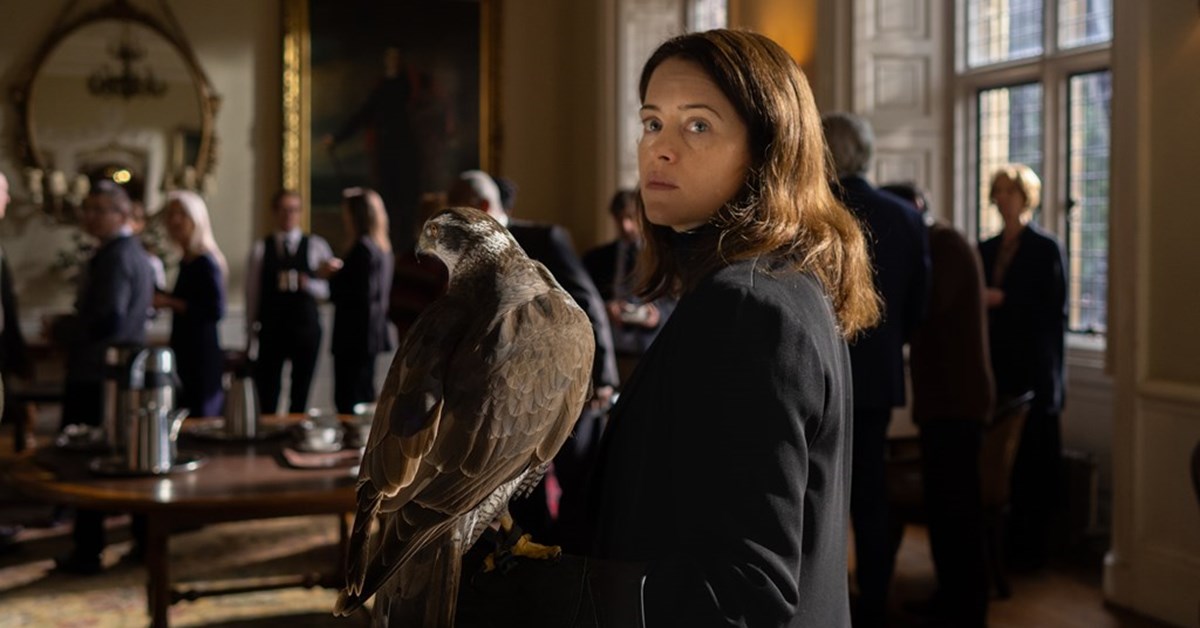
There will be no such reciprocity, or, rather, Mabel will, in exchange, learn to trust, indicating this to her austringer in various ways. One is by allowing Helen to take her everywhere she goes. At a college drinks party, the host asks “So you’re training her to hunt?” Mabel already knows how to hunt, Helen replies. The training involves letting Helen be there when she does. All very Arthurian, he jests. It is a brief allusion to Macdonald’s publication, which, by contrast, includes extensive references to T. H. White and his stories about the Knights of the Round Table.
In what she calls a shadow biography of that author, Helen recollects White’s own experiences with Gos, another goshawk. His emphasis was on exercising loving patience in handling the bird. In his adoption of the manner of Arthur’s chivalry, there was even a spiritual element to this. White would soothe Gos by reciting the hymn “The Lord’s my shepherd”. What is clear is that both he and Helen had a covenantal relationship with their charges: an unconditional love on their part, respecting the hawks’ need for freedom. She urges people to try looking at the world through imaginative empathy with wild creatures. Don’t go breaking a goshawk’s spirit and thereby distorting its natural instincts.
Helen’s self-sacrificial love for Mabel reaches the stage at which passion (true to the Latin for suffering or endurance) does become obsessive. As a result, a propensity to shut out everyone and everything else — career, hygiene, domestic routines —completely is inevitable. Those around her watch and wait and weep, helplessly yearning for signs of recovery. She is diagnosed as clinically depressed.
Macdonald’s book makes extensive references to the 14th-century anchoress Julian of Norwich. Julian’s Revelations of Divine Love proclaims that, while we may not escape painful loss, we won’t, through God’s grace, be overcome by it. In the film adaptation, Christina, far too briefly, invokes the famous quotation “All shall be well and all manner of things shall be well.” From thereon, we see less of Mabel, as Helen applies some of the mystic’s healing perseverance to herself.
While appreciating the film’s depth of sensitivity, audiences unfamiliar with either the Revelations or Macdonald’s writing may have their work cut out in joining up these final dots.