REBELLIONS and revolutions bookended Joseph Wright’s life. The artist’s early schooling took place in Repton rather than Derby, because the Wright family home, in the shadow of what is now Derby Cathedral, was evacuated to billet soldiers resisting the 1745 Jacobite rising.
Reaching Derby on 4 December, the most southerly incursion of the invasion from Scotland, Charles Stuart’s attempt to restore the throne to his Roman Catholic father, who believed in the divine right of kings, ended at the Battle of Culloden, in April the following year.
By the end of Wright’s life in 1797, revolution across the Channel had brought the return of long-exiled English RCs from French and Flemish seminaries and convents, while the French National Assembly adopted, in 1789, the Declaration of the Rights of Man and of the Citizen, a foundational document of Enlightenment ideals on human rights and democracy. Across the Atlantic, the American War of Independence brought another powerful secular republic into being.
Yet, in popular imagination, the revolution that Wright’s art is most associated with — the early Industrial Revolution — is possibly the wrong one. Christine Riding, curator of “Wright of Derby: From the Shadows”, points out that this is not a term that Wright would have recognised, as it was coined, along with “the Enlightenment”, in the late 19th century. Instead, the revolution that Wright was conscious of living through was the expansion of public exhibition opportunities for artists, with the establishment in 1768 of the Royal Academy, which opened up a whole new audience for artists previously dependent on aristocratic patrons.
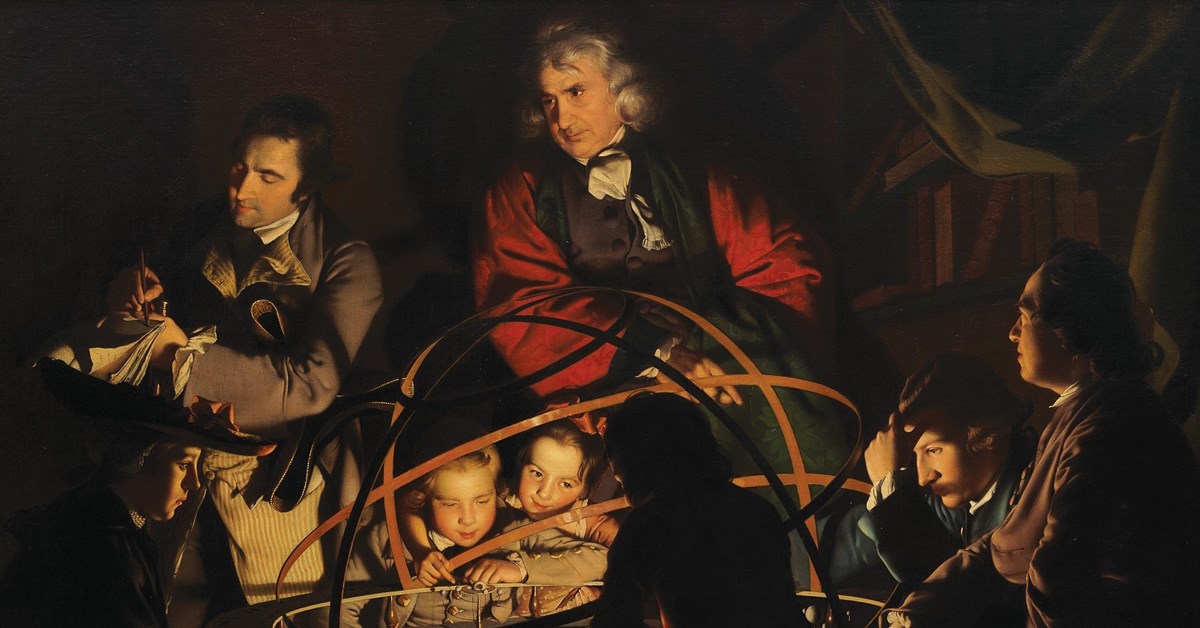
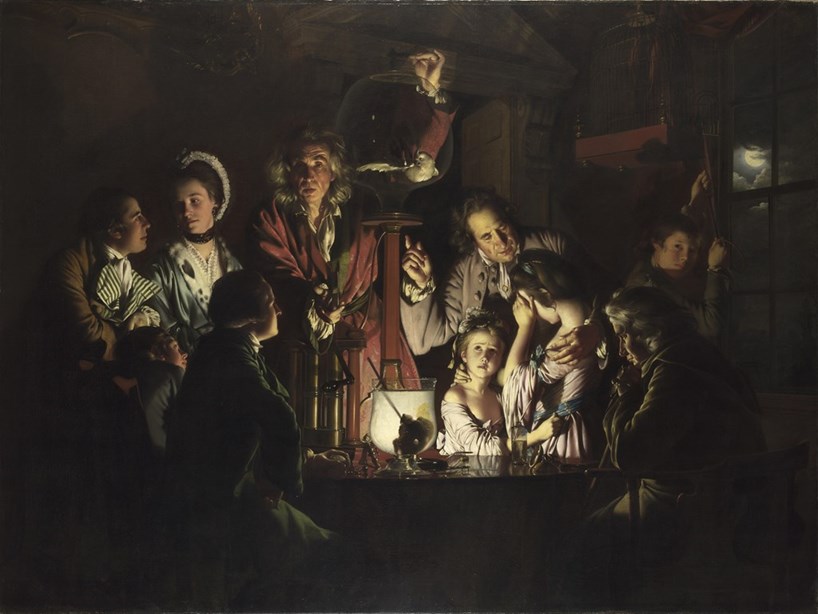 © The National Gallery, LondonJoseph Wright of Derby, An Experiment on a Bird in the Air Pump (1768), oil on canvas
As the opportunities to display works widened, artists needed to develop a distinctive style to stand out. Wright’s adoption of a tenebrist style, exaggerating light and dark for psychological and emotional effect and derived from late Baroque art and followers of Caravaggio. Through adopting a style also seen in 17th-century Dutch, often religious, paintings, Wright gave his work a signature look different from his rivals’.
Candlelight, a feature of Wright’s celebrated A Philosopher Giving That Lecture on the Orrery in which a Lamp is Put in Place of the Sun (1766), An Experiment on a Bird in the Air Pump (1768), and Three Persons Viewing the Gladiator by Candlelight (1765), also had layered spiritual meaning for Georgian audiences. Candlelight was associated with religious scholars, who applied themselves through the dark hours to the scriptures. There is also the reference to Jesus as “the Light of the World”, and the bright, omnipotent god-like treatment of the scientist/philosopher figures in The Orrery and the Bird in the Air Pump.
Wright made his London debut with Gladiator in 1765 at the Society of Artists. The scene shows three men around a cast of a sculpture of an ancient Greek swordsman. The Borghese Gladiator had become an icon of classical art and human anatomy. Making images from the sculpture was a staple in art academy classes, and copies at different scales were contained in many British collections. By featuring the sculpture, Wright acknowledged the tastes of his aristocratic clients who had undertaken a Grand Tour and expected British artists to pay homage to the subjects and artistic styles that they had seen on their travels.
Both The Orrery and the Bird in the Air Pump reference Gerit van Honthurst’s The Denial of St Peter (c.1623), in scale and complexity. In his most celebrated works, Wright elevates the everyday experience of his contemporary audience to the profundity of a religious experience. The diseased skull in the jar at the centre of the Bird in the Air Pump follows in the memento mori tradition, and is a reminder of the fleetingness of life as much as the suffering bird at the heart of the drama.
Wright’s use of silver beneath paint pigment, to add luminosity to light areas of the canvas, echoes the mirrors used in vanitas paintings, to emphasise the emptiness of worldly attractions and pursuits. And candles themselves were part of the vanitas tradition, underlining that human life was short and ultimately to be snuffed out. The contemplation of the heavens in The Orrery can also be read as human endeavour to understand creation, so that they could live more in step with the divine plan.
Theological light and dark blaze through Wright work. And as Ms Riding indicates, darkness and its associations would have been as compelling to his contemporaries, if not more so, as the light.
“Wright of Derby: From the Shadows” is at the National Gallery, Trafalgar Square, London WC2, until 10 May. Phone 020 7747 2885. www.nationalgallery.org.uk