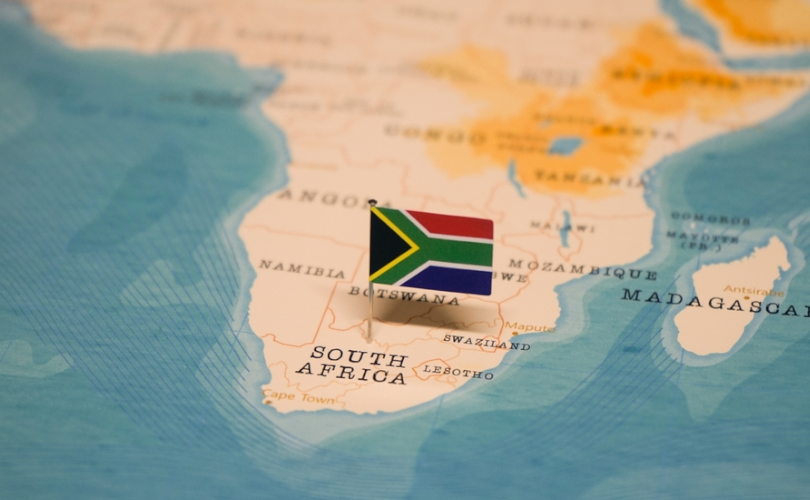
VATICAN CITY (LifeSiteNews) — Pope Leo XIV has appointed Bishop Sithembele Anton Sipuka as archbishop of Cape Town, South Africa, after the prelate previously led a major progressive ecumenical body and has advocated for the liturgical inculturation of a local pagan rite.
On January 9, Pope Leo appointed Sipuka as archbishop of Cape Town following his years of service as bishop of Mthatha, president of the Southern African Catholic Bishops’ Conference from 2019 to 2025, and president of the South African Council of Churches from 2024.
READ: Bishop Conley says abortion remains ‘greatest issue of the day’ at Prayer Vigil for Life
In October 2024, Sipuka was elected president of the South African Council of Churches (SACC), becoming the first Catholic – and the first Catholic bishop – to hold that position. The SACC is an ecumenical body that brings together a wide range of Christian denominations in South Africa and has a long public history dating back to the anti-apartheid era.
The SACC has been historically associated with leftist activism, and among its most internationally known leaders was pro-LGBT Anglican Archbishop Desmond Tutu. Sipuka’s election marked a significant moment for the council, given that its presidency had previously been held by non-Catholics.
On June 22, 2025, Sipuka preached a homily as SACC president during an ecumenical prayer service called “National Prayer Day for Healing and Reconciliation,” held at Grace Bible Church in Soweto, a Protestant congregation.
According to Sipuka, divisions among Christians are due to the fact that “dividing walls that seem so permanent to us are not permanent to God,” since the “categories that define our conflicts – us and them, insider and outsider, deserving and undeserving – these are human constructions, not divine decrees.”
Furthermore, Sipuka appeared to reduce the Christian notion of redemption to a sociological meaning of liberation: “Your liberation is tied to your neighbour’s liberation. Your welfare is connected to your enemy’s welfare.” He has also used Christianity to justify socialist political ideals: “There cannot be reconciliation without transformation. True reconciliation demands structural change – transformation of our economy so that wealth is shared more equitably.”
On July 3, 2025, Pope Leo XIV appointed Sipuka as a member of the Vatican Dicastery for Interreligious Dialogue.
In January 2023, while serving as president of the Southern African Catholic Bishops’ Conference, Sipuka gave an interview to Radio Veritas that was later reported by ACI Africa. In that interview, he reflected on earlier efforts at inculturation in Catholic liturgy in South Africa, particularly those that took place in the 1980s.
Liturgical inculturation seeks to introduce into the Roman Catholic rite elements taken from local religious cultures that are foreign to and sometimes older than the Christian tradition. Such rituals are often linked to superstitions or polytheistic practices, based on the belief that every culture can serve as an expression of worship to God.
However, Catholic liturgy does not belong to cultures but to the Church, and it is directed not to man but to God. Consequently, it is able to communicate grace to every human being regardless of historical or geographical context, because the human heart – made to receive God – is always the same everywhere. Therefore, the liturgy cannot be reshaped by local customs or beliefs without risking a loss of its true nature.
READ: Attempts to change Church governance to synodal model have failed throughout history
“Inculturation in terms of the liturgy was stronger in the ‘80s, then it stopped,” Sipuka complained in the interview. “We are doing liturgy as inculturated from those experiences, it has not developed.”
“We are trying to understand it in its traditional context so that we can see how we merge it with faith. The principle is that, in culture, there are a lot of things that are good; so it is not in our view that anything cultural must be thrown away.”
In particular, Sipuka appeared to be interested in merging Catholic liturgy with the local rite of ubungoma, a traditional South African spiritual practice in which a person becomes a healer or diviner through channeling ancestors.
“Now we are dealing with ubungoma,” Sipuka said. “We hope to complete the research by the end of this year and then hopefully by next year maybe we can be able to give some direction,” he said.
For quite some time, South African theologians have been trying to reinterpret this pagan practice in an effort to reconcile it with Catholic theology, for example by re‑reading the vocation of the prophet Jeremiah as an experience that can be linked to ubungoma.