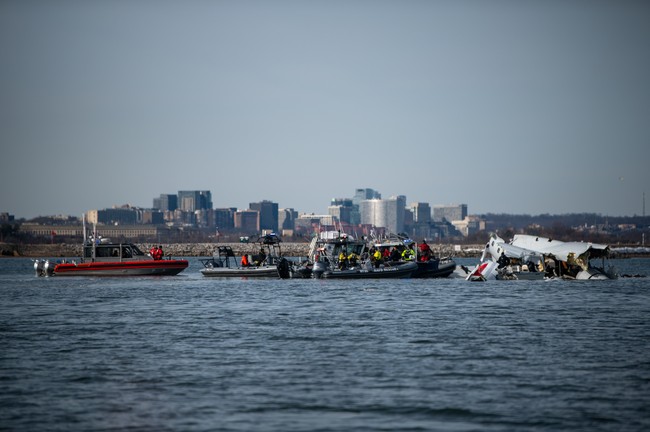
The National Transportation Safety Board (NTSB) held an all-day hearing Tuesday to finalize its findings on what caused last January’s mid-air collision between a U.S. Army Black Hawk helicopter and a commercial passenger jet over the Potomac River near Ronald Reagan Washington National Airport just outside of Washington, D.C.
After a nearly year-long investigation into the January 29, 2025 crash, which resulted in the deaths of 67 people, NTSB investigators determined that a number of factors, including the placement of a helicopter route so close to commercial air traffic and Army helicopter training standards, led to the tragic collision.
Before releasing its final conclusions, the board revealed some new information on the collision itself: “According to the NTSB, the helicopter contacted the left wing of the airplane with its main rotor. The helicopter was approaching from the right and the airplane was in a left turn, meaning the left wing was low. That means the two aircraft just clipped each other.”
The board ultimately determined the primary probable cause to be “the FAA’s placement of a helicopter route in close proximity to a runway approach path.” From the hearing transcript:
The NTSB determines that the probable cause of this accident was the FAA’s placement of a helicopter route in close proximity to a runway approach path. Their failure, failure to regularly review and evaluate helicopter routes and available data, and their failure to act on recommendations to mitigate the risk of a mid-air collision near Ronald Reagan Washington National Airport, as well as the air traffic system’s over-reliance on visual separation. In order to promote efficient traffic flow without consideration for the limitations of the see and avoid concept.
There was blame also placed on the Black Hawk crew: “Also causal was the lack of effective pilot applied visual separation by the helicopter crew, which resulted in a mid-air collision.”
READ MORE: Skater Whose Parents Died in DC Mid-Air Collision Is on His Way to the Olympics
The air traffic control crew working the night of the collision were determined to be overwhelmed by their work loads.
Additional causal factors were were the tower team’s loss of situational awareness and degraded performance due to a high workload of the combined helicopter and local control positions, and the absence of a risk assessment process to identify and mitigate real time operational risk factors, which resulted in miss prioritization of duties, inadequate traffic advisory advisories, and the lack of safety alerts to both flight crews.
And the Army was found to have had lapses in training its helicopter pilots on “the effects of air tolerances on barometric altimeter.” As RedState previously reported, the helicopter should have been flying below 200 feet as it approached Reagan National, but was determined to be flying at nearly 300 feet, which put it on a collision course with the commercial jet.
Also causal was the Army’s failure to ensure pilots were aware of the effects of air tolerances on barometric altimeter in their helicopters, which resulted in the crew flying above the maximum published helicopter route altitude.
The bulk of the criticisms were reserved for the FAA.
Contributing factors include the limitations of the traffic awareness and collision alerting systems on both aircraft, which precluded effective alerting of the impending collision to the flight crew’s. An unsustainable airport arrival rate, increasing traffic volume with a changing fleet mix and airline scheduling practices at DCA, which regularly strain the DCA ATC workforce and degraded safety over time. The Army’s lack of a fully implemented safety management system, which should have identified and addressed hazards associated with altitude exceedances on the Washington, D.C., helicopter routes.
The FAA’s failure across multiple organizations to implement previous NTSB recommendations, including Ads-b in and to follow and fully integrate its established safety management system, which should have led to several organizational and operational changes based on previously identified risk that were known to management and the absence of effective data sharing and analysis among the FAA aircraft operators and other relevant organizations.
Notably, the behavior and actions of the passenger jet pilots were not called into question in the NTSB’s finding. It seems they did everything correctly. There was an interesting video introduced during the hearing that showed visual recreations of what each flight crew saw, overlaid with actual cockpit audio recordings, as their aircraft approached the airport.
The NTSB posted their reconstruction of the visibility during the DCA midair collision, it has much more detail and data compared with the version I generated 2 years ago. pic.twitter.com/oZfnyTKUkK
— Scott Manley (@DJSnM) January 27, 2026
A visibly angry NTSB Chairwoman Jennifer Homendy told the media of the panel’s findings, “We should be angry, because for years no one listened. This was preventable, this was 100% preventable.”
Editor’s Note: Do you enjoy RedState’s conservative reporting that takes on the radical left and woke media? Support our work so that we can continue to bring you the truth.
Join RedState VIP and use the promo code FIGHT to get 60% off your VIP membership!