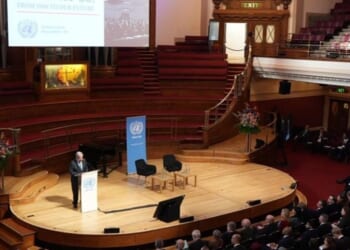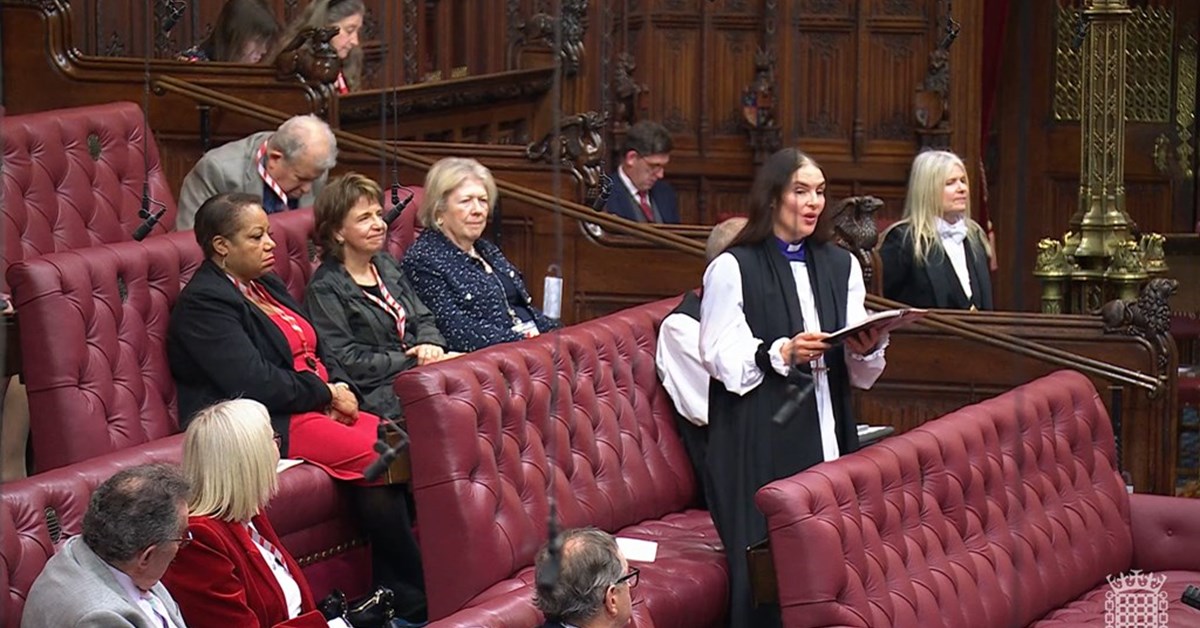
“BEING of Jewish heritage myself, I cannot recall a time when I was not aware of the Holocaust,” the Bishop of Coventry, the Rt Revd Sophie Jelley, said in her maiden speech in the House of Lords on Monday, the eve of Holocaust Memorial Day.
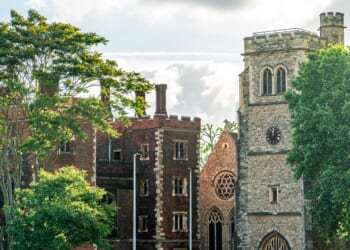
Coventry, she said, was “a city of peace and reconciliation, with a strong multicultural community and interfaith network”. She spoke of “a long history, including the welcome of 50 Kindertransport children on the eve of the Holocaust”.
She referred to Coventry Cathedral’s “worldwide ministry of peace and reconciliation, founded the very day after the destruction of the old cathedral in World War II. These relationships continue and are deeply precious to us.
“Just last month, we stood side by side with the President of the Federal Republic of Germany . . . gathering to mark our mutual challenges in peacebuilding and social cohesion to inspire a new generation to work together for peace in each of our countries.”
Bishop Jelley continued: “Our times are more divided, not less, in these days. We know that the study of human behaviour which led to the evil of the Holocaust begins by using words — words that separate us through the language of othering, words intent on harming rather than healing. . . Our words matter, and we can use words towards hostility or towards peace.”
In her introduction to the debate, the Minister, Baroness Taylor, read out the names of Holocaust survivors who had died during the past year, and raised the theme of education.
“Teaching about the Holocaust is not simply about understanding the past; it is about shaping a future where hatred cannot take root so easily. That is why I believe that having the national Holocaust memorial [News, 21 February 2025] and learning centre at the heart of our capital, beside Parliament, matters so deeply.”
The co-chairman of the UK Holocaust Memorial Foundation, the former Conservative Cabinet minister Lord Pickles, spoke of the demand “to resist hatred in all its modern forms”.
“In 2025, Britain received a series of wake-up calls that showed how fragile our complacency had become: a violent attack on Jews in Manchester; the conviction of terrorists who planned the mass murder of Jewish people; the shocking murders at Bondi Beach. . . Britain, like much of the world, is sleepwalking into disaster.”
He expressed concern that “institutional responses remain inconsistent. . . The long-term defence is education; yet this is where new challenges have emerged. The number of schools marking Holocaust Memorial Day has fallen sharply, from 2000 in 2023 to 1200 in 2024, and only 850 in 2025. . .
“Some refuse to mark Holocaust Memorial Day unless it is reframed. This is not just a moment to reflect; it is a warning, and there is a duty to deal with it.”
Baroness Deech (cross-bench) spoke of “the more than 1200 victims of the atrocities of 7 October and the more than 200 people who were taken hostage — the worst massacre of Jews since the Second World War”.
She said: “Many students learn about the Holocaust without learning about anti-Semitism itself. They do not understand its history, its ideological roots, or the social and religious narratives that sustain it.”
She said: “Winchester diocese’s work with Jewish communities to eliminate medieval stereotypes from religious education are welcome, and it would be encouraging to see similar programmes expanded nationwide.”
Responding to the discussion, Baroness Taylor praised Bishop Jelley’s speech and the way in which “Coventry is linking its devastation in the Second World War and the hatred that led to that with the importance of speaking to our young people about peacebuilding and reconciliation.
“Listening to the debate today, I think that we are all determined to do that to make sure that this is not just about memories, but about creating hope for the future that this will never happen again.”
Atrocities debated. Last week, the Bishop of Manchester, Dr David Walker, spoke in the Atrocity Crimes debate, referring to matters that had been drawn to his attention as chair of the mission agency USPG. He spoke of “places not only where atrocities are regularly committed against religious and ethnic minorities — sometimes Christians, but not exclusively — but where the security or the political situation is edging towards a greater risk of atrocity crimes and crimes against humanity in the future”.
Referring also to atrocities committed in the UK, and countries such as India where the potential for them was increasing because of a lack of government effort to restrict violence, he was concerned about not allowing UK commercial interests to trump — “and the pun is intended” — matters of morality: “That was the principle that justified the worst excesses of our own colonial history in centuries past.”
Lord Rook (Labour) said that it was “now almost seven years since the FCDO [Foreign, Commonwealth and Development Office] published the Bishop of Truro review . . . [which] assessed both the scale of persecution faced by Christians globally and the adequacy of our foreign policy response”.
He praised progress on the 22 recommendations and asked for “early interventions in relation to FoRB violations . . . particularly where religious persecution significantly heightens the risk of future atrocities”.
Responding, Baroness Chapman said that the Government would “continue to do the work that is needed”.