(LifeSiteNews) — All over the world, at every time and in every place, we find evidence that human beings are religious. But what exactly is religion? And how does understanding the nature of religion help us to prove that the Catholic religion is true?
We will begin to explore these questions in this article, which forms part of a longer series vindicating the claims of the Catholic Church.
Introduction
The most recent installment outlined how the science of Fundamental Theology uses both philosophy and history to establish the foundations of the Catholic religion.
That article explained that Fundamental Theology begins with a study, or “treatise,” that is often called “The True Religion” because it “undertakes to prove that there exists on earth one religion which has been revealed by God and meant for all men. That religion is the one brought to us by Jesus Christ, an authentic messenger from God; and that religion is, in the concrete, the religion professed by the Catholic Church.”
If we are to prove that the Catholic Church does indeed profess the true religion, we must first equip ourselves with a clear understanding of what “religion” actually is. If we don’t know what we mean by the term “religion,” how can we examine whether a given religion is true?
What is religion?
Earlier in this series, when we asked whether God exists, we took the generally understood idea of God as the beginning of our enquiry. The same approach can be taken with “religion.” That is, we may begin by asking what it is that men agree on calling “religion.”
The theologian Mgr. Gerard Van Noort wrote:
No one, not even an atheist, is ignorant of the existence of religion. Religion is as commonplace as trees, and like trees it grows in an endless variety of shapes, sizes, and colors all over the world. And as some trees are gigantic in size and others small; some flowering and some stunted; some beautiful in form and others grotesque, so too is it with the variant forms of religion.
And the philosopher A. M. Woodbury S.M. noted:
No one today can deny the existence of religious facts. For among various peoples, various religions have flourished and still flourish, and indeed so universally, that the human race viewed in general must be held to be genuinely religious.
Systems of belief and practice like Christianity, Islam, Judaism, Hinduism, Sikhism, Buddhism, and many others are universally referred to as religions.
The use of the term “religion” to encompass different, and often contradictory, systems of belief and practice, indicates that all these systems must be regarded as having something in common, which is not shared by systems we refer to by other terms, such as “philosophy” or “ideology.”
I think it will be uncontroversial to state that all the belief systems that are referred to as “religions” have one very obvious thing in common: they all profess to have something to say about God, or gods, or other spiritual forces. Religion is concerned with the relationship between men and these spiritual powers and always has a practical aspect, directing men on how to relate to supernatural beings through prayer, ritual, and the regulation of their actions. Religions also invariably treat to some degree of man’s fate after death; this is central to many religions, while in others it is less prominent.
Woodbury summarized these key aspects of religion as follows:
The various religions endeavour to solve the problem of our end: for they teach that besides this visible world, there exists another invisible, to which we can attain if we have communication with a superior being or beings who are regarded as existing there.
The Catholic Encyclopedia likewise notes:
In every form of religion is implied the conviction that the mysterious, supernatural Being (or beings) has control over the lives and destinies of men.
Another aspect of religion is evident at this preliminary, common sense, stage of our enquiry: every religion is practiced by more than one person, it is a communal endeavor, not a personal philosophy or practice. Religion also, almost universally, involves some form of hierarchy, or mediation with the divine, with forms of priesthood being common.
Throughout human history religion has, for the vast majority of human beings, been wholly integrated with their life in society, with entire communities being united in the practice of the same religion. To be a member of a society, and a practitioner of the society’s religion, have usually been one and the same thing.
In some societies, such as the Roman Empire, the practice of different religions was tolerated as long the official state religion was not threatened. Similar forms of toleration developed in Europe after the Reformation. However, the notion that a person’s religious belief is wholly distinct from their membership of the state, such that the state may (or even ought to) have no religion, while citizens freely choose their own system of belief, would be utterly alien to the vast majority of human beings who have ever lived.
A more detailed examination of historical religions
In the section above we have identified key elements that all the systems we call “religions” seem to share. Yet much more can be learned about the nature of religion through a serious study of existing and historical forms of religion.
The theologian Michaele Nicolau S.J. explained that “investigation into religion takes place by examining in a historical and ethnological way, that is, with the help of the comparison of languages, cultures, social forms, the relations of men to the supreme being and to superior beings, on which one professes that he is dependent and with whom he wishes to cooperate.”
It is not possible to explore in detail the vast scholarship on religion here, but its key findings have been summarized succinctly by Nicolau:
[T]he investigation into the religion of all peoples shows that the conviction about the existence of a personal supra-sensible power is valid everywhere, and that it is to be reverenced, placated and invoked. Towards it faith and certain duties are to be fulfilled, and rites and ceremonies are found everywhere whereby the cult of this numinous power is exercised. In a word: everywhere among the nations there is a complex of truths, duties and institutions that are the rule for man’s relations with the Supreme Being; everywhere this moral bond brings man into contact with this Being.
There are, Woodbury argues, three key elements that can be found in all religions, even though they manifest in significantly different forms. These elements are:
All religions have doctrine or dogma, that is, they hold certain things to be true as regards God, the gods, the world beyond this, or man’s ultimate fate. Religions differ significantly as regards the sophistication with which their doctrinal content is formulated and expressed, and the means by which it is professed, taught, and enforced. Nonetheless, all religions do have some doctrinal content; they profess, or assume, something about the supernatural order as true.
Secondly, all religions are concerned with human action and behavior. All propose rules or laws which man ought to follow if he is to relate rightly to God or the gods. Some religions have extensive moral codes, others do not, but no religion is indifferent to the actions of those who profess it.
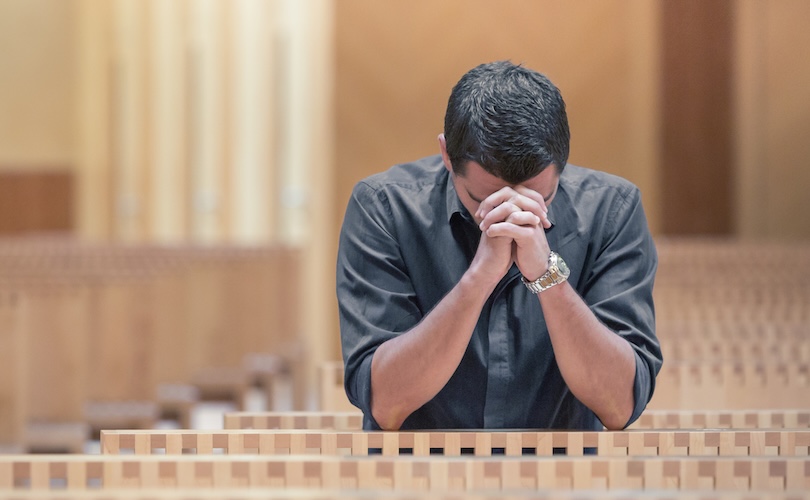
Finally, all religions involve some form of ritual or prayer. These rites vary widely but invariably involve some form of worship of the divine and are often accompanied by acts such as intercession and thanksgiving. Forms of sacrificial worship are extremely common. Many religions, especially those where a form of sacrifice is offered, have a class of priests, or priestesses, who conduct public rites of worship.
It is important to reiterate that affirming the universal presence of doctrine, law, and ritual is not to affirm that all religions ultimately teach the same doctrines, propose the same moral code, or practice the same rites. Neither is it to affirm that their doctrine, norms, and rites are all good and true. It is merely to affirm that these elements can be found, to some degree, in all those systems of belief and practice that we call religions.
The universality of religion demands an explanation
In his Choruses from “The Rock” the poet T. S. Eliot beautifully expressed man’s striving for religious truth:
And when there were men, in their various ways, they struggled in torment towards GOD
Blindly and vainly, for man is a vain thing, and man without GOD is a seed upon the wind: driven this way and that, and finding no place of lodgement and germination.
They followed the light and the shadow, and the light led them forward to light and the shadow led them to darkness,
Worshipping snakes or trees, worshipping devils rather than nothing: crying for life beyond life, for ecstasy not of the flesh.
On every continent, among every people, and in every era, human beings have sought knowledge about the divine power that governs and directs the world. They have striven not only to possess knowledge, but to order their lives according to that knowledge. They have worshipped, prayed, and sacrificed. They have ordered their lives according to norms they believe to be pleasing to the divine power; they have looked for assistance amidst the sufferings of this life, and have hoped that a better life might await them after death.
This universality of religion is a fact which demands explanation, according to the principle that “every effect must have a proportionate cause.”
Now that we have established the fact that man is a religious animal, we are ready to ask why this is so. There must be an explanation that adequately accounts for the phenomenon observed.
That is the question to which we will turn in the next installment.