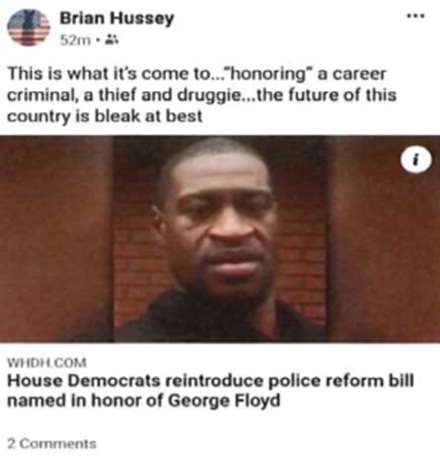
From today’s order granting rehearing en banc in Hussey v. City of Cambridge:
The majority panel opinion relied on First Circuit precedent for the proposition that “speech commenting on public ‘issues in a mocking, derogatory, and disparaging manner’ is accorded less weight in the [Pickering] balancing test.” Hussey v. City of Cambridge, No. 24-1279, Slip Op. (Aug. 15, 2025), at 16 (quoting MacRae v. Mattos, 106 F.4th 122, 137 (1st Cir. 2024), and also citing Curran v. Cousins, 509 F.3d 36, 49 (1st Cir. 2007) (“Speech done in a vulgar, insulting, and defiant manner is entitled to less weight in the Pickering balance.”)).
- Is this precedent consistent with the Supreme Court’s First Amendment jurisprudence, including but not limited to Rankin v. McPherson, 483 U.S. 378 (1987), and Connick v. [Myers], 461 U.S. 138 (1983)? Please address the propriety of giving less weight to “mocking, derogatory, and disparaging” speech on matters of public concern, and—in doing so—please discuss how the consideration of “manner, time, and place” in the Pickering balance bears on that question. Finally, please address whether the propriety of giving less weight to “mocking, derogatory, and disparaging” speech on matters of public concern depends on whether the speech occurred within the workplace or outside the workplace.
- Is there a more suitable approach, also consistent with First Amendment jurisprudence, for balancing the First Amendment right of a public employee to speak on a matter of public concern against the needs of the public employer?
- How would any proposed change in approach affect the analysis and outcome in this case? Please also discuss whether, and how, the Pickering balancing would differ under such an approach for speech by a public employee holding a different employment position or rank than appellant Hussey.
- If the proper Pickering inquiry considers whether the speech at issue disrupted the workplace without reducing the employee’s interest in the speech, is it necessary to remand the case to the District Court? Or did the District Court already make a finding on that score?
Here’s an excerpt from the panel majority, by Senior Judge Kermit Lipez, joined by Judge Gustavo Gelpí; the controversy was about police officer Hussey being disciplined for posting the Facebook post excerpted at the start of this post:
First, while Hussey’s and the public’s First Amendment interests in Hussey’s speech are significant, the speech’s value was modestly diminished due to its “mocking, derogatory, and disparaging” nature. Second, the Department’s prediction that Hussey’s post could undermine its relationship of trust with the community was reasonable. Third, there is no evidence suggesting that the Department’s decision to discipline him was driven by anything other than that reasonable prediction. Given the importance of that trusting relationship to the Department’s public service mission, we hold that the Department’s interest outweighs Hussey’s in the Pickering balancing test. Therefore, as explained above, our inquiry ends here.
And from the dissent by Senior Judge Jeffrey Howard:
There can be no disputing that a police department’s management has a powerful interest in maintaining the public’s confidence that the department serves without bias the entire community it is sworn to protect. But a government agency is not free to discipline an employee for simply expressing a viewpoint with which the employer disagrees to friends outside of work. Because Hussey’s online comment merits no less than the maximum protection afforded by the First Amendment, and the record belies the reasonableness of his suspension, the Pickering balance tilts decidedly in his favor. I would accordingly reverse the district court’s grant of summary judgment.
Finally, recall that, under Supreme Court precedents, the First Amendment protects a government employee’s speech from being restricted by the employer if
- the speech is said by the employer as a private citizen, and not said as part of the employee’s job duties, Garcetti v. Ceballos (2006), and
- the speech is on a matter of public concern, Connick v. Myers (1983), and
- the damage caused by the speech to the efficiency of the government agency’s operation does not outweigh the value of the speech to the employee and the public, Pickering v. Bd. of Ed. (1968).