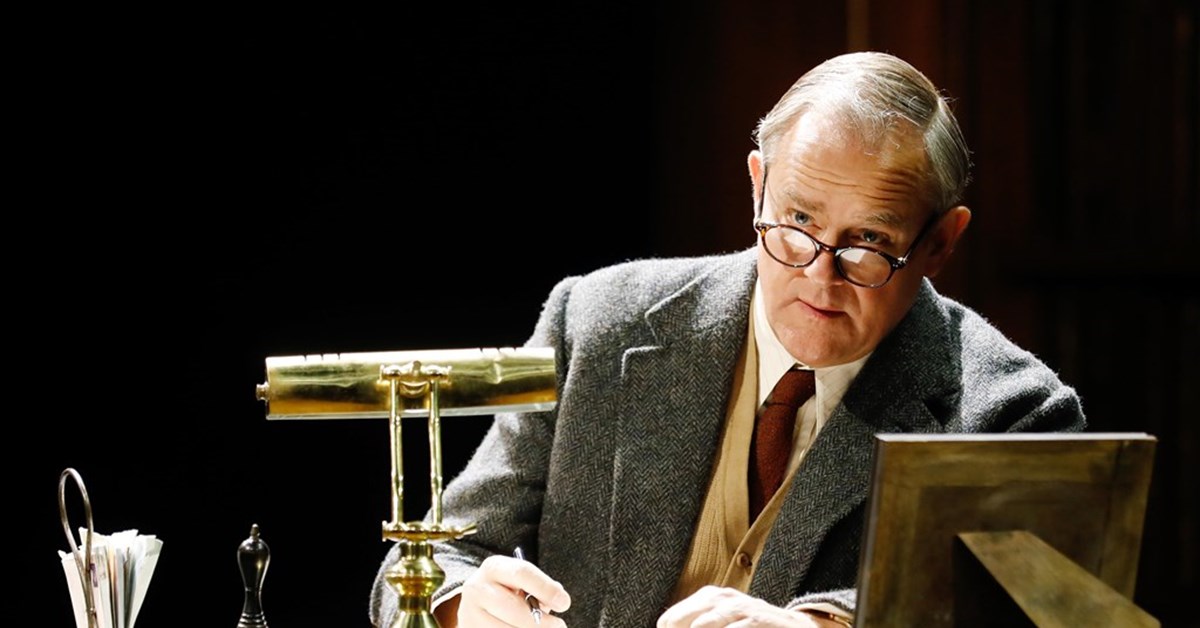
FOR a piece that began life as a low-budget TV drama for the BBC religious-broadcasting department in 1985, Shadowlands, the story of the later-life relationship between C. S. Lewis and the American poet Joy Davidman, has enjoyed remarkable longevity. The television film of Shadowlands, broadcast in December 1985, went on to win a BAFTA. A feature-film version, starring Anthony Hopkins and Debra Winger, was released in 1993. The latest incarnation is a West End production of the Shadowlands play originally staged at the Chichester Festival Theatre in 2019.
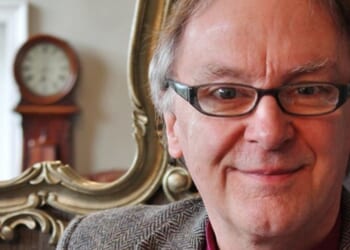
William Nicholson’s original script will barely be changed in the production at the Aldwych Theatre, which opens next week, apart from updating a story that a character reads from a newspaper. Raised as a Roman Catholic, Mr Nicholson initially had no time for C. S Lewis, sharing his mother’s view that the Narnia author was a “drippy Protty”. But, when his colleage in the BBC’s religious department Norman Stone — filmmaker, Lewis fan, and Christian — suggested creating a television drama about Lewis’s relationship and marriage to an American mother-of-two, Joy Davidman, Mr Nicholson was transfixed by their slow-burn love story.
“I personally connected, as a much younger person — I was 36 at the time — to the whole question of fear of commitment in love, which is maybe more of a male thing, but it was certainly something I was experiencing. I wanted to love and be loved, but was very afraid of committing myself to a full love affair, love relationship, marriage, children.”
Lewis’s loss of his mother at the age of ten probably affected the author’s ability to form close relationships, Mr Nicholson thinks. “When the person who is most central to your life, who gives you your sense of being loved, disappears and leaves you in pain, it’s reasonable to conclude that something closed off at that point, and had to be opened again. I responded to the fear of being made vulnerable by love. I made that one of the central themes, because that related strongly to me. I wasn’t married at the time; so I was able to channel a bit of myself into Lewis, and Lewis into myself.”
Mr Nicholson says that it is the element of “a grief observed” which elevates Lewis’s autobiography above “a sad cancer story” — and the issues of love and pain, and how a good God can permit suffering, keep “re-constellating” through the television, film, and stage versions of the story.
“For the play, I realised I could bookend the story with Lewis the lecturer. And I begin with him giving a strong confident lecture about how God can have seen suffering [as part of freedom] in the world. And then I repeat it at the beginning of Act Two, by which time everything’s gone wrong, and he gives the same lecture, and it begins to crack. And then I end with the same lecture, but transformed by his experience. It’s a simple framing device, but it works well in the theatre.”
The epistolary nature of Davidman’s and Lewis’s early relationship has modern echoes in online dating and romance fraud, Mr Nicholson suggests. “Epistolary romances are happening all the time. There is a thing called ‘romance fraud’. People pretend to be somebody they’re not, and have a very long-drawn-out online exchange, of basically letters with a lonely person. It grows and grows, and ends up sadly, with acts of deception and fraud, where they persuade the person on the other end to give them lots of money.
“But, apart from those which are sad and bad, I’m sure that there are people who go on dating sites and don’t immediately rush off to jump into bed together,” he says. “They have a long back-and-forth, and they get to know each other through their text exchanges, sometimes for a long time. Whether any of that can ever become a powerful drama of the future, I don’t know. Love at a distance is always going to be with us.”
THE theatre director Rachel Kavanaugh, who worked on both the Chichester and West End productions, says that she has “lived with the play” since 2018, when she was asked to do it at Chichester. “I made the hideous error of first reading it on public transport. I found it so upsetting and moving, I did proper crying on the G1 bus towards Battersea. Shadowlands speaks to something deep in all of us about loss, love and loss, and the fear of loss — and all the relationships between love and feeling alive, love and faith, loss of love, loss of life, and how that connects possibly to loss of faith: all the big questions.”
Distilling the appeal to a contemporary West End audience of a narrative written in the 1980s about a Christian 1950s Oxford don falling in love, she says: “Shadowlands deals with stuff that none of us are going to escape.” Her production keeps the play firmly in the 1950s. “It’s about some real people. C. S. Lewis, his brother, Warnie [Warren], and Joy Davidman are all real people: the characters use their names. Their story happened at a particular moment in time. So, for me, there is no advantage in moving that story from the time in which it happened.”
The characters will wear costumes of that period, Ms Kavanaugh says, noting that the clothes and settings symbolise the stuffy world of 1950s Oxbridge academia. “What Joy does, and what she disrupts, is in an academic, very male-dominated world that was a very powerful world at that particular time. Universities have changed, one would hope, from the college we see in the play, in terms of their outlook on women and people from other countries. But it’s important that the play is set in the time that the events actually happened.”
Further authenticity is lent to this production by the leading actors’ backgrounds. Hugh Bonneville, reprising his role of C. S Lewis from Chichester, read theology at Cambridge. Rowan Williams was one of his tutors. And Maggie Siff, playing Davidman, is an American actress of Jewish heritage. “There is a real authenticity in the casting. . . They don’t have to pretend a lot of things.”
The interplay between fantasy and reality gives Shadowlands a universality beyond its Oxford post-war period. “It’s set in a moment in time and space, but the universality of the subject matter is quite poetic,” she says. Of almost equal importance is the way in which the play deals with reality and fantasy. “It is quite poetic. It’s about the bridge between the real world and the world of Narnia and the world of the imagination, and that allows for a kind of staging and a kind of production which isn’t overly literal.”
Lewis’s overt Christianity should not present a barrier to today’s audiences any more than it did to theatregoers of 1989, when Shadowlands won the Evening Standard Best Play Award the following year, and then a Tony for the Broadway transfer, she says. “The world generally has become more polarised, but the way in which faith and death are examined in the play is deeply personal. It’s not politicised. Part of the play’s genius is that it invites you to examine your own responses to some of the things that C. S. Lewis expresses about faith and suffering, and loss, and his journey through loss.
“There is no one view of either faith or death in the play; there are many views. And the imaginative tie-up of what I’ve described as ‘other worlds’, which are sometimes heaven, sometimes Narnia, sometimes other imaginative places — and, to some of the characters, not imaginative, but very real — is both inherently theatrical, and inviting of an individual response.”
Ms Kavanaugh concludes that she would like the Shadowlands audience to leave the theatre having had a cathartically good laugh and a good cry. “For some people, not for others, it will be ‘What did I make of the C.S. Lewis’s relationship with God and how he imagines suffering in relationship to faith?’ And others will see the story in a purely personal, human way.”
Shadowlands is at the Aldwych Theatre, Aldwych, London WC2, from 5 February till 6 May. Box office at: shadowlandsplay.com (for access queries, phone 020 7836 5537).