For decades, Europe’s NATO countries were largely free riders when it came to national defense. The United States mostly bore the burden of defending all NATO members against the Russians and whatever other threats might materialize. That made sense when Europe was devastated in the aftermath of World War II, but more recently it has been an unhealthy dependence, as Europe has more people and about as much wealth as the United States.
One of the major accomplishments of the Trump administration (Trump I and now Trump II) has been impressing on Europeans the need to provide for their own defense. Trump has made it clear that the U.S. is no longer willing to shoulder the lion’s share of the burden, a position our government should have taken long ago. The good news is that the Europeans now generally acknowledge that Trump is right, and they are making serious efforts to upgrade their military capabilities.
That is the background to an unusually long article in the London Times: “Can Europe defend itself without help from America?”
The Pentagon has intimated that it would like Europe to take charge of its own defence as early as next year. What role the US would then play is unclear. Scenarios range from a gradual reduction of US support, where the nuclear umbrella remains intact and most of its 85,000 or so troops stay put, to a radically curtailed partnership in which Washington confines itself to selling weapons.
***
Optimists circulate lists of numbers that purport to show Europe’s overwhelming superiority over Russia: more men and women under arms, twice as many tanks and infantry fighting vehicles, three times the nominal defence spending, three times as many aircraft carriers, four times as many warships.
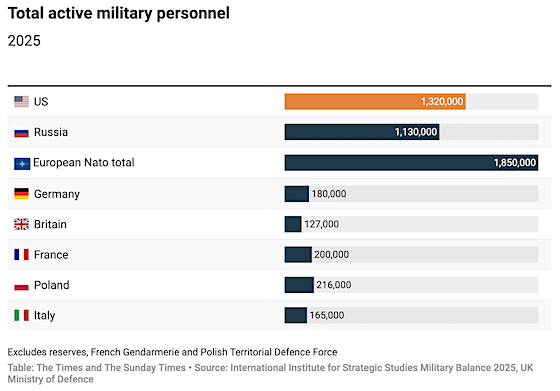
But the European forces are badly diverse:
Yet this strength is profoundly fragmented. Edward Stringer, a retired RAF air marshal and director-general of the UK’s Defence Academy, notes that in the ten main categories of weapons systems, such as battle tanks or fighter jets, the US has 33 main variants while the Europeans have 174, often with their own peculiar spare parts, fuel or ammunition.
And below the surface, things are not as rosy as they look:
Beyond that, the Europeans are desperately short on the basics: ammunition, surface-to-air interceptors, drones, long-range missiles. Even equipment that looks impressive on paper is sometimes so poorly maintained as to be more of a liability than an asset.
And there are some capabilities that the Europeans simply lack:
Yet there is one category of enabler where the deficit could barely be more glaring. Modern militaries rely on satellites not only for intelligence, surveillance and reconnaissance (ISR) but also for communications, navigation and guidance systems, as well as early warning of big enemy missile launches. Without them, the armed forces would be fighting blind.
Europe had until recently almost totally abdicated this field to the US.
These graphics sum up the main areas where Europe cannot do without America:
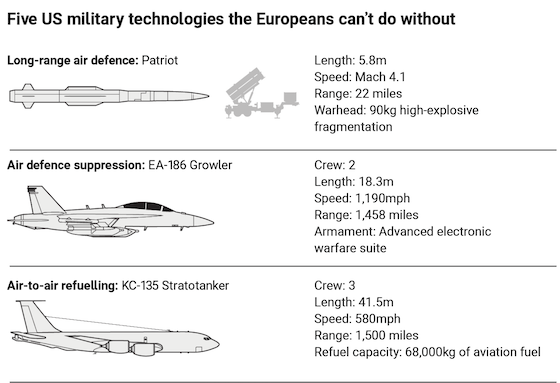
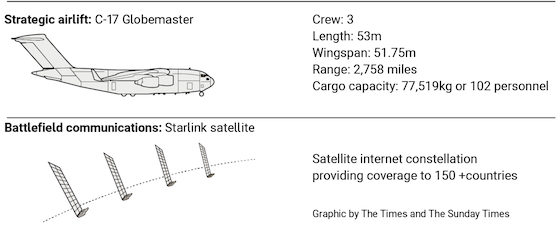
Then, of course, there is America’s nuclear force, the ultimate deterrent to a Russian invasion. Europeans worry that the Trump administration, or some future American government, might explicitly or implicitly withdraw our guarantee of a nuclear response, should Russia invade. I think there is no chance of that happening, but the fact that Europeans think about it is good.
Beyond all of these material issues lurks a more fundamental question: after decades of globalism and widespread pacifism, can the Europeans muster a culture that is sufficiently martial and patriotic to cope with serious security threats? In the end, men are more important than machines.
It is an open question, but I think indications are positive. Many were shocked when Nato secretary-general Mark Rutte told the British they had to either ramp up their military strength, or else teach their children to speak Russian. But by now, Europeans have largely absorbed that stark reality.
A few decades from now, historians may write that inducing Europeans to take responsibility for their own security was one of President Trump’s most important accomplishments.