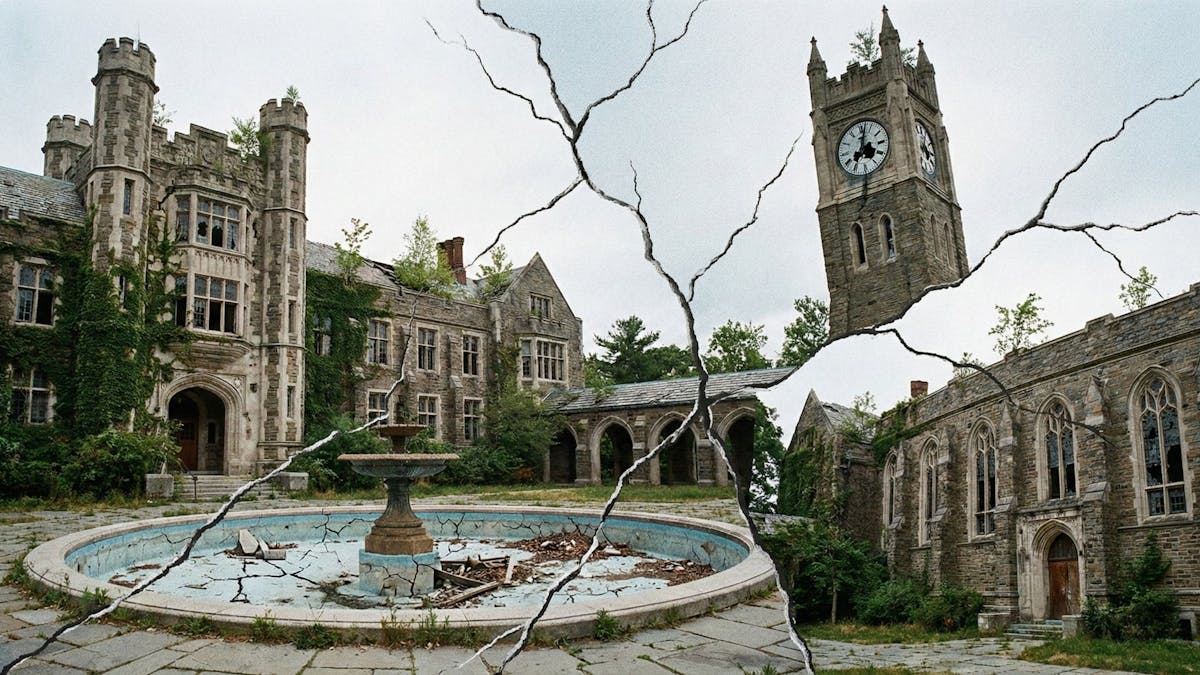
In Part I, we examined the four seismic forces reshaping higher education and how, together with already fragile finances of many institutions, they have produced a profound bifurcation in the prospective student market. Two distinct categories of students — and two corresponding types of institutions — now dominate the landscape. This divide is entrenched. Hundreds of institutions now find themselves boxed out of both.
The Great Bifurcation And Pivot
The bifurcation of the prospective student market today falls into two broad categories which we might label the “Elites,” and the “Pragmatics.”
Elites: Traditionally, these students are the core of the college‑going population. Elites tend to be younger, academically strong, and financially supported by their families. They arrive with high GPAs, strong test scores, and extensive advanced coursework. Demographically, they are more likely to be single and non‑URM (Under Represented Minority); economically, they are dependent on family support and relatively insensitive to price. Their primary decision driver is institutional prestige.
Pragmatics: Pragmatics are often older, more likely to be first‑generation, URM, married, and parents. Academically, they are mid‑ or low‑performing and less likely to have taken advanced coursework. Economically, they are poorer, employed (often full‑time workers), and highly price‑sensitive. Their decision drivers are proximity, cost, convenience, and the perceived financial payoff of the credential. By the 2010s, this group overtook Elites as the majority.
Bing Guan/Bloomberg via Getty Images
Table 1: Two Broad Prospective Student Markets
| Critical Concerns | “Elites” | “Pragmatics” |
| Top College Considerations | Brand, reputation, and ranking of school | Cost (room & board alone may disqualify), the desired discipline |
| Family and Student Financials | Wealthier families funding financially dependent students | Poorer families requiring student financial independence |
| Distance from Home | More willing to travel but require access to mass transit | Require close proximity to family and job |
| Primary College Objective | Outcomes: economic and social | ROI – outcomes vs. costs |
| Student Academic Preparedness | Highly Prepared – typically top 10% of graduating class | Underprepared – academically mid- or low-performing |
| Size of Postsecondary Market | Smaller and shrinking portion of postsecondary market | Largest and growing portion of postsecondary market |
Across both groups, one factor stands out as universally influential: proximity. Half of all students enroll within 17 miles of home, and nearly 70% remain within 50 miles. For Pragmatics, proximity is essential due to work and family obligations; for Elites, distance introduces cost and logistical barriers.
Due largely to demographic shifts, the proportion of Elites is shrinking rapidly; but the corresponding supply of Institutes of Higher Education (IHE) built to serve them has not contracted. The intensified competition for this market has disproportionately impacted public and private IHEs that are typically smaller, non-selective, struggling financially, expensive, more rural, and lesser known.
The responses of these schools have included increased discounting; refinancing or increasing debt; loosening admissions standards; expanding recruiting efforts; increasing high school visits and partnerships; more campus visits for families; and expanded data analytics to identify more likely “fits.” They have developed more robust advising and career planning resources, expanded curricular offerings, and dipped deeper into their waitlists.
All of these efforts have had limited success — chiefly because none of them address the top concerns of either Elites or Pragmatics. The relative prestige of the given school remains low, turning off most Elites; its costs, although discounted, remain multiples of lower‑cost options, eliminating nearly all Pragmatics; and their locations remain outside the preferred 17–50 mile radius for all candidates.

monkey business images. Getty Images.
The most prestigious schools — Ivies and a few others — have been largely insulated, protected by entrenched brands and massive endowments. A central strategy for struggling institutions has been heavy promotion of the “college premium” — the claim that graduates earn substantially more than non‑graduates. They cite figures showing that full-time workers with bachelor’s degrees earn significantly more per year and over a lifetime than high-school graduates or those with an associate’s degree.
For both educators and paying families, it is tempting to treat these correlations as causal. Yet substantial evidence shows the premium is far smaller than advertised. Even so, countless college websites continue to market it aggressively, some even branding it as their own institution’s “premium.” What they rarely mention is that the premium may be much smaller or nonexistent for certain majors and that it applies only to graduates.
For the new market of underprepared, economically fragile students, the college‑premium narrative is insufficient — and often misleading. IHEs needed another economic incentive and a moral argument.
The Great Pivot
As the proportional supply of traditional, well‑prepared students shrank, hundreds of IHEs pivoted toward a new candidate altogether — the poor, the academically underprepared, and under represented minorities (URMs). LinkedIn reports that as more prospective students applied to the most selective schools, those schools became even more exclusive, while struggling schools loosened admissions standards to fill empty seats and beds. They escalated scholarships, discounting, and grants to attract this poorer contingent.
Struggling schools often wrapped their outreach messaging in DEI priorities, positioning their efforts as righteously student‑centered. They admitted far more students who were historically underrepresented — higher‑risk students who were typically poor, first‑generation, academically underprepared, and non‑white and non‑Asian minorities.
leightrail. Getty Images.
In fact, the data show that between 2004 and 2024, even as overall enrollment fell, the number of schools accepting 70% or more of applicants increased from 58% to 64%, with enrollment at these schools rising 36%, from 767,000 to 1,043,000.
At the other end of the spectrum, elite schools saw enrollment skyrocket — not because they greatly expanded capacity, but because the number of schools in this segment jumped from 7 to 37, a 429% increase. In fact, in 2004, none of the Ivy League schools were in this segment, yet by 2024 all eight Ivy League schools were in this segment. Enrollment shot from 1,706 to 51,995, a whopping 2,900%, between 2004 and 2024. A few schools managed to target both groups by making their brick‑and‑mortar institutions more selective while expanding less selective online platforms and community college partnerships.
Meanwhile, hundreds of other schools found themselves boxed out — too expensive and geographically undesirable for Pragmatics, and not prestigious or selective enough for Elites.
Simultaneously, college readiness indicators declined sharply. ACT and SAT scores dropped. Faculty reported worsening preparedness in reading, writing, and quantitative skills. The National Assessment of Education Performance (NAEP) scores for high‑school seniors fell or stagnated in both reading and math —building on previous declines in all 50 states.
In “College Preparedness Over The Years,” Petrilli and Finn observe:
No wonder that, around 2005, the country felt an acute sense of crisis about so many students arriving on campus unready for college‑level work. Barely a majority of freshmen were ‘college‑prepared,’ versus two‑thirds of students a dozen years earlier.
They go on to postulate that this helps explain the paradox of why, despite levels of college matriculation being up, rates of college completion have declined. Remedial course work has exploded: today, half of all college students and 70% of community college students take some form of remediation, with many requiring 2–4 remedial courses.
Many colleges nonetheless stepped up marketing and recruiting dramatically. They found they could lower costs through digital marketing. The Common App, for example, now handles 25 million applications annually. This means expanded access, especially for first‑generation, low‑income, and URM students. Thanks to the Common App platform, applications per student has grown dramatically.
Test‑optional policies, expanded during COVID, boosted applications from lesser‑prepared students. Some 75-80% of IHEs adopted this policy and most have kept it. Struggling IHEs implemented new admissions policies: instant decisions, guaranteed admissions, and offering admission to high‑school seniors who had not yet even applied.
But recruiting alone could not solve the financial problem. With the cost of a bachelor’s degree soaring into the low‑ to mid‑six figures, and the target market hovering around poverty level, IHEs needed a financing mechanism. Pell grants, that today provide up to $7,395 per year, soared in usage from 3.8 million in 1990, to a peak of 9.4 million in 2011. But even these were not sufficient to bridge the growing financial gap.
The solution became the modern American student loan system.
The Student Loan Engine

zimmytws. Getty Images.
Today’s U.S. student loan system began in 1958 with the National Defense Education Act and expanded in 1965 with the federal guarantee program. For decades it served a relatively small share of students; but from the 1990s through 2010s, usage exploded. Between 2000 and 2020, total student debt more than quadrupled from $387 billion to $1.8 trillion. The average loan balance now exceeds $30k, and only 38% of borrowers are current.
Not only did the number of borrowers skyrocket, but the amount borrowed did as well. By 2017, some 8 million people took out new student loans — double the number who did so in 1995. The average amount borrowed increased 27% during that time, with the number of people owing $50k or more increasing seven-fold to over 5 million.
Borrowing grew fastest at riskier institutions — those where students are more likely to borrow heavily, drop out, default, or earn too little to repay. URMs, particularly Black and Hispanic/Latino students, were disproportionately affected. Pell‑eligible students — a proxy for low income, first‑generation status, and URM — are heavily concentrated in lower‑earning, non‑STEM, non‑Business majors.
Conclusion
Barry Winiker. Getty Images.
Although college can be valuable for some students, the divergence in outcomes has become stark. Well‑prepared students often thrive, while many underprepared students end up worse off — sometimes far worse — than if they had never enrolled. The consequences are broad: delayed homeownership, marriage, and childbearing; reduced retirement savings; and widening racial wealth gaps.
At the top, elite institutions — buoyed by brand power, selectivity, and massive endowments — continue to thrive. At the pragmatic end, large public systems, community colleges, and scalable online providers attract cost‑sensitive students who prioritize proximity, affordability, and flexibility.
But in the middle sit hundreds of institutions that cannot win either group. They are too expensive and geographically inconvenient for Pragmatics, and insufficiently prestigious for Elites. Their pivot toward underprepared, economically fragile students has kept enrollment and corresponding state reimbursement afloat but has also exposed those students to heightened academic and financial risk.
Completion rates remain low. Remediation remains high. Borrowing remains heavy and the college premium — widely advertised as universal — is increasingly questionable and uneven, masking enormous variance in outcomes. For many underprepared students, the combination of low completion probability, high borrowing, and weak labor‑market returns has inverted the traditional value proposition. Instead of college being a pathway to upward mobility, it has become a source of long‑term financial strain.
Higher education is no longer a single market. It is a bifurcated system in which a shrinking pool of Elites and a large pool of Pragmatics dominate demand, while hundreds of institutions find themselves unable to attract either group. Their survival strategy — the Great Pivot — has reshaped the sector, expanded access, and simultaneously exposed millions of underprepared students to financial and academic risks that the traditional college‑premium narrative obscures. The implications are profound: for students, for institutions, for society, and for the future of higher education itself.
* * *
RELATED: Why America’s Colleges Are Far More Fragile Than They Appear, Part I
* * *
Greg Salsbury, Ph.D., serves on the Board of Advisors for STARRS.US., and is the former president of Western Colorado University. He earned his Ph.D. from the University of Southern California, an M.A. from the University of Illinois, and an M.A. from the Annenberg School for Communication and Journalism at USC.
John Kawauchi, MBA, is a former VP of Enrollment Management and Marketing of Western Colorado University and Lake Superior State University, after spending most of his career in Retirement Planning and Product Marketing in the Financial Services industry. He earned his MBA from the University of Chicago and a BS from Cornell University.
The views expressed in this piece are those of the authors and do not necessarily represent those of The Daily Wire.