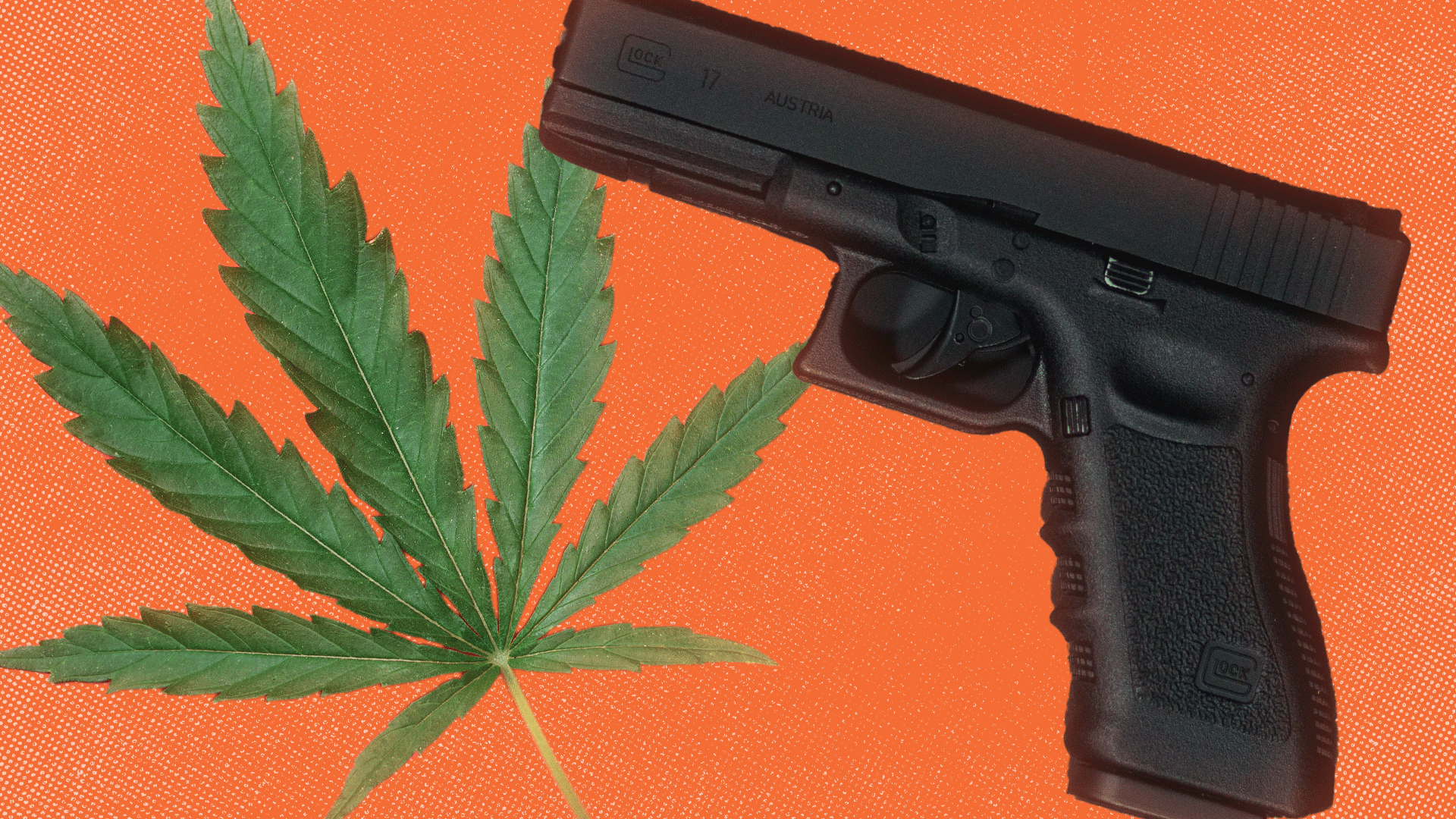
A federal law enacted in 1968, 177 years after the ratification of the Second Amendment, makes it a felony, currently punishable by up to 15 years in prison, for an “unlawful user” of “any controlled substance” to receive or possess a firearm. It therefore aims to disarm millions of Americans who pose no plausible threat to public safety, including cannabis consumers who live in states that have legalized marijuana.
That law, the U.S. Court of Appeals for the 5th Circuit held in the 2024 case United States v. Connelly, is unconstitutional as applied to defendants whose disqualification hinges on nothing more than “habitual or occasional drug use.” In United States v. Hemani, which the U.S. Supreme Court is scheduled to hear on March 2, the Trump administration is asking the justices to reject the 5th Circuit’s conclusion and reinstate the criminal case against a gun-owning marijuana user.
The government’s defense of the law at issue in Hemani, 18 USC 922(g)(3), has provoked rejoinders from an ideologically diverse set of organizations, including the National Rifle Association (NRA), a bunch of other gun rights groups, two drug policy reform organizations, several think tanks, and the National Association of Criminal Defense Lawyers (NACDL). Those briefs, filed in a case that lies at the intersection of gun control and the war on drugs, illustrate the potential for alliances between right-leaning critics of the former and left-leaning critics of the latter—a subject I cover in my book Beyond Control.
Until a few years ago, the NRA was reluctant even to comment on the constitutionality of Section 922(g)(3) as applied to state-legal cannabis consumers. Now it is arguing that the statute is unconstitutional as applied to a cannabis consumer in Texas, where recreational use is still illegal. And although 18 states that have legalized recreational use are nevertheless urging the Supreme Court to allow that prosecution, the Drug Policy Alliance (DPA) and the National Organization for the Reform of Marijuana Laws (NORML) have joined the NRA in asking the justices to uphold the 5th Circuit’s decision.
As you would expect, the briefs generally agree with the 5th Circuit that a categorical ban on gun possession by drug users is inconsistent with the Second Amendment. But they also offer other arguments against Section 922(g)(3), saying it is unconstitutionally vague, violates the Eighth Amendment’s prohibition of status-based crimes, and exceeds the federal government’s enumerated powers.
‘No Historical Justification’
Under the Second Amendment test established by the Supreme Court’s 2022 ruling in New York State Rifle & Pistol Association v. Bruen, Section 922(g)(3) passes muster only if the government can show it is “consistent with this Nation’s historical tradition of firearm regulation.” To make that case, the Trump administration relies primarily on the historical treatment of “habitual drunkards,” who could be confined to workhouses as “vagrants” or civilly committed based on judicial determinations. As several of the briefs opposing the government’s position note, that analogy is problematic for several reasons.
Since vagrancy and civil commitment laws “were not even ‘firearm regulations’ or ‘gun laws,'” a brief from Gun Owners of America (GOA) argues, “they are irrelevant under this Court’s precedents.” And unlike Section 922(g)(3), those laws “demanded pre-deprivation procedural protections and individualized findings,” the NACDL notes. “Process preceded prohibition. Before any restriction could attach, an official had to determine that a particular person was a habitual drunkard requiring commitment.”
According to the government’s brief, Section 922(g)(3) “burdens [the Second Amendment] right less severely than vagrancy laws and civil-commitment laws, which provided for drunkards to be confined in jails, workhouses, or asylums.” Since drunkards historically could be imprisoned, the government argues, it follows that the “lesser” consequence of disarmament must be acceptable.
“This argument misapprehends the historical framework,” the NACDL says. “The severity of historical punishments does not authorize modern restrictions that lack the features that made those punishments constitutionally tolerable. The ‘greater’ burden of imprisonment followed a judicial determination that the individual met the regulated category; it did not precede it.”
The NACDL adds that the government’s argument “proves too much” since “virtually any criminal offense—from vagrancy to public drunkenness to petty theft—[historically] was punishable by some form of confinement.” According to the government’s logic, it says, “Congress could categorically disarm anyone who commits any such offense, without individualized process, simply because the Founders permitted imprisonment for similar conduct.”
Along similar lines, the NRA notes that the government’s invocation of vagrancy laws “would lead to absurd results,” since “it would also allow for the disarmament of a sweeping array of other peaceable persons covered by vagrancy laws.” Categories of “vagrants” included “people who juggle, play the fiddle, play the bagpipes, read palms, ‘neglect their callings,’ ‘misspend what they earn,’ ‘do not provide for themselves,’ ‘do[] not for the space of ten days seek employment,’ ‘roam[] from place to place without any lawful business,’ are ‘stubborn servant[s],’ or ‘appear in the streets or in public in apparel usually worn exclusively by the opposite sex.'”
Notably, the government has abandoned an analogy that figured prominently in Connelly and other cases involving gun-owning cannabis consumers: early laws that prohibited people from publicly carrying or discharging guns while intoxicated. Those laws nevertheless are instructive because they addressed the potential hazards posed by drug-using gun owners in a way that was much more narrowly targeted than Section 922(g)(3).
Laws against drunken gun handling applied only in public and only to people who were actively intoxicated; they did not impose a categorical ban on gun possession by drinkers. Section 922(g)(3), by contrast, applies in all settings and even when drug users are sober. That distinction explains why the the 5th Circuit in Connelly found “no historical justification for disarming a sober citizen not presently under an impairing influence.”
No ‘Distinctly Similar’ Precedent
The 5th Circuit got that right, the Second Amendment Foundation says. “Historical regulations on carrying firearms while intoxicated provide the firm boundaries of what our historical tradition will tolerate,” the organization’s brief argues. “The historical record does not support the idea that earlier generations of Americans would have tolerated disarming someone because they sometimes consumed alcohol.”
The NRA likewise notes that “the combination of intoxicants and firearms is a problem that has persisted since the eighteenth century.” But historically, legislators addressed that problem with laws aimed at inherently dangerous conduct rather than broad bans on gun possession by people who consume intoxicants. Those laws, the NRA notes, “did not disarm individuals when they were sober simply because they chose to become intoxicated when not carrying or shooting firearms.” When gun laws address a longstanding problem, the Supreme Court said in Bruen, the lack of a “distinctly similar” historical analog is especially telling. But although “the nation has long faced the social problem of armed drunks,” the NRA says, “there is no ‘distinctly similar’ historical law that justifies [Section 922(g)(3)] as it applies to marijuana.”
That is not surprising. Drinking was common during the nation’s early history, and many drugs currently classified as “controlled substances,” including cannabis, were widely and legally consumed in patent medicines during the 19th century. “It was the ‘universal custom’ of Founding-era militias to imbibe,” the GOA brief notes. “Likewise, Thomas Jefferson, Abraham Lincoln, and [other] famous Americans possessed firearms while being users of drugs ranging from opium to cocaine. It seems unlikely that these previous generations ever would have approved of a law like Section 922(g)(3).”
Even today, NORML notes, people who use psychoactive medications do not thereby surrender their Second Amendment rights. Although “many lawful prescription medications can produce impairment equal to or greater than cannabis,” it observes, “their use does not trigger categorical firearms disabilities.”
Given those difficulties, it is not surprising that the Trump administration has ditched the claim that cannabis consumers, regardless of how they actually behave, are analogous to people who recklessly carry or shoot guns when they are drunk. But instead it is arguing that cannabis consumers, including patients who use marijuana for symptom relief in compliance with state law, are analogous to “habitual drunkards,” regardless of how often or in what context they use marijuana. As the NACDL notes, “the government conflates ‘habitual drunkards’ and ‘unlawful users’ as equivalent categories and assumes that any restriction historically applied to the former justifies any restriction now applied to the latter.”
The government tries to make that comparison seem more plausible by claiming that Section 922(g)(3) applies only to “habitual drug users.” But that is not what the law says. In fact, it treats people who are “addicted to any controlled substance” as a disqualified category distinct from people who are “unlawful user[s].” Although it does not define either term, a different statute says an “addict” is “any individual who habitually uses any narcotic drug so as to endanger the public morals, health, safety, or welfare, or who is so far addicted to the use of narcotic drugs as to have lost the power of self-control with reference to his addiction.”
Given that understanding of “addict,” the DPA argues, the Trump administration’s definition of “unlawful user” cannot be right: “Congress distinguished ‘unlawful users’ from ‘addicts,’ implying that ‘use’ has a different meaning than ‘habitual use.'” But beyond that, it is not at all clear what “unlawful user” means.
Ali Hemani, the Texas man whose prosecution is at the center of this case, admitted using marijuana a few times a week. But federal courts have not specified how recent or frequent drug use must be to disqualify someone from gun ownership. Under the relevant case law, “a temporal nexus is required between the drug use and the firearm possession,” the Justice Department says. “Courts now examine the ‘pattern and recency’ of the defendant’s drug use in determining if there is a temporal nexus between the possession of the firearm and drug use.” But they “do not require contemporaneous use.”
The Bureau of Alcohol, Tobacco, Firearms, and Explosives recently proposed a revised definition of “unlawful user.” Under that rule, “a person is not an unlawful user of a controlled substance if the person has ceased regularly unlawfully using the substance, or if the person’s unlawful use is isolated or sporadic or does not otherwise demonstrate a pattern of ongoing use.” Even with that change, someone who consumes marijuana once a day, once a week, or even once a month presumably would still be disqualified from owning a gun.
‘Void for Vagueness’
The uncertainty about who is covered by Section 922(g)(3) makes the law “void for vagueness,” the DPA argues. “The Constitution’s prohibition of vague laws protects the separation of powers by ensuring that Congress bears responsibility for determining what conduct is punished criminally, rather than members of the judicial or executive branches,” its brief notes. “It also ensures that individuals, consistent with Due Process, have fair notice of what conduct the law prohibits.”
Section 922(g)(3) does neither, the DPA says. “The statute provides no standard
for timing, frequency, or nexus to firearm possession, potentially subjecting tens of millions of Americans to criminal penalties for activity that is otherwise constitutionally
protected,” the DPA notes. “The statute does not provide fair notice to millions of Americans who may be subject to a felony conviction and a prohibition on future
gun possession for exercising otherwise constitutionally protected rights.” The “prohibition on future gun possession” is triggered by a different provision of the same statute, which permanently disarms anyone convicted of a crime punishable by more than a year of incarceration.
The DPA adds that Section 922(g)(3) invites “arbitrary enforcement” that tends to “exacerbate racial disparities.” Enforcement of Section 922(g)(3) is in fact wildly haphazard, as you would expect from a law that criminalizes millions of people, only a tiny percentage of whom are prosecuted each year. And as I note in Beyond Control, that situation opens the door to unequal treatment under the law. Although gun-owning drug users who are unlucky enough to attract the government’s attention can receive stiff prison sentences, the vast majority of potential defendants never face charges.
The New York State Rifle & Pistol Association (NYSRPA) joins the DPA in arguing that Section 922(g)(3) is “unconstitutionally vague” because “ordinary citizens cannot know when lawful firearm possession becomes a felony.” The Cato Institute and Reason Foundation (which publishes this website) likewise argue in a joint brief that “the term ‘unlawful user’ is unconstitutionally vague.” The National Association for Gun Rights agrees. “The statute disarms ‘users,’ and courts have struggled for decades to understand what that term means,” it notes. “Thus, [Hemani’s] vagueness arguments are sound.”
Even if Section 922(g)(3) “is not facially void for vagueness,” NORML suggests, “it is unconstitutionally vague as applied in States that authorize medical or adult-use cannabis. In those jurisdictions, an ordinary citizen cannot reasonably determine whether conduct the State affirmatively permits nevertheless renders him a prohibited person under federal law—particularly given the federal government’s longstanding accommodation of state cannabis regimes.” Even while maintaining the federal ban on cannabis, NORML notes, Congress has repeatedly approved a spending rider that bars the Justice Department from interfering with state medical marijuana programs.
The NYSRPA adds another wrinkle, noting that the Eighth Amendment “forbids criminal punishment based solely on status.” The Supreme Court enunciated that principle in the 1962 case Robinson v. California, which rejected a conviction under a state law that made it a crime to “be addicted to the use of narcotics.” Under Robinson, the NYSRPA notes, “punishment may not be imposed” in the absence of “a culpable act.” As applied to Hemani, it argues, Section 922(g)(3) “operates as a status based criminal prohibition indistinguishable in principle from the statute invalidated in Robinson.”
That law “does not require proof that the defendant used drugs at or near the time of possession or at any time, that drugs were present, or that his possession of a firearm was otherwise unlawful,” the NYSRPA brief points out. “Nor does the statute require proof that the defendant posed any danger to himself or others. As this case illustrates, a person may be convicted solely for possessing a firearm—conduct that is otherwise lawful—based entirely on an allegation of prior drug use or addiction. The government need not prove that the defendant engaged in any contemporaneous unlawful act. A mere allegation of status suffices.”
‘No General Police Power’
The Firearms Policy Coalition (FPC) sees a more fundamental problem with Section 922(g)(3). “The federal government has no general police power to impose an arms ban, temporary or otherwise,” its brief argues. The FPC adds that “the Commerce Clause does not authorize Congress to enact criminal laws banning mere possession of arms.”
That conclusion, the FPC says, is consistent with the Supreme Court’s 1995 decision in Lopez v. United States, which held that Congress exceeded its power to regulate interstate commerce when it purported to criminalize the possession of guns within 1,000 feet of a school. The Gun-Free School Zones Act “neither regulates a commercial activity nor contains a requirement that the possession be connected in any way to interstate commerce,” Chief Justice William Rehnquist wrote in the majority opinion. “If we were to accept the Government’s arguments, we are hard pressed to posit any activity by an individual that Congress is without power to regulate.” Rehnquist also noted that the law “contains no jurisdictional element which would ensure, through case-by-case inquiry, that the firearm possession in question affects interstate commerce.”
Congress responded to that decision by amending the Gun-Free School Zones Act so that it applied only to “a firearm that has moved in or that otherwise affects interstate or foreign commerce.” That amendment, federal appeals courts subsequently ruled, was enough to fix the defects that Rehnquist had identified. But that conclusion made little sense, since nothing of substance had changed.
Section 922(g)(3) includes similar language. It prohibits gun possession “in or affecting commerce” and receiving a gun that “has been shipped or transported in interstate or foreign commerce.” But those requirements impose no meaningful limits on prosecutions under the law.
Section 922(g)(3) “does not regulate economic activity,” “cannot be transformed into the regulation of interstate commerce by ‘aggregating’ the effects of all the violence the law hopes to avoid,” and “does not regulate any smaller part of a comprehensive economic program,” the FPC says. “The only question under the Commerce Clause, then, is whether the addition of a once-traveled-in-interstate-commerce jurisdictional element can salvage this law. But a requirement that can be satisfied by virtually every single firearm in the Nation does not make this legislation any less of an attempted exercise of a police power than the law in Lopez.”
In the end, the Supreme Court might not resolve any of these issues. The government’s brief invites the justices to uphold Section 922(g)(3) as applied to Hemani by concluding that he is an especially dangerous cannabis consumer. That claim is based on allegations of drug dealing and support for a terrorist organization (Iran’s Islamic Revolutionary Guard Corps), which the government’s brief plays up even though Hemani was never charged with either.
The NACDL says the decision to charge Hemani with illegal gun possession illustrates a broader pattern. In practice, it says, Section 922(g)(3) is mainly used as “a leverage tool—serving as an instrument for selective prosecution, a pressure point during plea negotiations, or as a means of incarcerating otherwise law-abiding citizens when the
government’s primary theory falls short. So who actually gets prosecuted? Whoever the
government chooses, often for reasons that have nothing to do with firearm misuse or danger.”
If the government “can prove that Mr. Hemani is a drug dealer or a terrorist, it should have charged him with the relevant crimes related to that conduct,” the Second Amendment Foundation says. “It did not do so….Thus, the only facts relevant to this matter are those related to Mr. Hemani’s illegal drug use while he was also in possession of a firearm, and [the Court] should not allow its ruling to be tainted by the Government’s innuendo.”
Although the government alleges that Hemani is “a terrorist sympathizer, attempted fraudster, and drug dealer,” GOA says, “none of these distractions has any bearing on
the question presented. But the reason for their inclusion in briefing is apparent. If petitioning unsympathetic criminal cases is the Government’s strategy for constitutionalizing its preferred gun control, this Court should decline to indulge this approach here.”