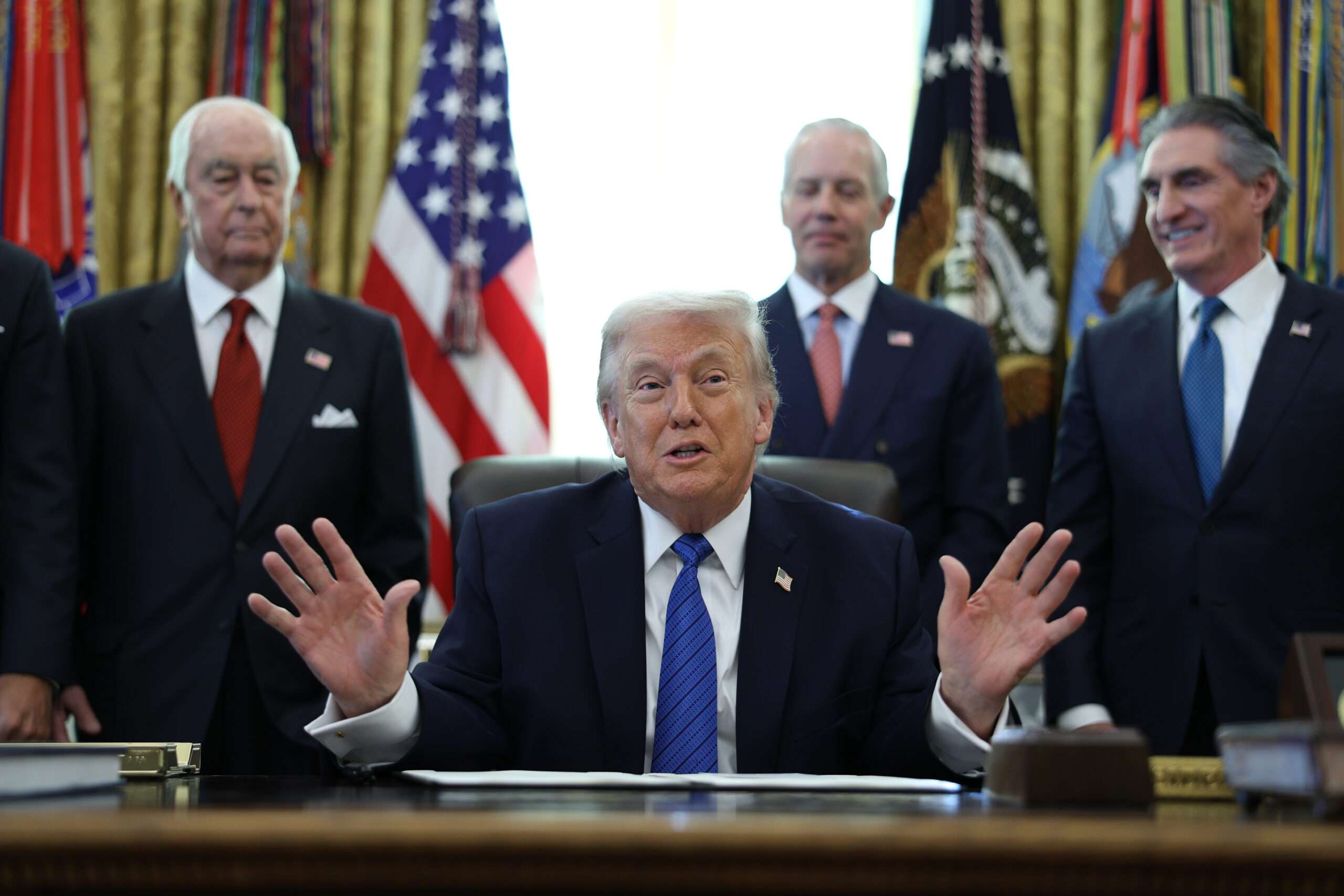
President Donald Trump recently said: “I don’t want to drive housing prices down. I want to drive housing prices up for people who own their homes.”
He’s made comments about wanting to raise housing prices before, even though those prices are exceptionally high right now. Many younger people have been priced out of the market—the median age of the first-time homebuyer is now 40 years old, a new high. Affordability is at an all-time low, with high prices and rising interest rates, and Trump wants to make houses even less affordable, though there is near-unanimous agreement that this is a profoundly bad idea. Why?
There are two possibilities. The first is that houses are assets, like stocks and bonds, and that Trump wants asset prices to go up under his presidency. With the homeownership rate at 66 percent, the theory goes, Trump is operating under the assumption that most people will get richer, even if that means the 34 percent of the population who don’t own homes are out of luck. In this scenario, you would have to assume that Trump is oblivious to the second- and third-order effects of virtually an entire generation not being able to own a home.
The second possibility is much more cynical. Older voters tend to be Trump voters, and older people are more likely to own houses. So maybe Trump is pandering to his base by increasing the wealth of his likely voters. He would be favoring one class of people over another: property owners versus non-property owners.
I’ll treat that as the less likely possibility. Always assume incompetence before malicious intent.
For almost a century, homeownership has been viewed as the ticket to building wealth in America. With the 30-year fixed-rate residential mortgage, the greatest financial innovation of the 20th century, middle- and even lower-class people could own homes and build equity over time. Trump’s solution to affordability was to propose a 50-year mortgage, which would allow people to build equity at a snail’s pace. The more obvious solution would be to build more homes, but Trump appears to be pressuring publicly traded homebuilders to build less. Creating artificial scarcity drives prices up.
The social impact of the housing affordability crisis is huge: fewer marriages, less household formation, lower birth rates, lower economic growth. The prices of stocks and bonds can go up indefinitely with few consequences. But housing is something people need, in addition to being an asset. It is an asset you also consume.
That isn’t the only way that it’s a funny sort of asset. It doesn’t pay dividends or coupon interest, and you have to sink about 1 percent of the home’s value into maintenance each year, on average. You have to pay for insurance and property taxes and maybe HOA dues. And yet despite those expenses, housing is the primary way people build wealth in the U.S. Most people are terrible investors, and will find a way to screw up index funds. But people will live in a house for 30 years, not pay much attention to the valuation, sell it once they own it free and clear, and have enough money to pay for virtually all expenses in retirement. The rate of return on housing averages only about 5 percent a year, compared to 10 percent for stocks, but housing is better at allowing people to build wealth.
Much has been made of how baby boomers rode the wave of a demographic boom and experienced vast amounts of wealth creation, leaving subsequent generations more likely to be stuck with debt and rent. If younger age cohorts are economically disenfranchised and disaffected, they’ll have a higher propensity to vote for illiberal economic policies in the future. In other countries where housing has become unaffordable, such as Canada and Australia, politics have moved sharply to the left—not solely because of housing costs, of course, but they are clearly a factor. If Donald Trump wanted to ensure more Republican votes in the future, he’d be trying to make more people property owners. But of course, Trump is the king of short-term thinking.
In the U.S., we build about 1.4 million new homes a year—not enough to keep up with population growth, and this is after a decade of underbuilding in the wake of the financial crisis. The solution to the housing crisis is more supply, not less. Trump’s views on the housing market are, for lack of a better word, insane.