Dramatic scenes have come to define the second Donald Trump administration’s immigration policy: federal troops patrolling the streets of American cities, agents snatching international students on video, hundreds of Venezuelan migrants disappeared to a brutal Salvadoran prison.
Behind those scenes, Trump is reshaping the country’s immigration bureaucracy. In just its first 100 days, the second Trump administration had “taken 181 immigration-specific executive actions,” found the nonpartisan Migration Policy Institute (MPI), “a sixfold increase over the fewer than 30 actions during the same period in Trump’s first term.” Visa processing and bureaucratic rulemaking don’t grab as much attention as harsh, highly visible enforcement actions, but they’re making it harder for immigrants to work, learn, and live in the United States.
In October, the Trump administration ended the automatic extension of employment authorization for certain immigrants. “For nearly a decade,” U.S. Citizenship and Immigration Services (USCIS) “automatically extended work permits for 180 days, which was later increased to 540 days, to provide relief from massive backlogs and delays in government processing,” noted American Immigration Lawyers Association President Jeff Joseph. The rule change means that “individuals who have already been deemed legally authorized to work will lose their jobs for no other reason than the government choosing not to process their paperwork in time,” argued over 70 members of Congress in a letter to USCIS.
The Trump administration has terminated temporary protected status (TPS) designations meant to help people from several ailing countries, including Venezuela, Nepal, Honduras, Nicaragua, Afghanistan, Cameroon, Syria, and South Sudan. That leaves nationals of those countries vulnerable to deportation, and it also effectively turns them into undocumented immigrants without work authorization. Some of those revocations are tied up in the courts. But as of October, over 680,000 individuals living in the U.S. saw their legal status jeopardized by the administration’s TPS revocations, according to the National Immigration Forum.
Officials have made it almost impossible for migrants to access asylum. Rather than screening for asylum (which provides an eventual pathway to citizenship), Department of Homeland Security agents at the U.S.-Mexico border “are only conducting screenings for Convention Against Torture protection, a subsidiary and nonpermanent status that allows citizens to be removed to third countries,” reported the MPI. The administration has paused TPS holders’ “applications for more durable statuses such as asylum and green cards,” and “has instructed immigration judges to close ‘legally deficient’ asylum cases without holding a hearing,” the MPI found.
Vulnerable people around the world might not make it to the United States at all thanks to the administration’s changes to refugee processing. Trump suspended refugee resettlement the day he took office “and since then only a trickle have entered the country, mostly white South Africans,” according to the Associated Press. In FY 2026, the U.S. will welcome up to 7,500 refugees, “primarily” Afrikaners from South Africa. That is the lowest cap in 45 years of the country’s refugee program. Trump has also eliminated an innovative and successful refugee resettlement pathway by ending the Welcome Corps program, which let Americans sponsor newcomers.
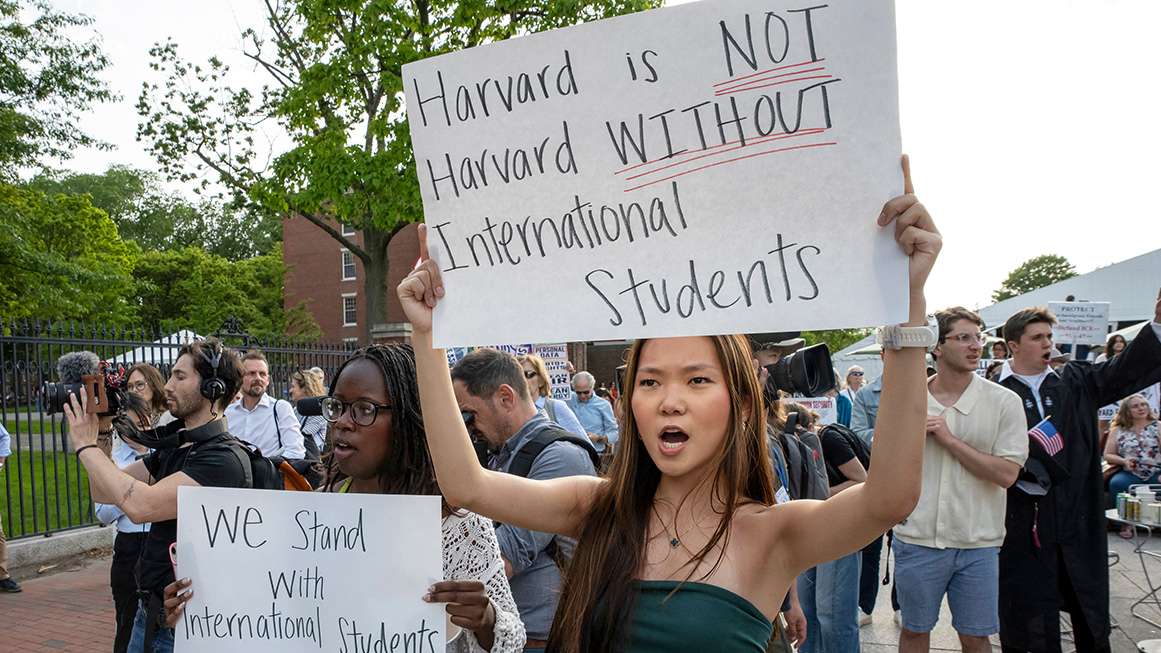
Despite Trump’s November comments defending Chinese students in the U.S., officials are trying to make it harder for foreigners to study at American universities. The State Department had revoked over 6,000 student visas by August, citing “overstays,” “breaking the law,” and “a small number for ‘support for terrorism,'” Reuters reported. That effort has been messy, reportedly targeting students for offenses as minor as speeding tickets. Last spring, Trump ordered consulates and embassies to stop arranging interviews with student visa applicants so agencies could expand “required social media screening and vetting.” An impending rule could “end or restrict” Optional Practical Training, one of the main ways international students stay to work in the United States after graduation, per Forbes.
Trump has been two-minded on high-skilled immigration, at times conceding that the H-1B visa program is useful because it “bring[s] in talent” that the American-born labor force doesn’t have, even as his administration cracks down on those foreign workers. In September, he announced that new H-1B visa applications would carry a $100,000 fee—”127 times higher than the US visa fees for workers without a high school degree,” observed Michael A. Clemens, a George Mason University economist. The policy is likely to send jobs overseas and keep talented workers from contributing to the American economy.
America’s immigration bureaucracy is becoming more unwelcoming—and more militarized. USCIS, the agency normally tasked with processing immigration paperwork, now has “its own police force” that is authorized “to arrest people for immigration violations or other criminal charges” and “carry guns,” The Wall Street Journal reported in September.
Trump may have run for his first presidential term on his promise to build a wall along the U.S.-Mexico border, but the actions he took to build a wall around the legal immigration system were far more detrimental to immigrants. “The administration massively expanded the amount of paperwork in immigration forms by double or, in some cases, triple,” wrote David J. Bier, the Cato Institute’s director of immigration studies, in 2018. Though the administration called it “extreme vetting,” it amounted to “nothing more than extreme bureaucracy,” said Bier. By 2019, “the denial rate for all applications—everything from travel and work authorizations to petitions for foreign workers—[had] risen every quarter except one under the Trump administration,” according to Cato.
Those barriers seem likely to regrow under the second Trump administration. USCIS currently has 11.3 million pending applications, “the largest immigration backlog in its history,” reported Newsweek in November. While officials say green card and visa processing are getting faster, “agency data from January through March shows that processing times for several key immigration forms have continued to rise, leaving applicants waiting months or even years longer than expected.” The “closure of consulates abroad” and “planned firing of State Department staff,” the MPI noted in April, were also “expected to lengthen visa wait times.”
Ripping peaceful immigrants from their families and communities is inconsistent with America’s tradition of welcome. So is crushing newcomers under an ever-growing immigration bureaucracy.
This article originally appeared in print under the headline “Trump’s Bureaucratic War on Immigrants.”