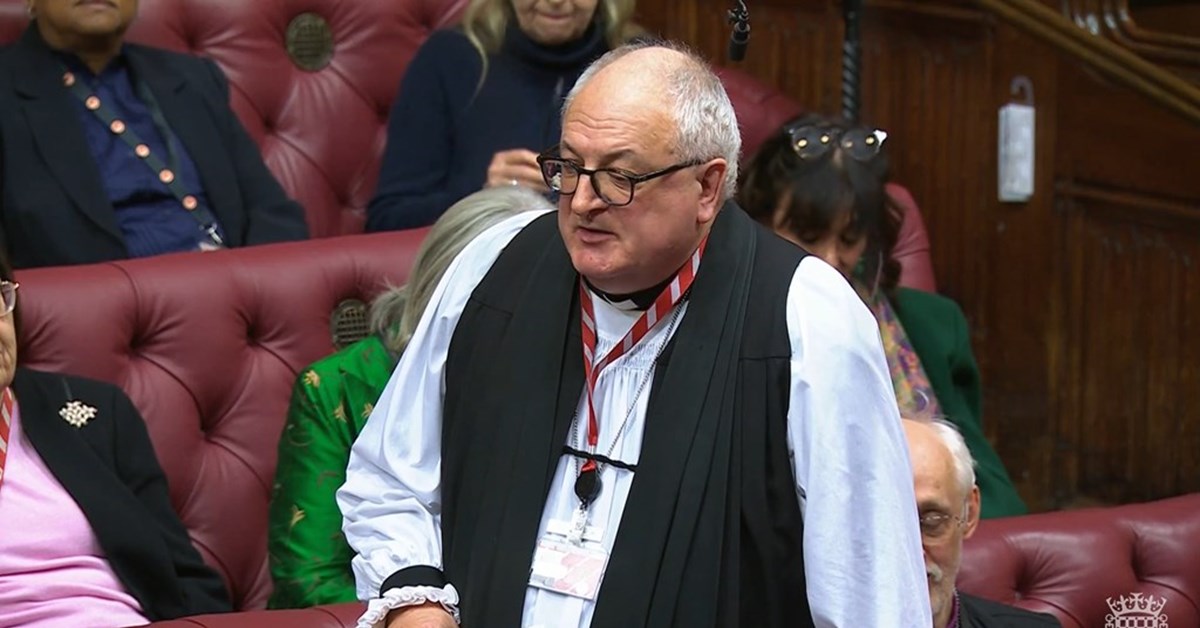
TO SAFEGUARD women who seek a late-term abortion from being treated as criminals, the onus should be on changing and investing in better police procedure, not criminal law, the Bishop of Lincoln, the Rt Revd Stephen Conway, has said.
He was speaking in a debate in the House of Lords on Monday on the Crime and Sentencing Bill, specifically on Clause 191, which states that women be removed from the criminal law related to abortion so that they cannot be prosecuted for seeking one — even after the 24-week limit set under the Abortion Act 1967. This was passed by the Commons in June (News, 20 June 2025).
Baroness Meyer (Conservative) moved an amendment to the clause which sought to “preserve legal protection for unborn babies who could survive outside the womb”. As it currently stood, abortions would be fully decriminalised by stating that a woman would commit no offence in relation to her own pregnancy, she said.
“In doing so, it would disapply not only Sections 58 and 59 of the Offences Against the Person Act 1861 but the Infant Life (Preservation) Act 1929.
“This is a serious change,” she said, particularly given that, in 1929, viability was understood to be around 28 weeks, whereas today, it was 24 weeks, and given that “medical advances mean that some babies can survive from around 22 weeks.”
She continued: “Clause 191 would remove protections where the death of a viable baby was caused by the mother, meaning that even a full-term baby could be aborted by the mother with no legal consequences. A baby’s protection would then depend not on whether it could survive independently but on who ended its life. This cannot be right.”
Bishop Conway agreed. The Chamber was on “precious ground”, he said, and while it was there “to support women who have been abused and coerced”, it was police procedure, he argued, that should be “changed and invested in, enabling us to move away from treating these women as criminals to treating them as witnesses and victims, so that the police activity is primarily engaged in going after coercers and bad actors.”
The Bishop was, he said, “one of those old men” — a single man with no children. But he was in regular contact with young families through baptism, and had only recently anointed a two-week-old baby in an acute cardiac unit.
He was, he said, convinced of the sanctity of life, and endorsed “the Church of England’s principle position in opposing the abortion of late-term foetuses who are viable, unless otherwise affected by the Abortion Act.
“I would like to see a different way of interpreting the law, which is differently enforced, which does not decriminalise or take away investigation, precisely for the protection of women and the preservation of unborn life.”
It was therefore more urgent, he said, to look at how police investigations into women seeking late-term abortions take place. He was among the more than 250 clergy to sign an open letter condemning as “a dangerous change” the move to decriminalise women who induce their own abortion (News, 27 June 2025).
Responding to the debate, which took place in two sessions, finishing late on Monday, Baroness Meyer thanked the Bishop and other speakers for their passion and eloquence. “It has been a very useful debate, which also highlighted how little scrutiny Clause 191 has received and how significant its potential effects could be — legally, socially and morally.”
Baroness Levitt, the Parliamentary Under-Secretary of State, Ministry of Justice, said of the amendment that, “where we do not consider there to be significant workability concerns, particular operational implications or unintended consequences that your Lordships may wish to consider: it is a simple policy decision to be made.”
Without her support, Baroness Meyer withdrew the amendment.