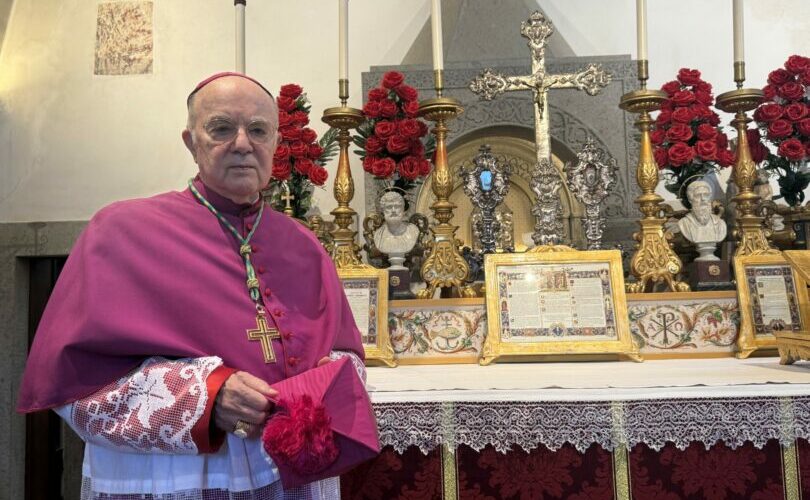
(LifeSiteNews) — Archbishop Carlo Maria Viganò expressed his “full support” for the upcoming Priestly Society of Saint Pius X (SSPX) episcopal consecrations, as Bishop Marian Eleganti has condemned the plans as a “schismatic act.”
“When the Hierarchy becomes complicit in the demolition of the Church, the only solution is to appeal to the state of necessity and guarantee that Apostolic Succession continues for the good of souls,” Viganò wrote in a X post. “Nothing has changed since 1988, and we can even say that the situation has dramatically worsened.”
The decision of the Priestly Fraternity of St. Pius X to consecrate new Bishops on July 1 demonstrates the impossibility of any dialogue with the Holy See.
The Vatican’s refusal to comply with the Society’s requests confirms a double standard:
On the one hand, synodality… pic.twitter.com/gqZN15Fi0r
— Arcivescovo Carlo Maria Viganò (@CarloMVigano) February 2, 2026
“I therefore express my full support for the decision taken by the Society of Saint Pius X,” he concluded.
Viganò had highlighted the “double standard” demonstrated by the Vatican’s “refusal to comply with” the requests of an orthodox Society as it promotes “synodality” that “opens to the way to schism,” something admitted by Bishop Eleganti himself.
According to Viganò, the Vatican has denied the SSPX permission to consecrate new bishops “precisely because it has not compromised with the conciliar revolution, the highest expression of which is synodality.”
By contrast, Bishop Eleganti, who has defended the Catholic faith from post-conciliar innovations such as synodality, denounced the SSPX’s plans for episcopal consecrations as “schismatic.”
The General House of the SSPX announced Monday that it plans to proceed with new episcopal consecrations without Vatican approval on July 1:
“After having long matured his reflection in prayer, and having received from the Holy See, in recent days, a letter which does not in any way respond to our requests, Father Pagliarani, in harmony with the unanimous advice of his Council, judges that the objective state of grave necessity in which souls find themselves requires such a decision,” read an SSPX communiqué dated February 2, 2026.
Bishop Eleganti maintained in a statement received by LifeSiteNews that the SSPX’s appeal to a state of emergency and prioritizing “the salvation of souls” “cannot in any way legitimize” episcopal consecrations without papal approval. The Catholic Church, he said, is “visibly realized in unity with the pope,” and this unity must be realized “canonically by refraining from obvious acts of canonical disobedience.”
“Popes adhere to tradition and do not contradict their predecessors on the Chair of St. Peter,” Bishop Eleganti said.
The SSPX and other orthodox clergy and Catholics have maintained, on the contrary, that popes have demonstrably contradicted their predecessors, particularly Pope Francis and Pope Leo XIV. For example, Francis’ document Traditionis Custodes, which directly touches on a key part of the SSPX’s mission, the preservation of the TLM, contradicts Summorum Pontificum as well as Quo Primum by declaring that bishops have the right to restrict the traditional Latin Mass in their dioceses.
Quo Primum, by contrast, specifically states that the traditional missal “is hereafter to be followed absolutely, without any scruple of conscience or fear of incurring any penalty, judgment, or censure, and may freely and lawfully be used … We likewise declare and ordain … that this present document cannot be revoked or modified but remains always valid and retains its full force.”
In another example of papal contradiction to predecessors, Pope Leo XIV recently declared that different Christian churches are “already” “one,” contrary to Catholic catechisms, as well as Pope Leo XIII’s teaching in the encyclical Satis Cognitum that Christian unity is grounded in shared faith, the sacraments, and governance.
Bishop Eleganti conceded that parts of “some conciliar documents” deserve criticism, and that the liturgical changes implemented after the Second Vatican Council “went beyond the will” of the Council Fathers. He nevertheless considers the new ordination of bishops by the SSPX to be “a definitively schismatic act that cannot be justified by the aforementioned shortcomings.”
The SSPX and its defenders stress that the salvation of souls is the supreme law of the Church (Canon 1752) and that the legitimacy of the exercise of the church’s laws and proceedings in general depends on their conformity to this supreme law. In other words, “If someone is trying to use a canon or a decree to block people from the Sacraments or to bury the perennial teachings of the Faith, they aren’t ‘following the law,’ they’re abusing it,” pointed out Abbey “Classic Catholic” following the SSPX’s announcement of forthcoming consecrations.
Mark Lambert, co-host of Catholic Unscripted, recently highlighted the fact that it is because of this very principle that canon law exempts from canonical penalties those who act out of grave necessity, as the SSPX has stated they are doing in the case of their planned episcopal consecrations.
“(Canon law) explicitly limits the application of penalties when moral culpability is absent or diminished. The law itself recognizes that a person who acts out of necessity or to avoid grave harm is not subject to canonical penalties, provided the act is not intrinsically evil or gravely damaging to souls,” Lambert wrote in a Tuesday blog post. “Even where responsibility is only partially diminished, the Code excludes automatic penalties. The principle that the salvation of souls is the supreme law of the Church is not a slogan but a governing norm.”
“The SSPX is therefore not arguing that the law does not exist. It is arguing that, in the present circumstances, the law does not bind in the way it ordinarily would. This is not an innovation. It belongs to the long Catholic tradition of epikeia, according to which the letter of the law cannot be applied when it would frustrate the very purpose for which the law exists,” Lambert noted.
Bishop Athanasius Schneider, who made official visits to SSPX seminaries on behalf of the Holy See in 2015, believes that there has been no substantial legal basis to deny the SSPX official canonical recognition in the first place.
“To my knowledge, there are no weighty reasons in order to deny the clergy and faithful of the SSPX the official canonical recognition,” he said, noting that “the SSPX believes, worships and conducts a moral life as it was demanded and recognized by the Supreme Magisterium and was observed universally in the Church during a centuries long period.”
The bishop also noted that “the SSPX recognizes the legitimacy of the Pope and the diocesan bishops and prays for them publicly and recognizes also the validity of the sacraments according to the editio typica of the new liturgical books.”
Indeed, the SSPX teaches and practices the Catholic faith as it has been for many centuries. Its most controversial position is its rejection of certain Vatican II documents that appear to contradict perennial Church magisterial teaching, such as Nostra Aetate’s suggestion that men can reach God through pagan religions such as Hinduism and Buddhism, in stark contradiction to the longstanding teaching of the Church and the Syllabus of Errors’ condemnation of the idea that “Man may, in the observance of any religion whatever, find the way of eternal salvation, and arrive at eternal salvation.”
The Vatican II document falsely claims that “in Hinduism, men contemplate the divine mystery,” and that Buddhism “teaches a way by which men … may be able either to acquire the state of perfect liberation, or attain, by their own efforts or through higher help, supreme illumination.”
Catholic commentators, including LifeSiteNews Editor-in-Chief John-Henry Westen, Anthony Stine of Return to Tradition, and Vatican correspondent Diane Montagna, have also pointed out that any potential excommunication of SSPX bishops or priests after new consecrations would be bewildering considering that the Vatican has not imposed canonical sanctions on Chinese clergy after the Chinese Communist Party (CCP) has “repeatedly proceeded with episcopal ordinations without prior papal approval, in violation of the Vatican-China accord.”
It would be difficult to see how the Holy See would impose any canonical sanctions on the SSPX given the fact that they have not done so in a comparable manner in China, where the Communist government has repeatedly proceeded with episcopal ordinations without prior papal… https://t.co/DotZU87j25
— Diane Montagna (@dianemontagna) February 2, 2026
In fact, it was the CCP’s appointment of bishops for its schismatic church that motivated Pius XII’s increase of the penalties on consecrations done without papal approval, as Westen noted. That’s where the automatic excommunication came from.
But under Francis’ pontificate, the Vatican recognized seven of the CCP’s bishops. One of those bishops, Joseph Shen Bin, said that this communist church’s theology uses “core socialist values as guidance to provide a creative interpretation of theological classics.”
Archbishop Carlo Maria Viganò’s full statement:
The decision of the Priestly Fraternity of St. Pius X to consecrate new Bishops on July 1 demonstrates the impossibility of any dialogue with the Holy See. The Vatican’s refusal to comply with the Society’s requests confirms a double standard: On the one hand, synodality opens the way to schism without this constituting a problem either for those who impose it from above or for those who suffer it from below.
On the other hand, a Priestly Fraternity of assured orthodoxy is denied permission to consecrate new Bishops precisely because it has not compromised with the conciliar revolution, the highest expression of which is synodality.
When the Hierarchy becomes complicit in the demolition of the Church, the only solution is to appeal to the state of necessity and guarantee that Apostolic Succession continues for the good of souls. Nothing has changed since 1988, and we can even say that the situation has dramatically worsened. I therefore express my full support for the decision taken by the Society of Saint Pius X.
Bishop Marian Eleganti’s full statement:
The universal primacy of the Pope’s jurisdiction (ex sese) over the entire Church has been an infallible, dogmatized truth since the First Vatican Council. Therefore, in this article, we cannot speak of a legalistic misunderstanding of ecclesiastical obedience on our part when we classify the announced consecration of bishops by the Priestly Society of Saint Pius X (FSSPX) without the express consent of the Pope as a schismatic act and, for the second time, note it with pain and condemn it in the strongest terms. By “we” I mean all believers who share my assessment presented here. Based on the media release of the Society of St. Pius X, I assume that the bishops who will be consecrated on July 1, 2026, will not be appointed by Pope Leo XIV.
The main argument of the Society of St. Pius X, of a historically unique ecclesiastical emergency and its reference to the priority of the salvation of souls – especially those who have joined the Priestly Society of St. Pius X – cannot in any way legitimize such a serious step. Since my youth, I have always spoken out against a “church” alongside the Church or a “church” within the Church – the former always understood as the faithful and true, the latter (universal) as the unfaithful, having strayed from the right path.
There is only one Church: the one, holy, apostolic, and catholic universal Church that Jesus Christ founded on Peter, the rock. It is visibly realized in unity with the Pope: this unity is not to be understood in an ideal sense (as a general recognition of the papacy or of the currently reigning Pope in prayer), but must be realized in fact and canonically by refraining from obvious acts of canonical disobedience. I do not include in the latter category criticism of the Pope that is always legitimate, which clearly distinguishes between fallible and infallible statements and acts of the Pope and generally concerns prudential judgments or spontaneous statements in interviews, or, in the worst case, non-infallible statements of the ordinary magisterium.
Popes adhere to tradition and do not contradict their predecessors on the Chair of St. Peter. The so-called “magisterium of Francis” (2013-2025) is a phenomenon sui generis in terms of rhetoric.
However, what the Priestly Society of St. Pius X announced on February 2, 2026, namely the ordination of additional bishops on July 1, 2026, is, in my opinion, a clearly schismatic act, consisting in establishing or expanding a hierarchy alongside that which is in full, visible, and canonical unity with the current Pope and is formed by thousands of bishops and priests throughout the world. This would mean that we would have – as I said – a “church” alongside the Church or within the Church with valid sacraments, which claims to be the true one. In this, it is mistaken.
What is meant here is the self-image of the Priestly Society of St. Pius X. What counts here is not communion in prayer and in the remaining intersections of common faith and common sacraments, but canonical unity with the Pope, which does not exist if bishops are ordained without his will. The saints did not go into schism in similar trials, while the schismatics always cited seemingly good and allegedly serious reasons to justify their action.
The 4th century is often cited as an analogous emergency situation in church history. Pope Julius I (337-352) supported Athanasius, took him in at Rome, rehabilitated him, and condemned his deposition. The condemnation of Athanasius by Pope Liberius (352-366) came about only under torture and was not considered legitimate by Athanasius because it was made under duress. Therefore, he did not comply with it. Later, Liberius revised his position. Athanasius defended him in his writings. Pope Damasus I (366-384) supported Athanasius. Basil (together with the other Cappadocians) made intensive efforts to gain support from the West against Arianism and imperial pressure (Valens). He wrote several times to Pope Damasus I, asking for clear support and recognition of the orthodox Eastern bishops (especially Meletius of Antioch).
Basil was somewhat frustrated because Rome did not always understand the theological subtleties of the East (hypostasis discussion), reacted too slowly and hesitantly, and clearly supported Paulinus in the Antiochian schism, while Basil placed his trust in Meletius. Tensions arose and Basil refused to sign a formula demanded by Rome. As far as I know, his resistance was more ecclesiastical-political and tactical than dogmatic in nature. However, Athanasius and Basil never took a heretical or schismatic position toward the pope, even though Rome’s practical support was disappointing for them at times. The idea that they were “disobedient” stems from later confessional polemics. This brings me back to the present day:
Even though I believe that: 1) passages in some conciliar documents (of varying importance) are certainly worthy of criticism; 2) the liturgical reform went beyond the will and ideas of the Council Fathers and introduced or abolished things that were not even within the horizon of their thinking and imagination and probably did not correspond to their intentions; I consider the ordination of further bishops by the Society of St. Pius X without express papal legitimation (appointment) to be a definitively schismatic act that cannot be justified by the aforementioned shortcomings.
The following remains advisable:
1. An honest examination of the liturgical reform and some of the statements of the Second Vatican Council.
2. A just order of rites in the Church that neither prohibits nor marginalizes the venerable Latin rite, but rather sees it as an inspiration to compensate for one-sidedness and deficiencies in the Novus Ordo.
As I have already emphasized, this requires expertise. Criticism must be taken seriously. The minutes of the council sessions are very helpful in providing an unbiased view and should be communicated to the next consistory that will deal with the liturgical question.
The faithful who – to put it somewhat simplistically – criticize the horizontalism and anthropocentrism in the Novus Ordo must be taken seriously. However, the solution is not the Society of St. Pius X or a return to the 1962 Missal, but rather a “reform of the reform” (Benedict XVI) of some kind that heals the obvious rifts that have occurred. I am concerned with the issue itself, not with the provocative term (reform of the reform).