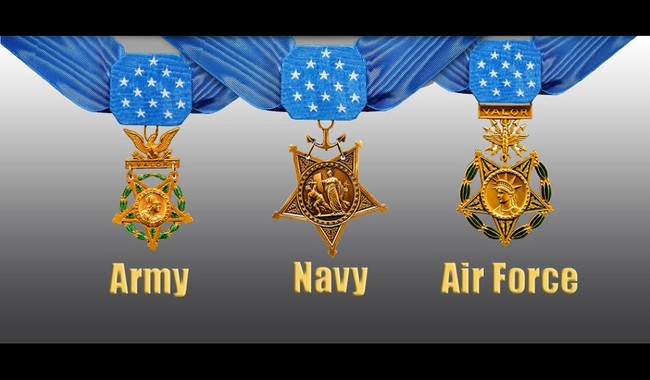
President Trump awarded two very belated Medals of Honor to two highly deserving Americans on Wednesday.
The first went to Army Staff Sergeant Michael Ollis, unfortuantely this was a posthumous award. SSG Ollis was assigned to 2d Battalion, 22d Infantry Regiment, 1st Brigade Combat Team, 10th Mountain Division (Light) stationed at Fort Drum, New York. From all accounts, he seems to have been a stud. He completed Airborne, Air Assault, and Ranger Schools. Getting a Ranger School slot as an enlisted man not on orders for a Ranger battalion shows he really stood out as a stellar soldier. He had served one combat tour in Iraq and was on his second combat tour in Afghanistan when he was killed in action. In fact, when he was killed, on August 28, 2013, he had less than two months left in Afghanistan before rotating home.
On August 28, 2013, a complex enemy attack involving vehicle-borne improvised explosive devices, suicide vests, indirect fire, and small arms fire struck Forward Operating Base Ghazni, Afghanistan. What made Ghazni unique was that it was defended by Polish Special Forces, who advised an Afghan unit also on the base. According to X, Ollis and his men were simply passing through the area enroute to Bagram and the “Freedom Bird” when things went pear-shaped.
Tom, thanks for what you did to get him this MoH. I was on Ghazni for the attack (I actually put together the first summary that was sent to RC-E while the attack was still underway), and was friends with Karol Cierpica. IMO there was no question SSG Ollis should have gotten the…
— JTR (@NewOriginals456) February 4, 2026
When the attack kicked off, Ollis got his men out of their billets and into bunkers. It was then he saw that the Taliban had breached the perimeter, and like any good soldier, he “marched to the sound of the guns.” Along the way, Ollis encountered Polish Second Lieutenant Karol Cierpica.
Ollis and Cierpica advanced on the enemy without body armor and armed only with their rifles. They linked up with the defenders nearest the breach and began attacking to drive the Taliban from the airfield and adjacent buildings, all the while under continuous small arms, indirect, and rocket-propelled grenade fire. The counterattack achieved its purpose.
During the counterattack, they rounded a corner in a field of storage containers and confronted a Taliban fighter. He opened fire, striking Cierpica in both legs. Ollis returned fire and seemingly fatally wounded the enemy fighter. The man was wearing a suicide vest, and Ollis positioned himself to shield Cierpica. As Ollis approached the dying man, he set off his suicide vest, killing Ollis.
Cierpica survived the blast and, when he returned home, named his newborn son Michael. Michael sleeps with a teddy bear made from a set of OIlis’s uniform bearing his name tape. (You really have to see the picture.)
Staff Sergeant Ollis was 24 when he died. He was awarded a Silver Star for his conduct during the counterattack. It was subsequently upgraded to a Distinguished Service Cross, the nation’s second-highest award for combat gallantry.
Oddly enough, New York Democrat Senator Chuck Schumer was one of the behind-the-scenes forces who kept the campaign to award Ollis the Medal of Honor alive when the official deadline expired in 2016.
The military training program at the Senior Academic High School at the College of Health Sciences has been renamed in his honor.
And below, a touching video from the naming ceremony.
The naming ceremony in Bydgoszcz was attended by the parents of the late Michael Ollis, the Polish officer whose life he saved, Karol Cierpica, as well as Polish and U.S. officers and soldiers. It began with a Mass with full… pic.twitter.com/wsOOiDucFQ
— Sebastian Meitz (@MeitzPL) February 4, 2026
Here is his father getting the official call from President Trump.
The moment President Trump informed the Ollis family that Staff Sgt. Michael Ollis would posthumously receive the Medal of Honor: https://t.co/bWnQL6XSEB pic.twitter.com/XyE6pqxg1h
— Kristina Wong 🇺🇸 (@Kristinawong) February 4, 2026
The second story is much more uplifting.
Elmer Royce Williams was born April 4, 1925, in Wilmot, South Dakota. He enlisted in the U.S. Navy shortly after Pearl Harbor as an aviation cadet and completed flight training in August 1945. Williams chose a career as a career officer and eventually flew the Navy’s first jet carrier fighter, the Grumman F9F Panther.
The year 1952 found Lieutenant Williams assigned to the Pacemakers of VF-781, flying off the USS Oriskany.
On November 18, 1952, Williams was part of an airstrike on the Hoeryong industrial complex near the Korea-Russia border. Later, in Williams’s second mission of the day, he was assigned to the Combat Air Patrol protecting the 20+ ships of Carrier Task Force 77, which included the battleship USS Missouri as well as the Oriskany, led by Admiral and Navy Cross recipient, Admiral “Jocko” Clark. It was then that seven Soviet MiG-15s, launched from a Soviet base near Vladivostok, appeared on the Oriskany’s radar and headed directly toward CTF 77. The Russians hadn’t attacked U.S. forces yet, but, then again, the Chinese hadn’t attacked right up to the point when they did. Williams and three other U.S. pilots flying F9F–5 Panthers were dispatched from the USS Oriskany to pursue the seven MiG–15s in blizzard conditions to engage over the Sea of Japan.
The flight leader’s instruments reported a fuel-pump warning; he aborted the mission and was escorted back to the USS Oriskany by his wingman. This left Williams and his wingman, Dave Rowlands, to do the heavy lifting.
Due to the weather, Williams and the Oriskany’s radar lost the seven MiGs (the middle-schooler in me can’t resist noting that the NATO codename for the MiG-15 is “Fagot,” spelled with one “g”, so I suppose that gets us by the DEI police). Their last sighting gave the impression they were headed home, so Williams was ordered to return to his assigned station guarding CTF 77. Not so fast, Scooter.
“While I was doing that,” Williams said, “the four that had turned to the right came at us in a finger-four formation and started firing. All of them were shooting.” With a head-on closure of over 1,000 knots, the chances of a hit were minimal, but a single hit from a MiG’s heavy cannon could be catastrophic.
“I kicked a lot of rudder and pulled hard to get on the tail of their number four plane as they shot by,” Williams recalled. “ I put the pipper, the aiming point, which was controlled by the gyro system, and maneuvered my plane to make sure the shells intercepted the target. I used fire discipline, since I had only about 720 rounds.”
As the two groups were merging, Williams scored hits on one MiG, and it fell out of formation. His wingman followed it out of formation, leaving Williams to pursue the remaining six MiG-15s on his own. In his efforts, Williams expended all of his ammunition and shot down four, very likely five, of the seven Soviet MiG–15s, setting the American aviator record for MiGs shot in a single sortie and the only naval dogfight over water in the Korean War. Only one other fighter pilot during the Korean War managed four kills in one day. On November 30, 1951, USAF Major George Davis claimed three Tupolev Tu-2 bombers and a MiG-15. Davis scored seven kills in World War II and 14 in Korea before he, himself, was killed in action on February 10, 1952
After 35 minutes of intense dogfighting, Williams—shot up, out of ammunition, his aircraft perforated with 263 bullet strikes, and without electrical or hydraulic systems—headed for home. A MiG was at his six o’clock, and it was then that his wingman made a surprise appearance. “I had a MiG on my tail. Then Rolands came up and followed the MiG until we made it back under the cloud deck. Apparently, his guns jammed so he could not fire but the MiG pilot chose not to attack,” Williams said. “During the fight Rowlands did not know what had happened to me. He thought he was going to have to tell my wife I was dead.”
Just to liven things up, some of the escort vessels for the Oriskany and Missouri mistook his Panther for a MiG and took him under fire.
Williams hit the Oriskany’s deck at 170 knots, a tad bit faster than the ideal landing speed of just over 100 knots. He snagged the number three wire and made a perfect landing. His plane was scrapped.
This is where the story goes cloak-and-dagger.
A few days later he was called by Vice Admiral Robert Briscoe, Commander, Seventh Fleet. “We met in his office and he had his secretary and intelligence officer with him,” Williams recalled. “The intel officer did not participate. The entire conversation was between Admiral Briscoe and myself.”
Williams was told the MiGs were not flown by North Koreans, or Chinese, but by Soviet Naval Aviation pilots flying out of Vladivostok. He was also told never to speak of the incident to anyone—his squadron mates or even his wife.
The then-new National Security Agency (NSA), using a variety of sensitive eavesdropping technology, had been listening in on Soviet air traffic out of Vladivostok on that November morning. The NSA already knew the Soviet Navy had sent the seven MiG-15s south to observe the carrier task force. But, intent on keeping the Soviet Union from learning how good their covert listening systems were, they had to erase all traces of the dogfight.
President-elect Dwight Eisenhower, visiting Korea, asked Williams to meet with him. “Eisenhower greeted me warmly and introduced me to Generals Bradley, Clark, and Ridgeway. They explained how important it was that no one ever know about the fight with the Russians.”
With the growing tension of the Cold War, U.S. officials covered up the entire incident—the first, and so far as is known, only time that U.S. and Soviet aircraft had met in combat. They feared U.S. public reaction to the aggressive attack by Soviet fighters on American pilots could ignite a global crisis.
For nearly 50 years only Williams and a few people in the Pentagon, the NSA, the White House and Soviet Union knew what had happened that day. But Williams had destroyed the MiG-15’s air of invincibility. He was awarded the Silver Star for his actions and went on serve in Vietnam.
Williams received a Silver Star for his gallantry. Williams served in the Navy for over 30 years, flew over 220 missions in Korea and Vietnam, and retired as a captain in 1984.
It wasn’t until Soviet archives became public, sorta, after the fall of the USSR, that the story of Lt. Williams’s lonely fight against seven Soviet MiGs could be made public.
In 2022, his Silver Star was upgraded to a Navy Cross, and his award of the Medal of Honor was made possible by a bill introduced by Republican Representative Darrell Issa (CA-48)
I can’t pretend to explain how a selfless hero like Michael Ollis wasn’t recommended for the Medal of Honor. The impulse to let the Russians save face might have been understandable during the Korean War, but by the time of the Reagan administration, it no longer made much sense deprive Williams of recognition. The belated actions have served some modicum of justice, but if we have time to look back over 100 years for fancied awards that were held back by racial, ethnic, or religious animus, we should have time to award fully deserved medals in a timely fashion.
RedState is your leading source for news and views on administration, politics, culture, and conservatism. If you appreciate our reporting and commentary, please consider becoming a member and supporting our efforts. Use promo code FIGHT to get 60% off your membership.