IT BEGAN when I stumbled on the second (1949) edition of Christian Healing: A consideration of the place of spiritual healing in the Church of today in the light of the doctrine and practice of the Ante-Nicene Church. In the foreword, the Revd T. W. Crafer, DD, referred to the author as “Miss Frost”. The title page, however, identified her as “Evelyn Frost, Ph.D.”.
Could that be right? Was there a Miss Frost living at Bury St Edmunds in the 1940s who not only wrote a formidably learned theological treatise, but who had also earned a Ph.D.? In the mid-20th century, it was extremely rare for even a faculty member at a British university to have a Ph.D.
Internet searches failed to turn up a biographical sketch. Frost, however, had written one more book, Christ and Wholeness, which was published posthumously in 1985. It made no mention of a Ph.D. or any other degrees, but its brief account of the author mentioned her “distinguished medical career”. That made more sense. Presumably the 1949 book had things garbled: she was Dr Frost, but her degree was an MD.
It turned out, however, that the 1985 account was the one that was garbled. (Its errors have also gone into the Library of Congress catalogue.) Frost entered the doctoral programme at King’s College, London (KCL), in 1936, and was awarded a Ph.D. in theology from the University of London in 1940. Scotland had got there first. In 1934, Elizabeth Hewart became the first woman to earn a Ph.D. in theology from a British university, when her degree was awarded by Edinburgh. Frost, however, seems to be the first woman to have earned a Ph.D. in theology from an English university.
It is recorded in the King’s College London Calendar for 1940-41. That source names all the students in the Theology Department who had achieved anything during that academic year — even just passing the intermediate examination on their way to a Bachelor’s degree — and yet Dr Frost is the only woman in an otherwise all-male list.
W. R. MATTHEWS, who had been Dean of King’s College, London, and went on to be Dean of St Paul’s, recalled another student (who worked with him on a translation for publication of a work by the German theologian Friedrich Schleiermacher): “Miss Sandbach Marshall was one of those women, more numerous then than they are today, who did not need to earn their living and studied theology primarily because the subject interested them. At King’s in my time, there were several.”
Frost was one of those several. In fact, the King’s College London Calendar for 1937-38 listed only two women pursuing postgraduate studies in theology: Sandbach Marshall and Frost. In 1933 (thus some years before she entered the Ph.D. programme), Matthews wrote of Frost: “She is one of the few women who have a first-rate equipment of all round theological scholarship, and has besides a good background of general culture. She is keenly alive to the problems of religious thought in their relation to modern conditions.”
Best practice at the University of London at that time was not only to write a thesis, but to demonstrate that it was worthy of the awarding of a Ph.D. by having it published. Thus, the first edition of Christian Healing appeared in 1940. It is impressively erudite. At the front is a “Chronological Table of Authors or Works”, which serves as a kind of dramatis personae for the Early Church material.
There are 36 entries, ranging from Clement of Rome to Lactantius, some of whom are far from being the usual suspects. For example, between the better-known Polycarp and Justin Martyr come Papias, Quadratus, Aristides, Hermas, and the Epistle to Diognetus; and the main text includes additional patristic figures and works beyond the 36.
Furthermore, church history and historical theology are only one portion of Frost’s achievement. Much of the work is systematic theology, which seeks to formulate doctrinal positions in the light of modern thought on a range of themes, including sin, guilt, the Fall, miracles, the sacraments, the Church, and the resurrection of the flesh. Finally, Christian Healing is also a work of liturgics and pastoral theology, committed to discerning what the Church’s ministry to the sick ought to be.
FROST kept an eye out for women in history. She dismissed the old, rationalist rejection of the resurrection of Christ as prejudiced by a misogynistic assumption that women were “too emotional” to be reliable witnesses. In Christ and Wholeness, she observed that, in the history of the Church, “women sometimes anointed the sick,” giving as an example the ministry of the fifth-century saint Genevieve.
Frost had a passion for formal education. The 1940 edition identifies her as “Evelyn Frost, BA, BD, AKC, STh”. Either the AKC (Associate of King’s College in Theology) or the BD would have been considered sufficient theological education for a man seeking Anglican ordination. The STh (Student in Theology) was created by the Church of England to help women to obtain a theological qualification. The prerequisites were at least three years of preparatory study (in other words, a Bachelor’s degree or equivalent), and Greek: “The standard of the examination is approximately that of the Honours School of Theology at a University.”
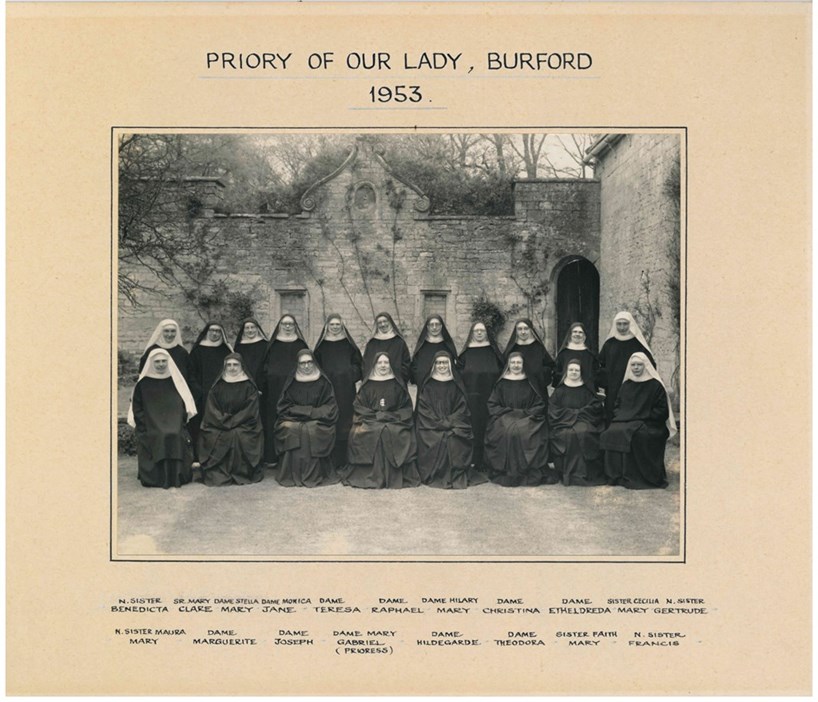 Mucknell AbbeyCommunity at the Priory of Our Lady, Burford, 1953
The STh, in turn, was a prerequisite for applying to the Archbishop of Canterbury for a licence to teach theology, which Frost eventually did in 1944. Despite her BD, AKC, STh, and Ph.D. in theology, her application for this licence was investigated with unbending, suspicious thoroughness.
The process involved obtaining a range of additional references, including one from the Archdeacon of Middlesex, who explained that he was also speaking on behalf of the Bishop of Kingston. Strangely, these referees often did not mention the Ph.D. at all, and, even if they did, persisted in referring to her as Miss Frost. This form of address can be contrasted with the common custom at that time in which bishops and other men — both clerical and lay — were often referred to by the title “Dr” on the strength of an honorary degree.
Indeed, it seems the fact that Frost really was a Doctor in Theology was often hard for people to assimilate. There was “an invidious London custom of recording the full first name for females but initials only for men”. Evelyn, of course, is a gender-neutral name, and Frost’s Ph.D. thesis was recorded in the University of London catalogue as by “Frost, E.”, revealing that the cataloguer assumed that she was a man.
Frost’s KCL student card was updated by hand as she changed addresses and accumulated degrees. The relevant addition says: “?Ph.D. Theology — July 1940”, the question mark apparently indicating that even the institution where she did her doctoral studies could not quite believe it.
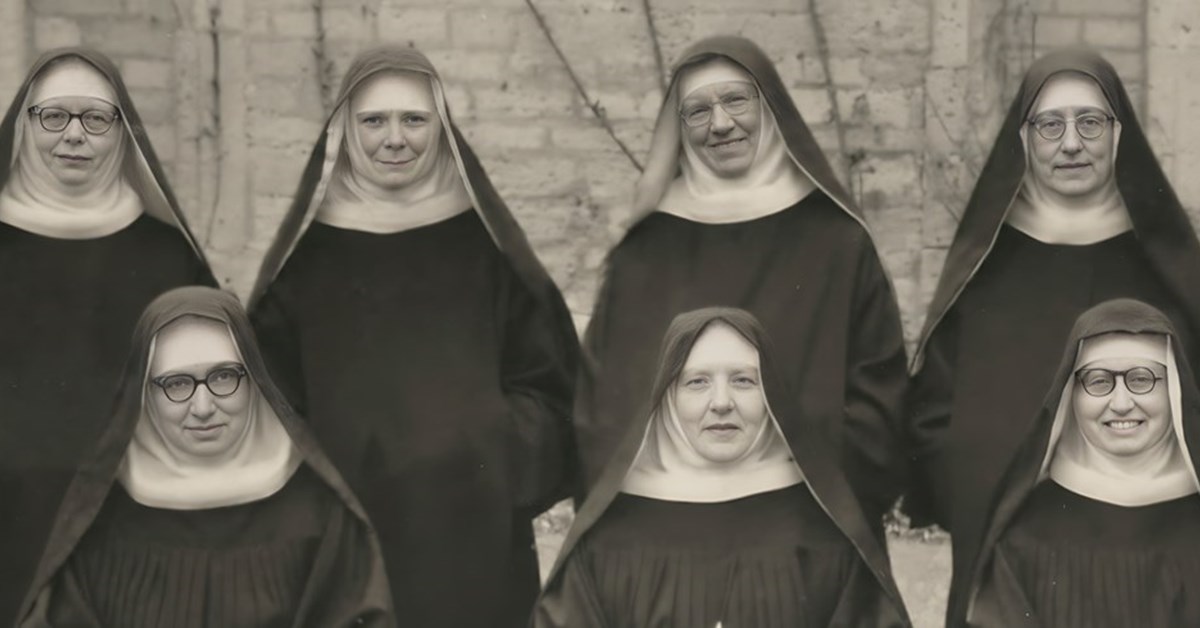
ONE reason for Frost’s obscurity is that — rather than pursue a career as an academic, scholar, teacher, or author — in midlife she discerned a call to become an Anglican nun in a contemplative community, Burford Priory. Frost had been active in the healing ministry, through the Guild of St Raphael. Benedictine nuns at that time took the title Dame as an equivalent to the male Dom. Thus, Frost’s new identity became that of Dame Raphael.
Although serving only her enclosed community, Dame Raphael’s scholarly pursuits as a nun included “making an English translation of a large part of the Psalter, after comparison with Latin, Greek & Hebrew versions”.
In a 1948 lecture, Frost commended St Paul himself by observing that he should be viewed as the equivalent of “a university graduate with a research degree”. Through her degrees and writings, Evelyn Frost, Ph.D./Raphael Frost OSB (1903-1981) provided overwhelming proof that she had earned the right to take her place alongside the male theologians of her day.
Timothy Larsen teaches at Wheaton College. His books include The Fires of Moloch: Anglican clergymen in the furnace of World War One. He would welcome further information about Evelyn Frost, or other early examples of women with theology doctorates. timothy.larsen@wheaton.edu.