
(Campaign Life Coalition) — Online anger about a controversial vote at the Conservative convention is still going strong three weeks after the anti-conversion therapy ban policy was defeated.
The common-sense policy aimed to cancel Bill C-4 which, in 2021, made it illegal for parents to obtain body-affirming talk therapy to help their gender-confused child feel comfortable in the body God gave them.
Under the Liberal law, parents can face five years in jail for arranging counseling to help their kids accept their bodily reality.
The only parental response permitted under Bill C-4, is total affirmation of the delusion that your child was “born in the wrong body.”
Online outrage among conservatives was rejuvenated and intensified after the tragic Tumbler Ridge Secondary School mass shooting in BC.
What began as shock and deep sadness over the senseless loss of innocent lives quickly turned into urgent calls for accountability.
Jesse Strang, an 18-year-old male who identified and dressed as a woman, shot up a school and killed nine people, including children, wounding 25 others, before taking his own life.
This was the latest in a disturbing string of mass shootings by “transgender” individuals in recent years, following the terror attack at Covenant Christian School in Nashville that killed six, the horrifying event at Annunciation Catholic Church in Minneapolis where 14 children were shot and two killed, plus many other incidents.
The Tumbler Ridge killing has heightened concerns that radical gender ideology and the transitioning of children with puberty blockers and powerful cross-sex hormones, usually combined with SSRI drugs, is neglecting underlying mental health issues and pushing susceptible young people towards violence.
READ: Tumbler Ridge tragedy exposes demonization of Canadians who reject ‘transgender’ movement
Those who followed the shocking defeat of the Conservative policy to repeal the Bill C-4 “conversion therapy ban” immediately recognized something and asked the question…
Could this tragedy have been averted if Canadian law didn’t make it illegal for parents like Strang’s to procure body-affirming talk therapy for their gender-confused teen?
You see, before 2021, a therapist who was asked to treat a child like Jesse Strang would have been legally permitted to explore the underlying causes of anxiety about one’s body and to help resolve them, whether they be related to mental health problems or the experience of childhood trauma.
However, the Justin Trudeau Liberals made that counseling option illegal throughout most of the period that the young teen was “transitioning,” which began when he was around age 12.
This brings me back to the Conservative policy resolution to repeal Bill C-4, which was so shockingly defeated at the party convention on January 31st.
‘Clickergate’: Suspicious voting machine failures, numbers that don’t jive
A lot of observers and Conservative delegates were stunned when the “right to body-affirming talk therapy for gender-confused kids” policy was defeated at the Calgary convention.
It was truly surprising given the strong opposition to gender ideology and child mutilation among the small-c conservative movement, both in Alberta and across Canada.
Many elements surrounding the published vote result are suspicious, or just don’t make any sense…
For instance, a couple of hours earlier, on the same stage, Alberta Premier Danielle Smith received a standing ovation after criticizing gender ideology and stating:
“The majority of Canadians agree biological men do not belong in women’s sports. Period.”
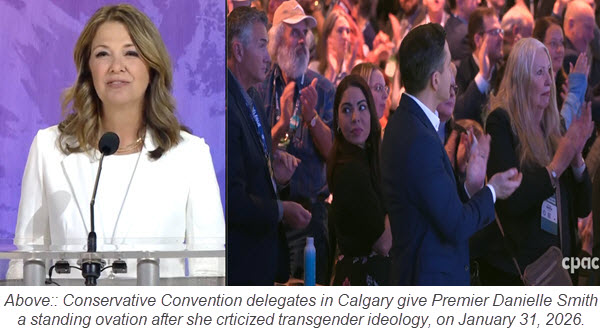
How did the exact same delegates go from giving a standing ovation for criticism of gender ideology, to just two hours later, voting against a policy that sought to protect kids from puberty blockers and surgical mutilation?
In fact, Premier Smith herself passed legislation in Alberta – that is wildly popular – which bans puberty blockers, cross-sex hormones and sex-change surgeries for children. The defeat of a similar policy at this convention seems illogical, doesn’t it?
Another reason the math doesn’t add up for me is that I personally spoke to hundreds of delegates before the vote and asked them to support the policy. Literally – and I’m not exaggerating – 90% of those I spoke with told me: “Absolutely,” “I agree,” “That’s what I care about,” or some variant thereof.
You see, as delegates were approaching to enter the voting room, I handed out a powerful postcard with talking points to persuade them to vote YES.
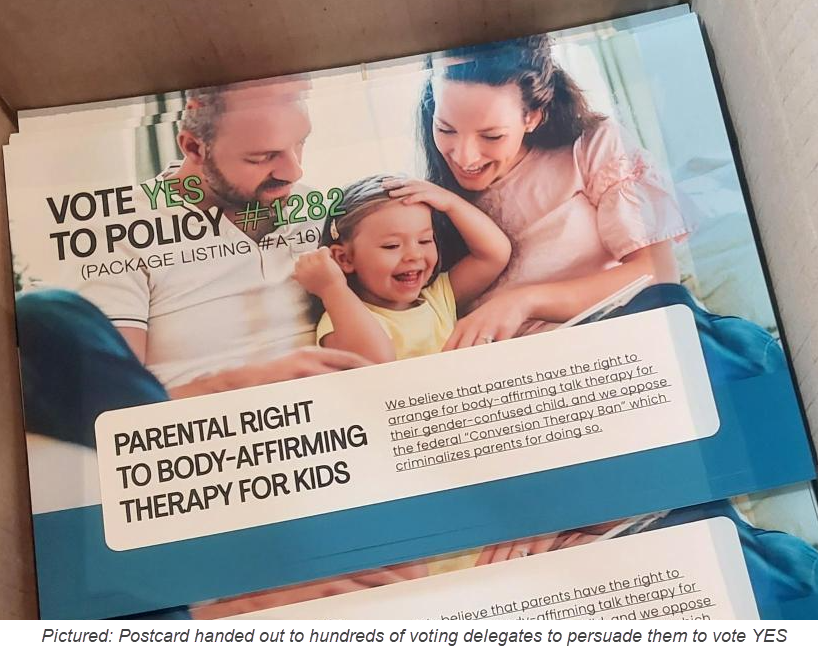
Someone might argue: “Well, Jack, you didn’t speak to all 1,626 delegates who cast a vote, did you, so how can you be confident the policy was as popular as you’re saying?”
That’s true. I didn’t speak to every delegate. However, I spoke to roughly 300 of them.
And I got a commitment from 90% of those people that they’d vote yes. That’s a significant sample size.
So, how did only 52% end up voting YES to pass the first threshold, and it fell short by two delegate votes in Manitoba to pass the second necessary threshold (winning a majority of provinces)?
So, now we have to talk about the odd voting machine “malfunctions.”
For the nine policies voted on before this resolution, the hand-held, computerized, electronic clicker machines ran pretty smoothly. Likewise, the clickers worked smoothly for the 21 policy votes that were taken after the one on body-affirming therapy.
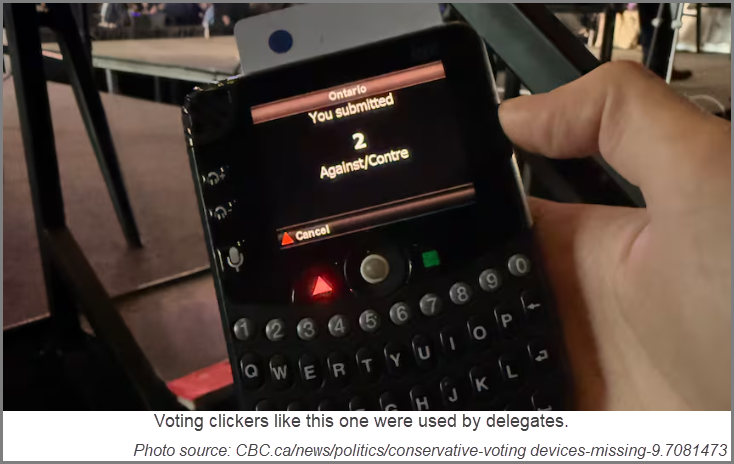
Sure, there were a few people here and there who had to ask for help to reset their clicker when it got stuck, but no major problems arose.
For the anti-gender ideology policy, however, things went down very differently. Malfunctions were so widespread that the Chair had to redo the entire vote three different times!
Delegates were forced to wait in suspense while party officials reviewed the results with the tech team each time. And then, after the third try, we were informed that the policy only got 52% support and failed to obtain a majority of provinces.
Is it just pure coincidence that the one policy which the Leader’s office wanted to see defeated – and we know this because MP Tamara Kronos was sent to speak against it – is the only one where voting machines suffered dramatic malfunctions?
Every other policy passed that day. This was the only one that was defeated. In fact, a significant number of policies passed with upwards of 90% in favor. No other policy had results in the 50% range.
It’s funny how that worked out, eh?
Let’s add some other observations that don’t instill trust in the integrity of the vote:
- Tables were observed where there were more clickers than delegates. This opened up the possibility that some delegates voted twice.
- Although all voting delegates were asked by the chair to be seated at the table during votes, some people were observed using their clickers while standing at the back of the room, and then going to sit down at a table, still during the voting period. Might they have voted twice?
- After the convention, news media reported that many clickers and more than 220 Smart Cards (which provide the unique voter ID) went missing. Again, this is not a confidence builder.
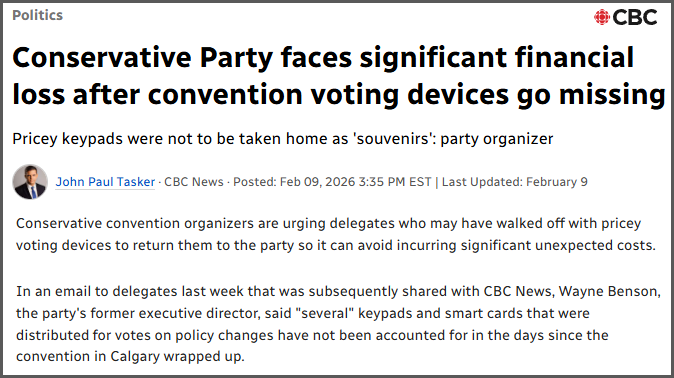
Whether the vote was tampered with or not, the Conservative Party missed a valuable opportunity to do the right thing.
Just 10 days after the CPC turned down this invitation to commit to repealing the so-called “conversion therapy ban” of Bill C-4 which traps kids in harmful fantasies and denies them access to valuable counseling, the Tumbler Ridge massacre happened.
Six days after Tumbler Ridge, on February 16, another transgender gunman posing as a woman opened fire in a hockey arena in Rhode Island, killing two people and injuring three others.
Clearly, something awful is happening in society and it’s related to gender ideology.
Unstable people, detached from reality and encouraged in their transgender delusions, are committing violent atrocities at a rate that cannot be explained away as coincidence.
Canada needs the Conservative Party, and a future Conservative government, to repeal Bill C-4 in its entirety so therapists can go back to helping people like they did before the 2021 “conversion therapy ban” was implemented.
Reprinted with permission from Campaign Life Coalition.