JUST as this quinquennium of the General Synod draws to a close, an archiepiscopate begins. Our final London meeting was the first with the new Archbishop of Canterbury in post, and began with a standing ovation for her. The Archbishop of York observed that, as a former Chief Nurse, she would make “a very, very good chief shepherd”.
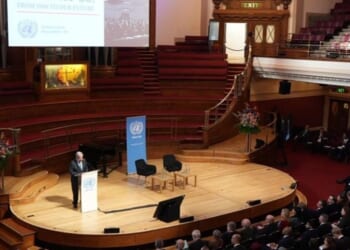
They say that a change is as good as a rest, but, after an archiepiscopal interregnum, there could be no doubting the breath of fresh air in the chamber as Archbishop Mullally addressed the Synod — our first female archbishop. She promised “calm, consistency, and compassion” as we seek to together be a stable presence in an unstable world.
A careful checklist for various themes and groups was worked through, and boxes were ticked. Despite this, her words remained heartfelt: she spoke warmly of “the pearl of great price — glimpsed in faithful, local, sensitive, intelligent ministry”. There was talk of hope, of love and service, rather than of developing “new programmes and initiatives”. A tired Synod was refreshingly proffered compliments rather than criticism: “I see the personal sacrifices you make to be here” and the “love you pour into this task”. The Archbishop made time to have the odd chat with members in the tea-room. A quiet presence for a quiet revival?
Tone set, the Synod moved on to business. The new Archbishop brought us the motion on reimagining care: considering how the Church could contribute to the flourishing of all those who received care, and those who provided it to them. This was the work of a commission set up by her predecessor, but felt particularly pertinent, given her nursing experience. Serving and caring was a theme that ran through many of her speeches in this group of sessions. On safeguarding, she had a realism and honesty about how “earning trust, creating an environment of transparency, and the willingness to speak truth to power when abuse occurs” would work.
It felt good to have leadership from someone comfortable with uncertainty. In a debate on Bishop’s Mission Orders, she confessed, mid-debate, to not yet knowing how she would vote. She would listen, then decide. It is something that we might all aspire to, as, if members knew how they would vote before any debate, what a waste of money our time in Westminster would be. And our financial ecosystem, parochial fees, and Project Spire look set to provide plenty of grit to form our pearls.
Much has been made of the new Archbishop’s penchant for following process, something that I am delighted by. Within those processes, however, there is much that remains uncertain. The struggle over Living in Love and Faith (LLF) continued in one final debate before its rebranding. Here, the Synod was offered a framework for the next steps.
As ever, wildly different views were expressed. After the debate, both sides appeared to claim victory. It made for quite the conversation between two polarised speakers on the Radio 4 Today programme the morning after, as both the Revd Dr Charlie Baczyk-Bell and the Revd Dr Ian Paul appeared to claim victory. They wondered aloud whether they had attended the same Synod debate. The presenter implied that the motion was merely obfuscation.
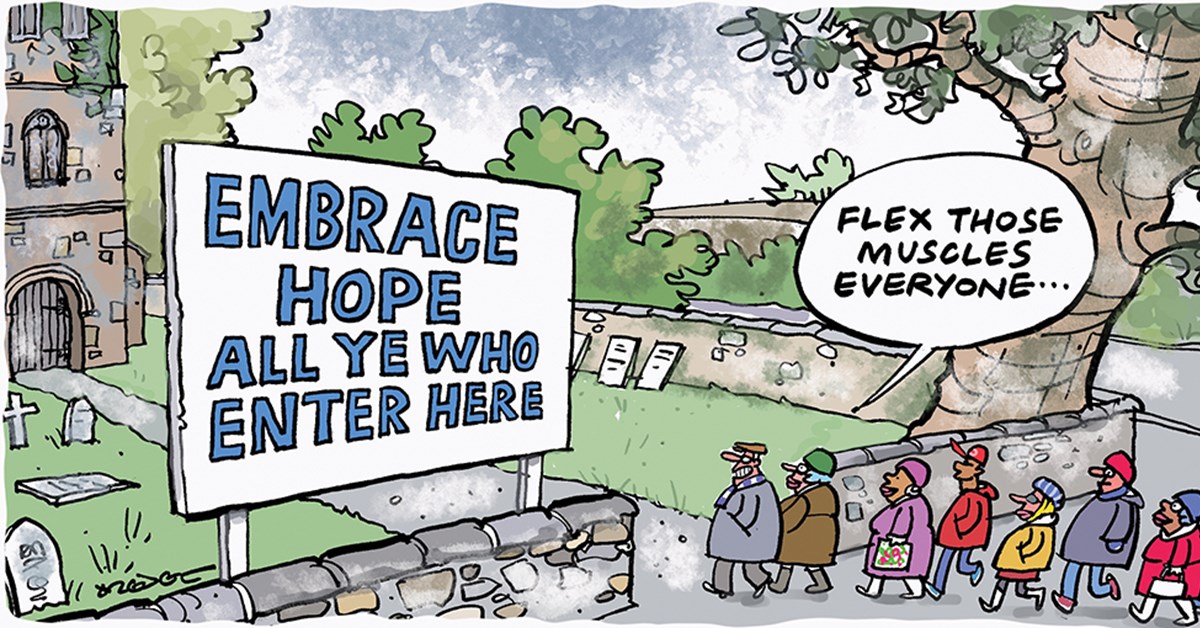
Despite the differing views, our new Archbishop of Canterbury called us to have hope about LLF. Hope was a muscle that we needed to flex, she reminded us. For many, hope felt long gone. Have hope not in the Church, but in God, she urged.
Archbishop Mullally made a point of thanking Synod members for their tone, their engagement, and their remaining part of the debate, despite its difficulties. She also made a point of thanking the support staff at Church House, as the Synod concluded.
Other small details provided lighter moments: in the debate on working-class ministry, the Revd Robb Sutherland spoke of having found himself invited to Lambeth Palace, to partake of the Iceland Christmas-buffet icon that is the prawn ring, by our comprehensive-educated Archbishop. And, having to read out a long list of names of new Synod members, Archbishop Mullally admitted that, as a dyslexic, this was something she was fearful of. Self-deprecation by an archbishop in the Synod isn’t new. But showing us (with a smile) that it is OK to struggle, that it is OK not to know, that it is OK not to be OK — that felt fresh.
We have clear signs of a renewed focus on parishes, of a desire to serve people, of a move away from big-picture programmes. When I think about my parish, process matters, people matter, and being present matters. The tone in which things are said also makes a huge difference. At this Synod meeting, we saw our new Archbishop prioritising listening to people, thanking those who serve, promising to serve us, and encouraging us to have hope in God.
None of this is staggeringly novel. But it is refreshing, and a model that each of us can look to, whether we are serving in parishes or in positions of greater power. Perhaps this is a new way to live out being simpler, humbler, bolder, at every level of our Church: listening, thanking, and serving, all the while putting our hope in Christ. No programmes or initiatives required.
Rebecca Chapman is a General Synod representative for the diocese of Southwark.