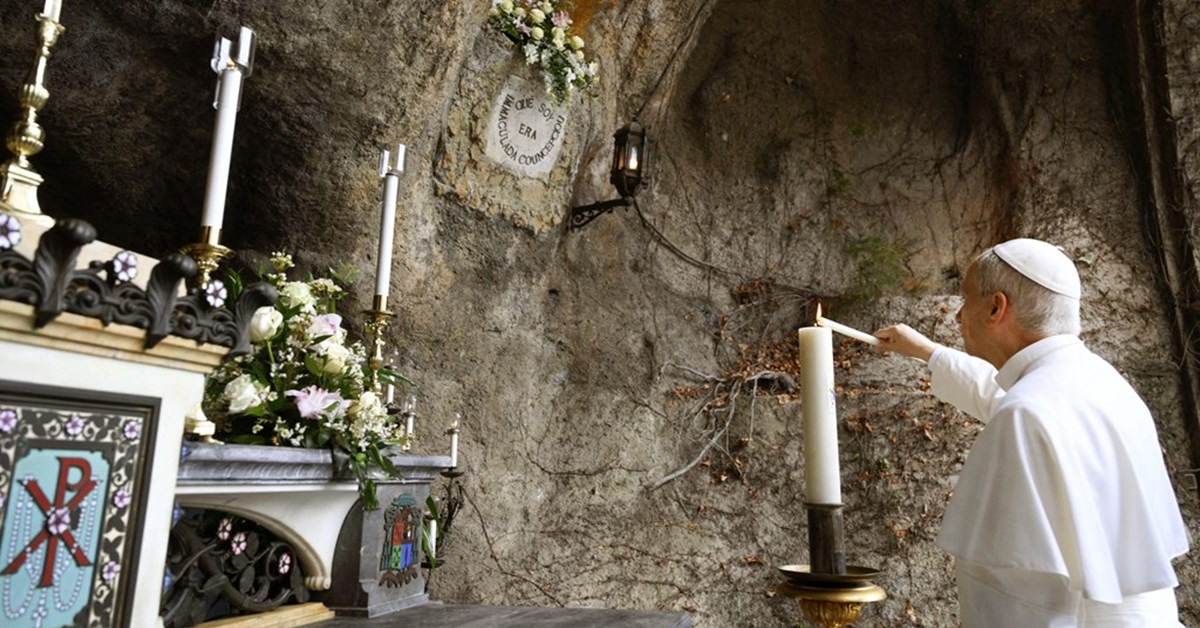
THE World Day of the Sick, observed by the Roman Catholic Church on Wednesday of last week, was introduced by Pope St John Paul II in 1993. The new Pope has given it his full support; for it reflects his profound desire to place those whom society marginalises and devalues at the heart of the Church’s life. When we uphold the dignity of those who suffer, we encounter the face of Christ.
But this year the day passed in macabre juxtaposed with the legislation now moving through Parliament: the Terminally Ill Adults (End of Life) Bill, sponsored in the House of Lords by Lord Falconer.
As worshippers of the “Prince of life” (Acts 3.15), on our way to meet him in word and sacrament, we must ask ourselves whether we are prepared for a society in which edifices dedicated to death will be found on our high streets alongside Pret A Manger and Greggs.
For two millennia, Christians have proclaimed that life — fragile, dependent, and unfinished — is not a problem to be solved, but a mystery to be accompanied. Yet the assisted-dying Bill invites us to imagine death not as the final horizon of a life held in communion, but as a purchasable solution to suffering, administered with clinical tidiness and cultural indifference.
Once death becomes a service, it inevitably becomes a convenience. Once it becomes a convenience, it will not be long before it becomes an expectation — especially for people who already feel like a burden.
Those who believe that strict safeguards will remain intact — including the requirement for judicial sign-off — should look again at jurisdictions that set out upon this path with the same assurances. In Canada, assisted dying has expanded far beyond terminal illness to include conditions such as depression. Further extensions are being actively considered (Comment, 29 November 2024). In Australia, where abortion is now available up to the point of delivery in some states, we see how quickly the boundaries around life and death can shift once the principle of “ending suffering” becomes detached from a communal ethic of care.
SECULAR society has absorbed Descartes’s mantra “I think, therefore I am” so deeply that consciousness is often treated as the measure of identity, worth, and even moral standing. In contrast, the gospel and Catholic social teaching offer a far richer account of human dignity.
Take dementia: a chronic, progressive, irreversible decline in memory which ultimately ends in death. If personhood is reduced to cognitive capacity, then the 15 million people worldwide living with dementia — including more than 800,000 in the UK — become prime candidates for assisted dying.
But God’s perspective is different. People who live with dementia are made in his image; and scripture insists that this image is “very good”. The Bible sees the human person as an embodied soul, capable of spiritual life and held in communion with God (John 20.22; 1 Thessalonians 5.23). In other words: God thinks, therefore we are. It is his creating, sustaining, and cherishing of us that gives us our value — not our productivity, memory, or independence. This truth should not only shape our pastoral imagination: it should be a catalyst for the firm and permanent rejection of the assisted-dying Bill.
Jesus spent his earthly ministry restoring people to wholeness of body, mind, and spirit — and it is an instinct that society should recover, reflecting the God who redeems rather than discards. It is worth remembering that Christ descended into hell, breaking down every barrier between who is “in” and who is “out”, who is “worthy” and who is “unworthy”. In his eyes, every person is worthy of love, and that dignity must be extended to all, especially those who are suffering.
Technology, too, should follow this pattern. Just as Jesus restored sight to the blind, our medical and scientific advances should be directed toward healing, comfort, and the continual improvement of palliative care — not towards welcoming death as a guest or offering it as a solution.
ST THOMAS À KEMPIS urges us to imitate Christ. One of the clearest modern echoes of that instinct can be found in the Samaritans. This charity takes calls from people in profound distress — including many who are experiencing suicidal thoughts or are in the process of attempting to end their lives.
The Samaritans do not passively accept that someone intends to die. Their vocation is to get alongside them, to let them talk about their pain, to listen with reverence, to reflect, to clarify, and to help them to find even the smallest foothold for choosing life rather than death.
On the World Day of the Sick this month, Pope Leo called us to be like the Good Samaritan. And it is precisely this posture — attentive, patient, unhurried, and full of dignity — that society needs to recover. A culture shaped by the gospel does not step aside when someone suffers. It draws near; it listens; it accompanies. It refuses to treat a person’s darkest hour as a justification for ending their story.
James Gordon Reid Haveloch-Jones is an educational consultant and applied theologian. He is an Honorary Associate Fellow of St George’s House, Windsor Castle, a contributing writer for the Catholic Bishops’ Conference initiative “The God Who Speaks”, and a trustee of the Heythrop Association at the University of London.