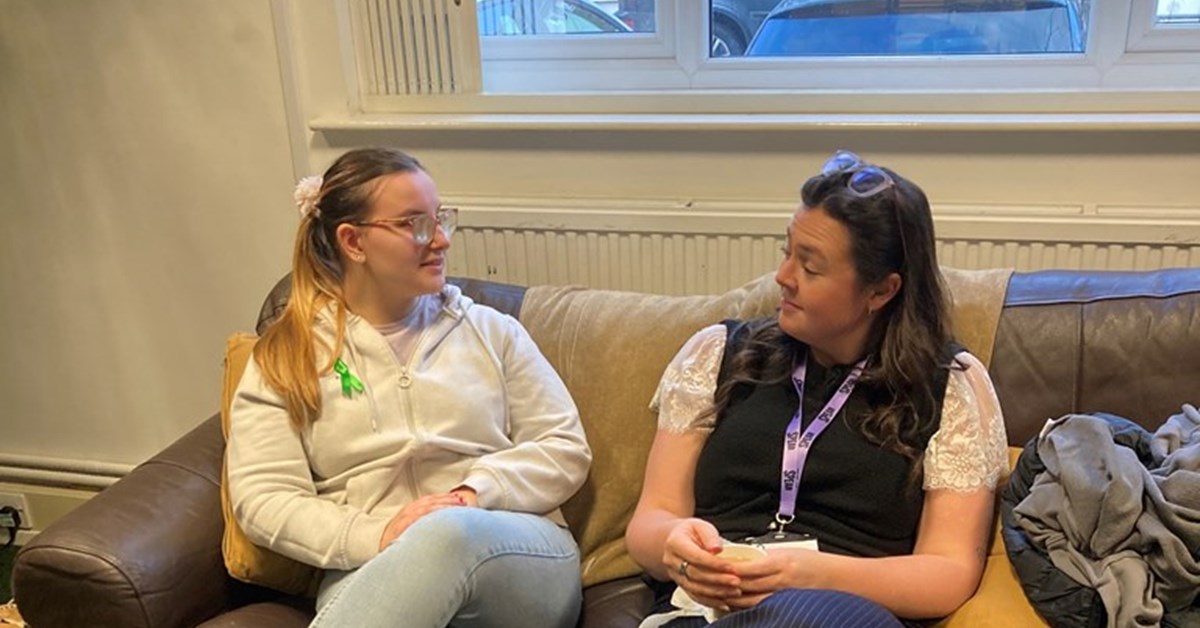
IT IS a cold January morning, but York Vineyard Church is providing a warm welcome to the new cohort of young people arriving for the first day of the Spear coaching programme. The place is buzzing: there is a foodbank operating in the foyer, soft play is under way, and many people are milling around.
The church’s signage is modest, and its frontage doesn’t look like a church building at all, which makes it a perfect venue for the group composed of 16- to 24-year-olds not currently in education, employment, or training — collectively known as NEETs.
Today is going to be a pivotal day for a group of trainees who have enrolled on this intensive four-week programme of one-to-one and group coaching sessions, mock interviews, application support, and CV workshops. The holistic and tailored support is designed to help them grow in confidence and realise the potential that they have.
Spear began in 2003, when its co-founders, the Revd Tom Jackson (still chair of the trustees) and Jo Rice, started a small charity, originally called Resurgo, working with unemployed young people in Hammersmith, west London.
A decade after its inception, it won the Guardian Charity Award, and, in 2024, it was named Provider of the Year by ERSA, the Employment Related Services Association. More than 11,000 young people have enrolled since 2004. Spear meets regularly with government officials to discuss ways to tackle youth unemployment. Benchmarked by the Government’s Data Lab in 2002, the charity was found to be “highly effective”.
York is the most recent of the 18 towns and cities in which Spear programmes operate. They are all based in churches (widely regarded as having a significant part to play in influencing social change) and largely funded by them: a partnership model that makes it very much part of a church’s ministry, while being a stand-alone enterprise.
“We would describe ourselves as faith-based, but not faith-biased,” the chief executive, Iona Ledwidge, says. “We work with young people of all faiths and none. We employ people who are Christians and who have a missional heart for this sort of work, but it’s super-diverse.”
There are an estimated one million NEETs in the UK, equating to one in eight of the 16-to-24 age group. Those who embark on the programme will have typically faced at least three of the 13 common barriers to accessing work, which include having fewer than five GCSEs, physical or mental health challenges, having a criminal record in the family, being in temporary or emergency housing, or coming from a disadvantaged family background.
Over the four weeks of the intensive Streamline programme (followed by six months of one-to-one support), or the six weeks of the Classic programme (followed by 12 months of support), they learn and practise the skills needed for achieving five distinct work-ready indicators. These are: having a positive and driven attitude; communicating confidently in tone, words, and body language; demonstrating professional behaviour appropriate for the workplace; showing self-leadership; and being mindful of the needs of others.
“WE MEET them where they’re at, but we want to move them forwards to being ready for work, and in the mindset to stay in work. Because it’s not just one thing to get a job,” Ms Ledwidge says. “You’ve got to stay in that job, and be able to show up and perform. Work can be tough: you’ve got to learn how to handle conflict, so that you don’t get stuck in a victim mentality, and how to confront obstacles.
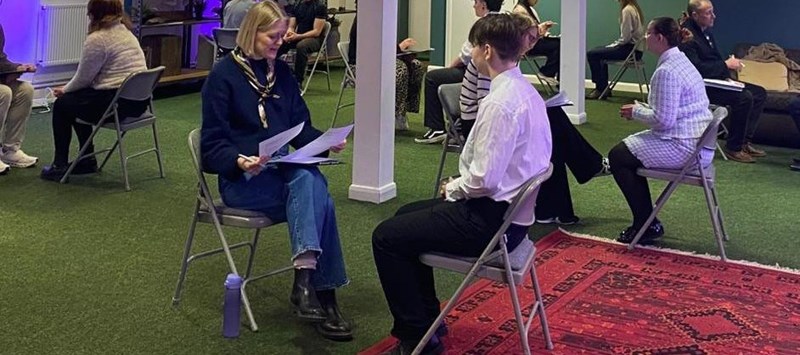 SpearIona Ledwidge, CEO of Spear, doing a mock interview with AJ at Spear York
“We help them to reframe certain things that no one ever taught them. When you start thinking about generational cycles of poverty, they’ve never seen a parent or a caregiver work; so they don’t have that inspiration or those role models in place.”
The joy of church partnerships, she says, is that churches are embedded locally. “The church will usually have a relationship with the Jobcentre; so they can start building on that connection. And it may well also have connections with social-services and mental-health teams. They might have a refugee drop-in or a foodbank already in the church, and connections too, of course, with the schools.”
On this first Tuesday, as the cohort is due to arrive for session one of the four-week programme, the sense of expectation and excitement upstairs in the office are palpable. The two coaches, Naomi Thomas, who is the Spear Centre manager, and Paige Goudie, assistant coach, have met them all once, as individuals; so some ice has been broken, and everything — including drinks and snacks — is ready downstairs in the area that doubles as a worship space.
There is some awkwardness as the young people drift in: some look a little wary, wondering, perhaps, what they may have let themselves in for; some remain deliberately on the fringes; others make tentative contact with one another at the drinks station; some tuck themselves away in the recesses of the sofas.
When they all come together, Naomi and Paige are easy and familiar with the group while being thoroughly professional. Though there are inevitable awkward silences, there is a visible lessening of tension and, in some cases, a lowering of defences, as they move into introductions and aspirations. An encouraging buzz develops.
I TALK to AJ in the break. He has put in a myriad of job applications, and most of the companies don’t even respond, but he has grown to be realistic about the odds. “My stepdad’s on the other side of this, because he’s someone who hires,” he says. “He put out an application for one job and got 300 responses. It’s a matter of being overwhelmed. That’s what you’re up against; that’s what I’m thinking is the main issue.
“He doesn’t wade through all the applications: he goes through until he finds someone who fits the job and stands out from the rest. But he does still keep the list of applicants; so it’s not entirely wasted. At least you know it’s not usually your fault. You’re just hidden in this sea of people.”
AJ had embarked on a college course to be a veterinary nurse, but it costs £2500 a year, and he needs a job to pay for the training, the expenses, and his daily living costs. He hopes that the Spear course could even start him on the way to finding a small apprenticeship. “You’re still learning something and doing some sort of education, but you still get an income. You could make clear plans. It’s just figuring out how to get there,” he says.
Zinedine’s mum found out about the programme and said he must join it. He had found himself “kicked out of two different schools — one was not my fault, one was because I did something silly” — and job-hunting has yielded nothing. He is engaged and articulate in the group — “I like meeting new people” — and, while realistic about his immediate prospects, he would love ultimately to be an actor. “I did drama at school and Theatre Coach [stage training] for nine years,” he says. “That would be my dream job.”
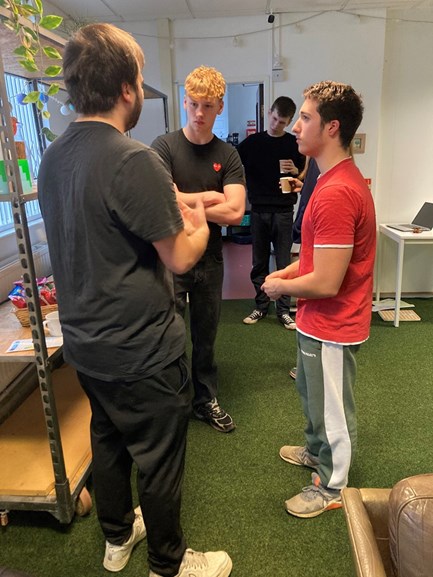 Pat AshworthZinedine, wearing red T-shirt, and other course members at Spear York
Grace found out about Spear through the Jobcentre, which sent her to a jobs fair, where she met Naomi. “I’ve put in loads and loads of applications, and it always seems to be, ‘Thank you for your time, but we’ve chosen a different candidate with more skills,’” she says. “It’s disheartening, but I think, with more experience and more skills, I’d be able to be that candidate.”
She has got as far as interviews, which have been a mixed experience: one, for a call-centre job with EE, she describes as “very professional, a whole day of watching all the time, so you could see exactly what the job entailed and what it would be like . . . and then the interview. I felt like I did really well, but there were people there with a lot more experience [of interviews] than I had.
“I think that’s the kind of experience you’ll learn here. The programme looks really good. I’m excited to learn more, and how to present at interviews and know what they’re looking for, and then to be able to get into a job and stay there and learn to deal with anything that comes up within the job, with my manager: to be confident and ready.”
Spear now has 18 centres in England and Wales. Plans are now signed off for a centre in Wolverhampton, which will open this year and be the first in the Midlands.
“I think what we’ve worked really hard on is having a consistent programme that delivers to a consistently high quality across all our centres,” says Spear’s head of impact and strategy, Chernise Neo.
“Our national employer partner, Nando’s, has now taken 150 Spear trainees across their restaurants. We give each centre lots of training, but also quite a lot of autonomy in terms of how they build local relationships with referral partners and employers who will come in and interview young people for jobs. So there’s lots of training and support, but also flexibility for each team in each context.
“Most of the trainees are referred by the Jobcentre, but the young people are not mandated to take the programme. We actually prefer that, because then we know that they are there of their own free will, and we often find that their inclination to stay the course with us is a lot higher.
“Certainly, from a funding point of view, [being independent] has given us a lot of independence to experiment over the years. We have built up relationships with many private trusts and foundations and major donors, who have placed a great deal of trust in us to come up with something that works.
“That said, we need the confidence, love, and prayers to try and roll it out across the country, particularly in areas of highest need, so that it reaches many young people as we can. From that perspective, we’re actually trying to engage much more with the Government, and we have found the DWP pretty receptive.”
And, while some churches invite Spear to open a centre, it has also undertaken research to identify the kinds of churches which it can work best with. “We now quite intentionally research and approach churches that look as though they would be the ideal sort of partner — accessible and a safe warm building, of course, but also how well young people can get to it by public transport,” she says.
JONATHAN and Nicki Abbey are senior pastors at York Vineyard. The couple felt called to York, where they both grew up, to plant a church, in 2008. The significant development in terms of its growth was buying the five-storey building in 2021, during Covid.
“What happened with Spear was interesting,” Mr Abbey says. “We were at a party with a friend, a businessman who lives outside York and was doing Spear coaching at the hub in Leeds. He said how nice it would be if there was a Spear in York: we thought nothing more about it, but it soon became obvious that there was something going on here.”
The couple attended a Spear presentation evening in Leeds, which convinced them that it was something that they should pursue. “We were just exploring, but, the more we saw, we were very impressed with the professionalism of Spear and really taken with how the whole thing was structured, sitting within the Christian faith. People tend to think York is an affluent city, but, because we work alongside a number of people in different ways, we know there is a lot of need here and a lot of areas where there’s poverty and people coming from struggling and dysfunctional upbringings.”
The couple sounded out potential trustees before putting it to the church, “knowing that they would love it and want to get involved”. Spear is “gifted and equipped and professional and with a real heart”, he says, warmly. “I just love the way it engages with young people. They come in very nervous, and [by the end of the course], to see them stand up and give a presentation, to engage in conversation with them, is really quite remarkable.
“It sits in the values and vision of the church. It’s Kingdom stuff. We’re new kids on the block really, but it seems to be going well.”
As Spear’s partner, it costs a church around £50,000 a year for the staff costs of the centre manager and assistant coach, who are part of the church staff team, plus a £10,000 contribution from the church. “It’s a big thing to go from zero to fund-raising that kind of money,” Iona Ledwidge acknowledges. “We have a seed fund to help, and then we help them develop a funding plan.”
It is a focused and data-driven organisation with very clear goals: three more Streamline centres to be opened this year, including Wolverhampton, and a regional hub in Birmingham in 2027. Spear is hoping in five years’ time to have 36 centres, and a presence as well in Scotland and Northern Ireland.
The results speak for themselves: the figure for those in work or study a year after completing the initial stage of the Spear programme is more than 70 per cent. Spear has 28 corporate partners, with 200 corporate volunteers who volunteer as mock interviewers, career panels, and to host visits. There are 27 employer partners, in addition to the national partner, Nando’s who have said in 2025 that “Spear trainees are some of the best employees we’ve hired.”
LAST words on this first Tuesday in York go to Faye and Ellie, who completed an earlier course and have come back to encourage the new cohort and pass on their experience since then. Faye confesses that she didn’t come on to the course with very high expectations, thinking it was likely to be “telling you what you need to do but not telling you how to do it. . . The hardest bit of the course was probably learning to believe in myself. It’s a big jump from ‘I can’t do it’ to ‘I can do it.’”
She was taken on by Nando’s, and loves the job. “I walked in on my first day and instantly wanted to run back out,” she says. “But I’d already met some of my co-workers on my trial shift, and I met my manager, who was really nice. I was scared that I was going to come in and be treated like the new girl, in the stereotypical sense that people were going to bully me.” Rather, she says, “they were really helpful and welcoming, and I felt like one of the team from the minute I stepped in. I didn’t feel at all like an outsider.”
Ellie hasn’t yet got a job, but feels that her chances are greatly increased after finishing the course. “I was surprised when I came that they actually talked about who I was and what I wanted to do, and even about my interest in things. It was more casual and more chilled and being treated liked an equal,” she says. “It’s really helped me socially with my confidence. I’m in a lot better mind than I was.”
She is applying for “anything I can find: waitressing, cleaning jobs, anything. They’ve helped me with my CV and interview and everything. I definitely feel I have a better chance. I feel like the person I want to to be.”