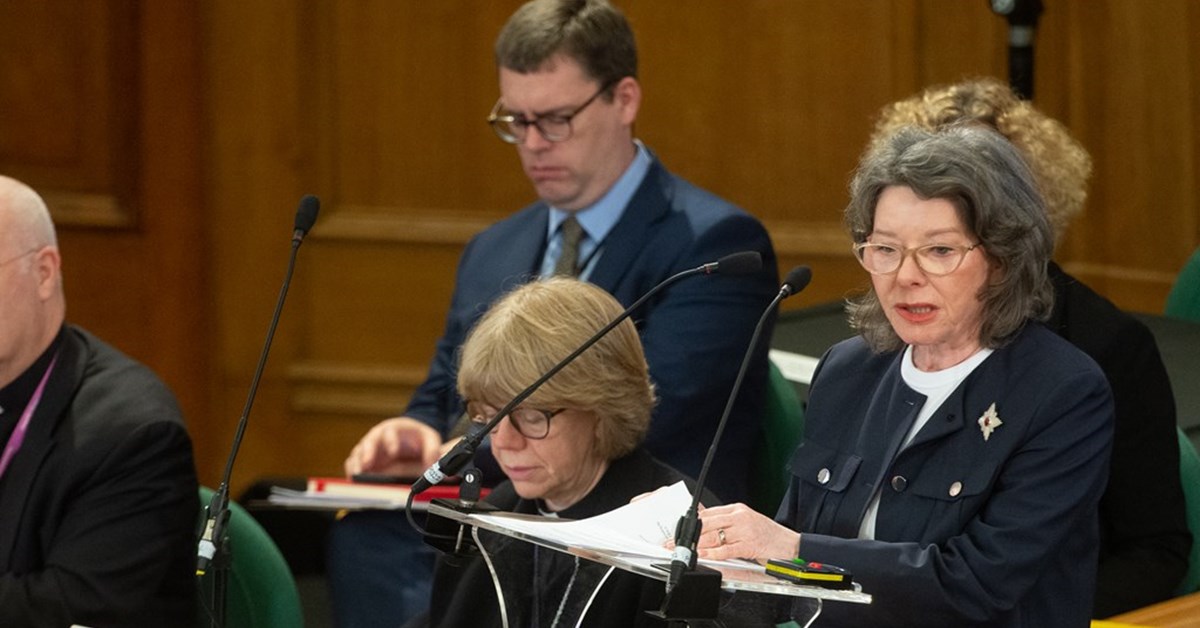
THE Church’s outsourcing of its safeguarding work to an independent body was endorsed overwhelmingly by the General Synod on the Wednesday afternoon, in a vote by 354-1 with three recorded abstentions.
The Synod welcomed an update, endorsed the direction of travel set out in the report, and looked forward to considering proposals where necessary.
The Bishop of St Edmundsbury & Ipswich, Dr Joanne Grenfell, who is the lead bishop for safeguarding, gave the opening presentation. She said that any reforms to truly strengthen safeguarding must “carry the confidence of the whole Church and, crucially, victims, and survivors”.
She handed over to Dame Christine Ryan, the executive chair of the Safeguarding Structures Programme Board, which is implementing the reforms.
Dame Christine came into post last October from a career in governance and regulation. She had spoken with survivors, safeguarding professionals, staff and clergy, volunteers, and more, and read previous reviews and reports. Her first observation was that “this is a Church ready to change — there is deep commitment to do what is right.” She praised the deliberation undertaken, but said that actual change had been too slow to happen. The regulators, Parliament, and the public would no longer tolerate incremental improvements — only a new safeguarding system that was credible and accountable.
Synod members should be reassured, however, that safeguarding was better in reality than in perception, Dame Christine said. She acknowledged that this alone was not enough to restore trust. Safeguarding was too often experienced as overly complex and inconsistent. Decision-making was unclear and too dispersed. “The Church can find itself in the invidious position of being both pastor and judge.” This perpetuated a safeguarding culture that could be vulnerable to exploitation, and where poor practice could go unchallenged, she said. People had to trust the system.
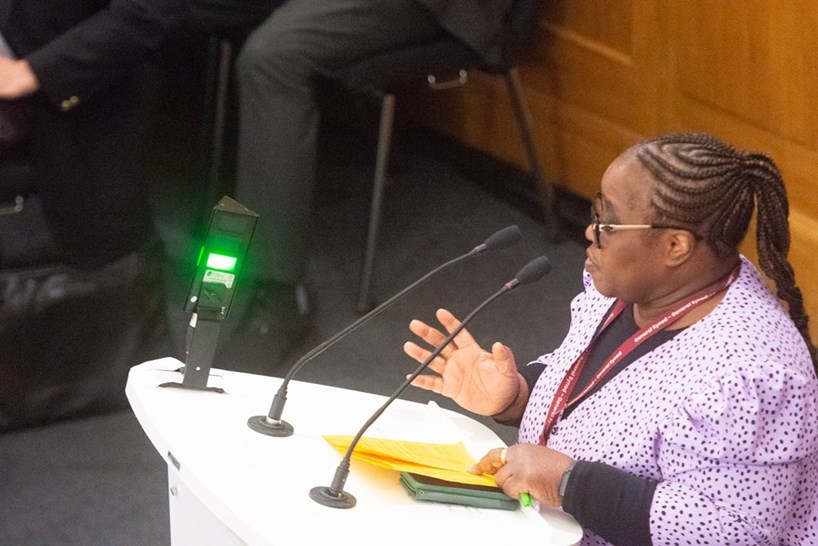 Geoff Crawford/Church TimesChristiana Olomolaiye (Bristol) begins the debate
She had also found out how complex the Church was, although it was not uniquely so. Other organisations had successfully navigated complex reform, she reassured the Synod. “It is time to remove that complexity, which is why I have realigned this work into a single, unified vision.” She believed that this new model could be delivered at pace if the Synod voted in favour of it.
At the heart of this was the creation of a national charity, provisionally called the Independent Safeguarding Authority (ISA). She hoped that her paper would resolve several tensions, principally around independence and complexity. The charity would be overseen by a majority-independent external board, and its chief safeguarding officer would be accountable to outside regulators. There would also be a uniform complaints process, which could begin as soon as this year, without any legislation.
The ISA would act as a professional “anchor” for local safeguarding teams, even as they remained legally accountable to diocesan trustee bodies, she explained. This was not about replacing safeguarding teams, but giving them improved resources, training, and support, Dame Christine said. All this would begin to rebuild a healthier culture. “My ask today is simple: endorse this direction of travel. The cost of delayed action will be measured in the harm that it enables.”
Dr Grenfell moved the motion, acknowledging that a different approach had been presented just 12 months ago. But the context had changed, and so, too, had the Church’s approach. “I find Dame Christine’s approach to be persuasive because of her external perspective.” The C of E had a “powerhouse of expertise, dedication, and care”, and this new model would not replace this, but “fortify it through enhanced expert supervision”. What was now on offer was a single, unified system to bring together scrutiny and delivery, while separating out operational decisions from leadership. “This separation is the only way to rebuild lasting trust.”
Dr Grenfell knew that many members were worried that independence would undermine the “embeddedness” of local safeguarding. This new model had found a way to “square that circle”, although some details were still to be ironed out. “We have done the thinking, put in the hard yards, debated, discussed, and discerned,” she said. Now, Dame Christine had shown the Church how to implement this in a single vision, reducing complexity. This would end the cycle of constant structural reform, freeing the Church’s leaders to look out at mission rather than inwards at structures.
Christiana Olomolaiye (Bristol) was shocked that the ISA would exclude “churchpeople” and would mainly consist of “non-church people”. The board should include people with Christian compassion and give priority to those who knew the workings of the Church of England, she argued. If people were a part of Christian culture and had the skill, the professional expertise, and the qualifications, they should be on the board, she said.
The Bishop of Tewkesbury, the Rt Revd Robert Springett (Southern Suffragans), who is the deputy lead bishop for safeguarding, argued that a whole-system approach that connected scrutiny, delivery, and an end-stage complaint process was needed. He praised this as an independent system that had the statutory ability to intervene, so that it could not be said to be the Church “marking its own homework”.
Peter Adams (St Albans) welcomed the process, but opposed the soon-to-be-proposed amendments. He was concerned about pace, and that the amendments might reset the process. Lessons were still being learned from the Soul Survivor case, he said, particularly on good governance at a local level.
The Revd Lesley Jones (Durham) praised the plan as a way to “regain trust”. True separation was necessary, she said, besides bringing the right people with the right skills on board. “We should be concentrating on mission,” she said. “This is a window of opportunity to set our house in order. Let’s do it.”
Nicola Denyer (Newcastle) was cheered to hear that the C of E was no more complicated than other organisations. She praised the new model for its “clarity, recognition of local expertise, and the importance of victims and survivors’ voices being at the heart”.
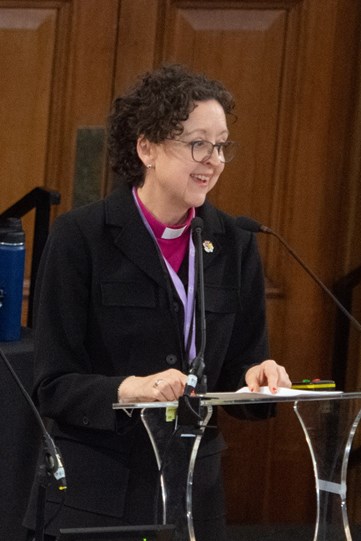 Geoff Crawford/Church TimesThe Bishop of St Edmundsbury & Ipswich, Dr Joanne Grenfell, who is the lead bishop for safeguarding
The Revd Trudi Oliver (Rochester) had had an “excruciating” time putting in place proper safeguarding procedures in three rural churches, receiving pushback over DBS checks from one PCC. There remained a lot of ambiguity over whether PCC members had to be DBS-checked or not, and the e-manual from the National Safeguarding Team was unhelpful, she said. “I am really hoping this new process will lead to clarity for what should be simple questions.”
On behalf of the Revd Robert Thompson (London), who was recovering from surgery and could not be present, Robert Zampetti (London) moved an amendment. This would set an 18-month deadline to bring back legislative proposals to the Synod. Direction alone was not the same thing as delivery, he said. The question was no longer what the Church wanted to do, but “when it will actually do it”. The Charity Commission had been clear that independence was necessary and must be implemented at pace. His amendment did not demand completion by July 2027, and did not “short-circuit due process”, but good intentions without delivery were not enough: survivors and regulators were asking for “evidence of momentum”.
Dr Grenfell said that, while she would not be upset should the amendment be carried, she would resist it for imposing “excessive detail and inflexibility”. She wanted to move even faster than July 2027. “Setting the date doesn’t really add much.”
The Revd Dr Catherine Shelley (Leeds), who had been a child-protection lawyer before ordination, said that speed was crucial. A deadline would be helpful, and, if it could be done quicker, so much the better. Delays and complexity had caused real problems on the ground, she said.
The amendment was defeated.
Mr Zampetti moved a second amendment, which would require detailed options for transferring local safeguarding staff to the employment of the new ISA to be drawn up and brought to the Synod by July 2027. This would not mandate immediate restructuring, he said, but would ensure that the Synod was not asked at a later point to make an “irrevocable” decision without proper information. The paper left unresolved what safeguarding independence meant at a local level, he said.
It was not about making a decision now, but doing preparatory work to avoid further delays. Safeguarding professionals needed “clarity and stability” to do their jobs well, he said. “We cannot credibly endorse independence in principle without establishing what it would mean in practice.”
Dr Grenfell was happy to hear the strength of feeling, but could not vote for the amendment. Every focus must be given to the overall design of the new ISA, she said, and not be distracted by exploring other options at the same time. This was the advice of the independent safeguarding expert. “Please trust them. We have found a way through to make the most effective change happen quickly.”
The Bishop of Blackburn, the Rt Revd Philip North, said that the paper contained strong proposals had built on what the Synod had voted for the previous year. He reminded members why “Option Four” had been rejected the previous year, and warned that, if the amendment were to be carried, it would ignore the advice of large numbers of independent safeguarding professionals, as well as auditors.
Lt. Gen. Robin Brims (Newcastle) was disappointed, suggesting that the paper lacked details. He was in favour of the amendment, which, he said, “forces clarity” and “injects urgency”.
Joel Plant (Youth Representatives) did not support the amendment, because it did not refer to the original Synod paper on safeguarding structures.
Nadine Daniel (Liverpool) was sympathetic to the amendment, but told members that they should listen to Dr Grenfell and reject it. If the Synod could move towards independent safeguarding, “so much the better”, but rushing the process would “actually create even more problems”.
Michaela Suckling (Sheffield) understood why members would be in favour of total independence, but urged them to vote against the amendment. She spoke of Doncaster Council and its decision to make its children’s services independent, as an example of how this had failed to work and had wasted money.
The Archdeacon of Liverpool, the Ven. Dr Miranda Threlfall-Holmes (Liverpool), a member of the Archbishops’ Council, also resisted the amendment: work needed to “progress at pace”.
The amendment was lost.
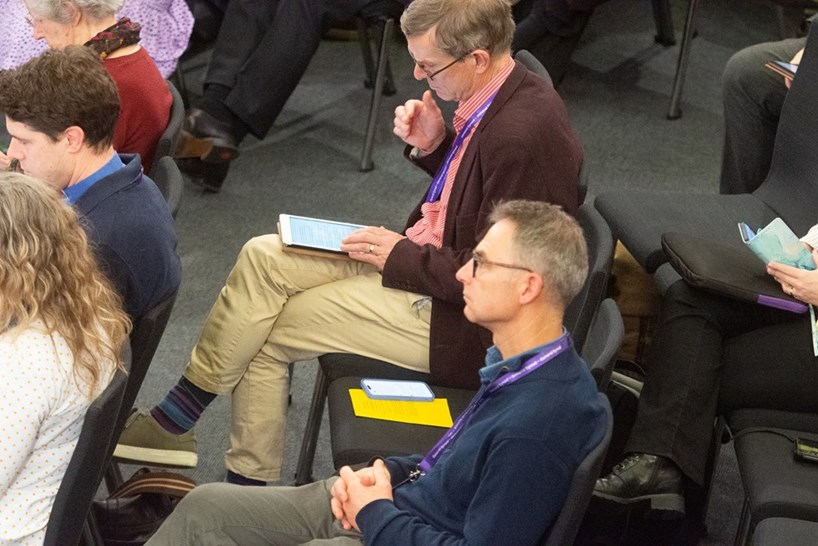 Geoff Crawford/Church TimesSynod members listen to the debate
The Revd William Harwood (Truro) backed the main motion wholeheartedly. He described himself as a survivor of church-based abuse. “God draws near to the broken-hearted. Will we do the same?” Could the Church walk with survivors, not as an adjunct to the institution, but as integral to decision-making, he asked.
Stephen Hofmeyr (Guildford) asked for more clarity about “non-church members”. Was this solely for those who were not members of the Church of England or were not Christians generally?
The Archbishop of Canterbury praised the hard work and listening that had procured this new direction of travel “through what has seemed like intractable change”. The Church must be a model to others in how it protected children and responded to abuse and the misuse of power, she said. She supported the motion as a sensible new approach, which could be “delivered at pace”. It blended independence on decision-making while retaining responsibility, allowing safeguarding professionals to pursue impartial judgements without abdicating charitable duties. “This is just the next step: earning people’s trust inside and outside the Church will take more than just one motion,” she warned.
Alison Coulter (Winchester) said that the past five years had been “painful” for her and others on the Archbishops’ Council, as they had faced their failures around safeguarding. “It has been humbling, and very clear we need to do better.” She paid tribute to the victims and survivors who had been on the Safeguarding Structures Programme Board with her, offering their wisdom. The parliamentary Ecclesiastical Committee had told the Synod that it expected the Church to “fix” safeguarding at pace, she said.
Dr Ian Johnston (Portsmouth) praised the paper, but said that the ISA would have no specific authority to insist that the Church comply with its decisions. He also said that it should not seek to “reinvent the wheel” where dioceses already had good practice. The Synod should oversee the independent overseer, he said.
Fr Stephen Maxfield (Greek Orthodox Church) asked about para-church organisations run by Anglicans but out of the control of the Church of England. Was the Synod certain that the new ISA would have power over such organisations?
Dr Brendan Biggs (Bristol) observed that the chief safeguarding officer would report to both the ISA board and an external regulator. Who was this regulator, he asked: would it be the Charity Commission? Asking about the independent ombudsman who would handle complaints, he insisted that there had to be independence between the group deciding on safeguarding cases and the body handling complaints about these decisions.
Dr Grenfell said that the independent members of the board could be Christians, survivors, or even churchgoers, but that they could not be church officers. She also clarified that the backstop accountable body might be a committee in Parliament, but, whatever it ended up being, this had to be outside of the Church, and not a commercially tendered organisation.
Read more reports from the General Synod Digest here