A MOTION from Chester diocesan synod, which expressed regret that 12 mainland dioceses received no Lowest Income Communities (LInC) funding, was debated by the General Synod on the Tuesday evening.
This was despite the fact that these dioceses contain 268 parishes that were among the 25 per cent most “socially deprived”, the Synod was told.
The motion called on the Church Commissioners and the Archbishops’ Council to review the formula used to distribute the funding. It asked to move to one “that accrues a total to each diocese based on analysis of existing published data relating to individual parishes” and which takes into account socio-economic data and parish population, to provide extra support to work among the largest socially deprived populations.
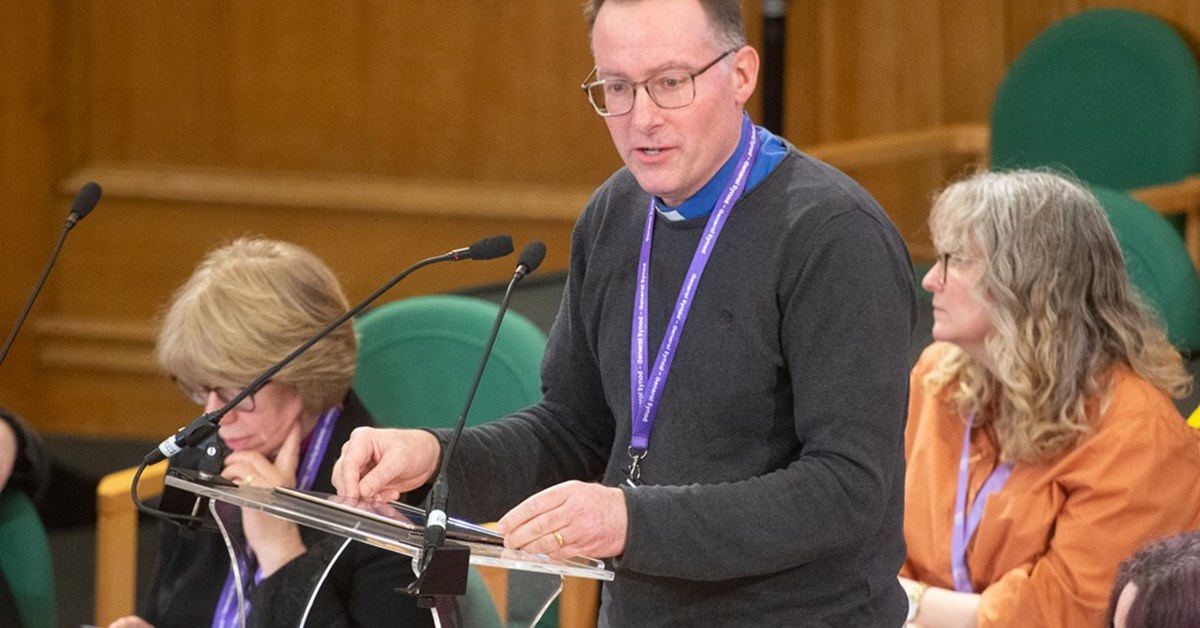
Introducing the debate, the Revd Christopher Blunt (Chester), a rector in Stockport, said that LInC totalled £133 million over the next three years: an “eye-wateringly large amount of money, for which we are thankful”. LiNC aimed to support ministry in the most deprived parts of the country. It was the “cornerstone of the Church of England’s commitment to the poor”. But it also had a “blind spot” that needed to be addressed: ineligible dioceses contained parishes in areas of extreme deprivation. Chester received no LInC funding, and his parish was among the one per cent most deprived in the country.
The “generous” system in the diocese meant that his parish was asked for only 45 per cent of a standard parish share, while wealthy ones paid up to 145 per cent. The demographically wealthy parishes found this tough to meet. “When you are part of a parish where a large number of the congregation are living and giving out of Universal Credit or PIP [Personal Independence Payment] or state pension, even the wonderful and generous subsidy of 45-per-cent share is hard to meet.” Was LiNC funding not designed for parishes such as this?
The motion — “born out of frustration” — was “modest”, he suggested. It sought to move to a parish-level assessment. “To say I’m disappointed by the response is an understatement.” He urged the Synod to “forget any scaremongering about the impact on rural parishes”. The motion proposed a “proportionately modest transfer from middle-class parishes in LInC-funded dioceses to the nationally most deprived parishes wherever they are located”.
A parish-level assessment opened up the possibility of passing LInC funding directly to the parishes, he said. This was a “far simpler approach to the disbursement”. Much of LInC did not reach deprived parishes or could not be accounted for, he said. This equated to tens of millions, “potentially top-sliced to fill diocesan deficits as if parochial deficits didn’t matter”.
Canon Andy Salmon (Manchester) spoke against the motion because of the effect on the poorest dioceses and parishes. “It could go horribly wrong,” he said. He supported the principle of redistribution to ensure that funding went to those in need and accepted that there would be winners and losers. “Somebody has to draw a line.” He suggested that the line could even be drawn lower, so that slightly fewer dioceses benefited, “because we have some very needy parishes in our country.”
A former diocesan secretary in Manchester had spoken of visiting a former Bishop of Stockport to discuss the possibility of redrawing diocesan boundaries to include within Manchester diocese the parishes, “very wealthy — largely”, in Trafford and Stockport. “Perhaps, if Chester would give us those wealthy parishes, we might consider supporting this motion.”
Emma Robarts (St Albans) supported the motion. “LInC funding is the difference between ministry surviving and ministry collapsing in places where the Church of England is often the last functioning institution.” The 2024 accounts showed that “we can afford more LInC. Money is about the only problem the Church doesn’t have.”
The Church Funding Update for the Synod acknowledged the challenges of sustaining stipendiary ministry, but the proposed remedy was a programme of work concluding in 2027, when a debate would be held. “This is classic administrative capture: working out their answer before we are allowed to discuss it. The problem is immediate and urgent,” she said. “The need is evidenced, and the accountability structures are in place. We don’t need more data, more modelling, or more consultation. We need deeds, not words.”
She warned: “We do not want the legacy of Vision and Strategy to be the death through neglect of the parishes.” The plight of the “poor vicarless parishes” reminded her of the joke about the tinker’s donkey: “He had just taught it to go without food when it died.” The Synod needed to send a clear message now. “The threat to the parish system is now.”
The Revd Graham Kirk-Spriggs (Norwich) was not convinced about the need to change the system. He wanted assurances that the funding would not be taken away from the parishes already in receipt of it. Parish share was really important, he said. “Things like the Ephesian Fund [News, 30 January] are deeply unhelpful, because, really, we might not need as much LInC funding if wealthy churches weren’t siphoning off money to pay into their own silos.”
The Revd Chris Collins (Leicester) said that, were it not for LInC funding “there would be serious questions about the sustainability of ministry in our context. . . Without it, I fear there would be no church in ten years’ time.”
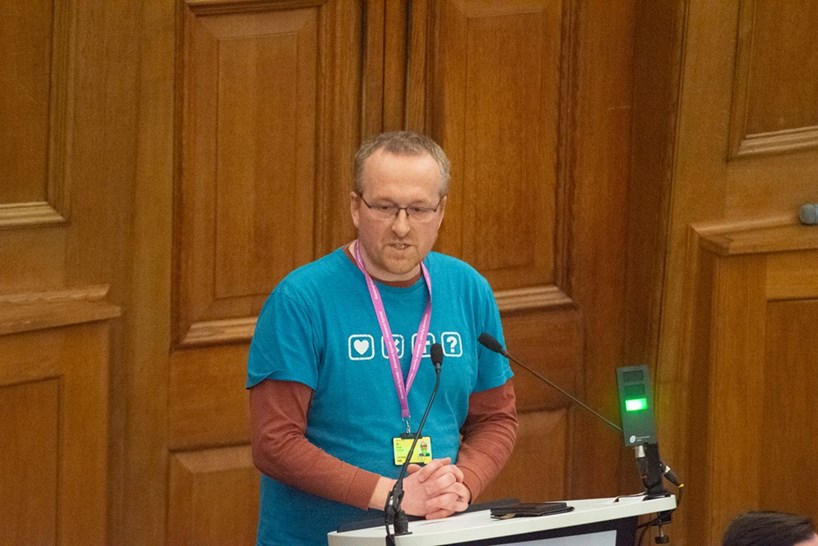 Geoff Crawford/Church TimesThe Revd Chris Collins (Leicester)
As a single church, they received about £38,000 a year in a top-two-per-cent-deprived parish of nearly 11,000. Yet, Mr Blunt’s three-church parish of about 20,000 people, which was in the top one per cent most deprived, received no funding. He supported the motion and requested more money from the Strategic Mission and Ministry Investment Board (SMMIB). His “back-of-the envelope” calculations suggested that extending LInC to the top ten per cent of the most deprived parishes in non-LInC dioceses would cost £2 million to £2.5 million. “The words ‘postcode lottery’ spring to mind.”
Carl Hughes, who chairs the Finance Committee, proposed an amendment “in a constructive spirit”. The original motion expressed “an important and heartfelt concern”. The amendment would have the Synod commission the review requested in the motion without specifying in advance the precise data sets or technical mechanisms that must be used. It also suggested that this should be addressed together with the wider funding framework.
He said: “Whilst I remain concerned that we support the most deprived parishes in the country, I do have concerns that the approach proposed moves decisions about how best to support local parishes from diocesan leadership to national church bodies. It would also remove accountability over such funding from diocesan synods.” LInC funding was “primarily used” to support stipendiary posts, which were under the oversight of diocesan bishops. The new light-touch reporting for LInC meant that its use was now “transparent” for each diocesan synod.
“In my opinion, the use of a national formula to determine local deployment is absolutely not desirable and indicative of a level of centralisation that many in this chamber complain about regularly.” Any review must take into account the resources that dioceses themselves could deploy, “and should not weaken the core virtue of mutuality of support among parishes within a diocese”.
Mr Blunt suggested that the amendment was saying “Please trust the Church Commissioners and the Archbishops’ Council to do their jobs. OK, but actually I do. And this motion is far more positive than I think you are giving us credit for.” The responsibility was not being moved from the diocese to the national Church, but from the diocese to the parish, he said.
The Triennium Funding Working Group had shown that a large amount of funding was not making its way to the most deprived parishes. The change was not expected to result in “financial shocks across the Church, but we do expect it to right an injustice and give us, as the Church of England, the right to say to the nation that we value ministry in every deprived community”. He resisted the amendment.
Jason Clarke (Chester) spoke of his parish, Blacon, situated on a large council estate of between 15,000 and 20,000 people. It could not afford the parish share last year. The incumbent worked “incredibly hard”, and the church did a huge amount of work in the community, he said. LInC funding “might mean that we get to keep our incumbent, and, when she retires in a few years’ time, that we will get another full-time incumbent”.
The Bishop of Blackburn, the Rt Revd Philip North, supported the amendment. “The growing vibrancy of the urban Church in this nation owes a great deal to the LInC funding.” If carried unamended, the motion could threaten that by reducing disbursements to existing recipients, he said. “In the Church, wealthier areas should support more deprived areas. That’s a basic principle that goes back to Acts 2. This motion, unless backed by a significant real-terms increase in LInC disbursement, undermines that principle. It means that funding will flow into wealthier dioceses at the direct expense of more deprived dioceses.”
It would, he said, “undermine carefully drawn-up nine-year plans”. There was a perception that some dioceses were not using LInC as intended. But Blackburn diocese did not recognise data on this, and the Synod must not be misled by it. In his diocese, all of the money in LInC was spent on Lancashire parishes that were in the 25 per cent most deprived nationally, he said.
Julie Dziegiel (Oxford) spoke of allocating parish share over the course of many years, and was aware of the complexity. She feared that the unamended motion risked unintended consequences. The second most deprived church in her deanery had one of the most income-adjusted for size in the deanery. Money could end up in the pockets of parishes that didn’t really need it. She urged the Synod to “be careful”.
Andrew Gray (St Edmundsbury & Ipswich) suggested that the feeding of the five thousand “wouldn’t have happened had General Synod been involved”. Rather than faith and hope, there was “fear that if we pass this, something will go wrong”. The motion was simply asking the Church Commissioners to review the formula and take into account two sets of data. It was not tying the hands of the central Church. “Anyone would think, from some of the responses, that what it was actually asking for is the nuclear access codes.”
The amendment was a rewrite of the motion, telling the diocese of Chester, “Don’t worry about it, central Church knows what it’s doing,” he said. He urged the Synod to resist the amendment. “We have a funding crisis in our poorest communities.” The Commissioners were sitting on “record amounts of funding. So, why don’t we, just for a change, do something a little bit risky and out our faith in God, if that isn’t too much to ask?”
The Bishop of Hereford, the Rt Revd Richard Jackson, supported Bishop North.
The Archdeacon of Ashford, the Ven. Darren Miller (Canterbury), supported the amendment. He had been “horrified” by data suggesting that more than half the LInC funding was going to parishes outside the 25 per cent most deprived, but his diocesan office had told him that only 8.31 per cent went to such parishes. These were now part of larger single parishes. The motion was looking to parishes rather than to communities and the local situation, he said. “The stats do not keep up with reality on the ground.”
The amendment was carried.
The Revd Marcus Walker (London) said: “For the Church to mean what we say in following our Lord’s command to take care of the poor, we must ensure that the parishes looking after the most-deprived communities are properly funded.” The LInC did this only “partially”, and how it was distributed was “worrying”, he said. A “good number of dioceses do not pass on this money to the parishes in question”.
Last year, 30 per cent of the money did not reach these parishes, he said. He spoke of a diocese that he had visited in which churches with LInC funding of £56,000 and £78,000 “tagged” to them were both told that they could not have a parish priest because they did not meet their parish share. But the diocese had collected the LInC money. “We need to tag this money to the parishes, and we need that money to go to the parishes.”
The Revd Jane Richards (Chelmsford) supported the motion. She had previously served in an estates parish that benefited from LInC funding, enabling it to have a full-time stipendiary priest and to pay its share in full. But, with the loss of Darlow funding and other funding changes, she had not been replaced when she left, and a plurality had been formed with the parish next door, “stretching resources even further”. The community “felt let down”, she said. In her post as Continuing Ministerial Development Adviser for the Barking Area, she had become “ever more aware of the impact of a lack of resources in rural communities”.
The Archbishop of York, grateful to the diocese of Chester, said that LInC funding should be further increased. “However, you cannot separate out the poverty of a parish from the poverty of a diocese. The things that keep me awake at night . . . is how we support ministry in Middlesbrough and Hull. We, as a diocese, need to be able to have some agency with the LInC funding we receive, because it goes to pay stipends.” The money must be accounted for, but “the figures that have been presented . . . Many of us bishops do not recognise them.” A review was needed, but it must be joined up with other reviews about the disbursement of funds, he concluded.
Mr Blunt pointed out that three of the four speakers in favour of the amendment had “central church positions”. He was disappointed that it had been carried. “There is enough fish to go round, not that we would know it today.” He concluded: “We are not looking for a radical upheaval. . . For the sake of a Christian presence in every community, we cannot let this postcode lottery continue.”
The motion was carried. It read:
That this Synod: recognising that areas of deprivation exist across all dioceses, call upon the Church Commissioners and Archbishops’ Council to review the formula and processes used to distribute Lowest Income Communities Funding (LInC), as part of the wider review of the Church’s funding framework for ministry, and report back to this Synod any alternative approaches to the distribution of LInC that align with the outcomes of this wider review.
Read more reports from the General Synod Digest here