SMALL terracotta figures, female in form, have been uncovered by archaeologists all over the territory of ancient Israel. Judaean pillar figurines were long thought to be totems of fertility. But it is urban ruins, not the lush countryside, where we find them in number. Is this an accident of survival, or were they really more popular in cities? If so, why? Was it nostalgia, or more frequent ritual practice, or a higher risk of plague? Were they devotional items at all? Nobody knows.
The study of belief and unbelief in the ancient world is an exercise in methodology: what counts as evidence, how it can be interpreted, and which theoretical frameworks apply. All the contributors to this collection handle these questions in more or less detail, and Thomas Harrison proves a particularly illuminating guide. The methodological dimension gives some unity to an otherwise eclectic volume. Subjects range through the Hebrew Bible, St Paul, and St Augustine, to archaic Greek art, Aramaean epigraphy, and, of course, Judaean figurines.
Teresa Morgan’s Roman Faith and Christian Faith (OUP, 2015) set a new standard for the study of faith in antiquity. Here, she brings that historical and philological acumen to bear on Augustine. The Church’s most important theologian is certainly concerned with the propositional content of faith, but, as Morgan shows, even more so with its relational aspects. Trust and belief are central to the great thinker who is still a converted sinner at heart. On other Christian writers, Matthew Sharp explores the limits of Paul’s claim to hold a faith based on empirical evidence, while David Johnston calls us to reconsider the view that ethnic divisions are central to the concept of faith in the Epistle to the Romans.
Some chapters are more speculative. The vocabulary of Ptolemaic kingship may or may not have been influential on how God is described in the Septuagint. Belief in the gods seems to matter a little more to Thucydides than was previously thought, but still without mattering very much. The Hebrew Bible is an ambiguous witness on faith and belief and whether the two terms can be distinguished. Even in expert hands, ancient writings are scarcely more forthcoming than ancient objects.
If these contributions feel a little unsatisfactory, they are no less valuable for that. The tendency of these texts to resist our questions is something that we forget at our peril, and especially when the questions touch on the living faith of the asker. The Bible, in particular, goes on being mined minutely, not for what it can can tell us in concrete terms, but because the little that it might tell us feels indispensable.
Cautious and well-evidenced scholarship on ancient belief matters, if only to save us from loading the exiguous record with more interpretative weight than it can bear. A cautionary tale from the British Museum: at an exhibition on Vikings some years ago, the curators attributed “unknown talismanic significance” to what were, very obviously, earrings.
The Revd Dr Melanie Marshall trained as a classicist and is an assistant priest at St Mary Magdalen’s, Oxford.
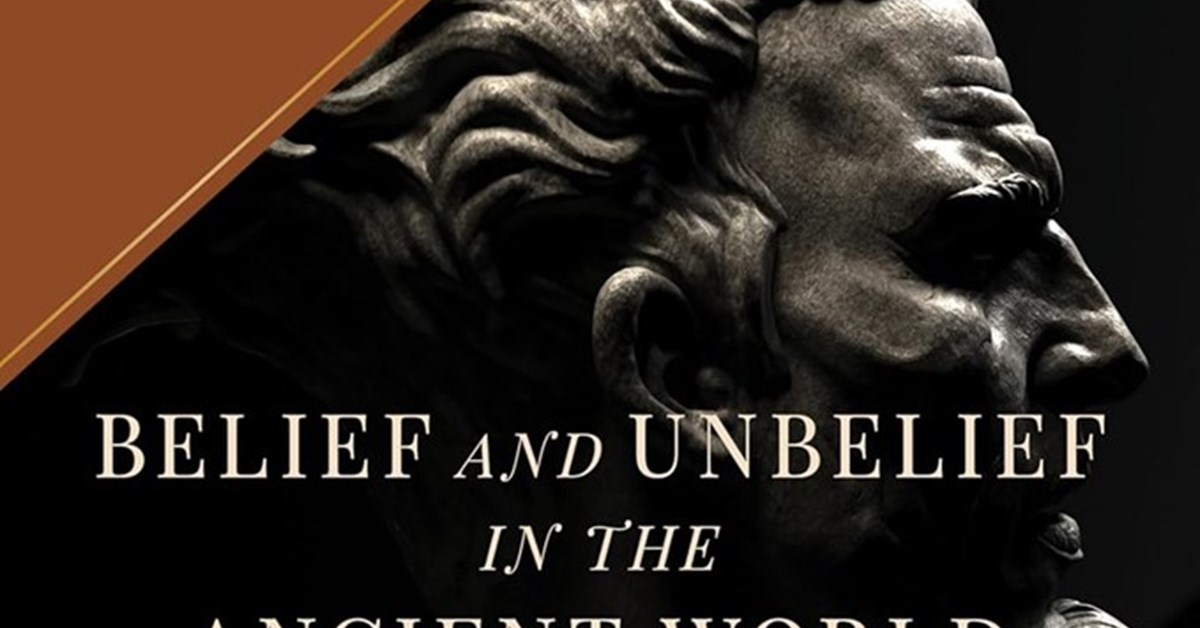
Belief and Unbelief in the Ancient World
Taylor O. Gray, Ethan R. Johnson, and Martina Vercesi, editors
Eerdmans £54.99
(978-0-8028-7897-7)
Church Times Bookshop £49.49