THE Master of the St Johns’ Almshouse Triptych, which went under the hammer for £5.2 million (Sotheby’s, 3 December), was one of the undoubted highlights of the ghastly theme-park show “Gothic” at the V&A more than 20 years ago (Arts, 10 October 2003). That was when I last saw it properly.
There, it was suggested to come from Picardy, c.1480. The Bond Street sale catalogue suggested a similar dating and shifted its likely production a little, to Flanders. It is not known when it was brought to England or given to the almshouse, whether before or after the Reformation. The figures on the outer wings (Sts Peter and Paul, James and Thomas) make clear that it was not intended for King Henry VI’s (1437) foundation in Sherborne; that is dedicated in honour of the Baptist and the Evangelist.
Five healing miracles of Christ centre on the raising of Lazarus. The right-hand wing features the raising of the son of the widow of Nain, a teenager who looks bashfully relieved no longer to be snuggled beneath folds of an embroidered funeral pall, heavy with silver thread and crimson foliage.
In the crowd opposite Jesus and his Apostles, an Augustinian friar stands at the foot of the bier, his hands arched cathedral-like together in prayer as a single tear escapes his left eye. It is a contemporary street scene, familiar across Christendom. Life and death in the 15th century were accompanied at every step by the Church.
Members of the mendicant orders lived in towns and cities unlike the cloistered orders, such as the Cistercians. The Franciscans and Dominicans mixed with the people whom they served in praying, preaching, and praising God. Their basilica-like churches were built as preaching boxes to welcome hundreds of lay people to hear the Word of God, not for the closeted worship of a closed community.
Jonathan Ruffer, in his Spanish Gallery at Bishop Auckland, has focused our attention on the mendicant tradition of contemplative prayer with two anniversaries that fall in 2025 -26: St Francis of Assisi died in October 1226, within a year of the birth in Sicily of St Thomas Aquinas, who was to become a noted Dominican preacher. The Order of Preachers was established in 1215.
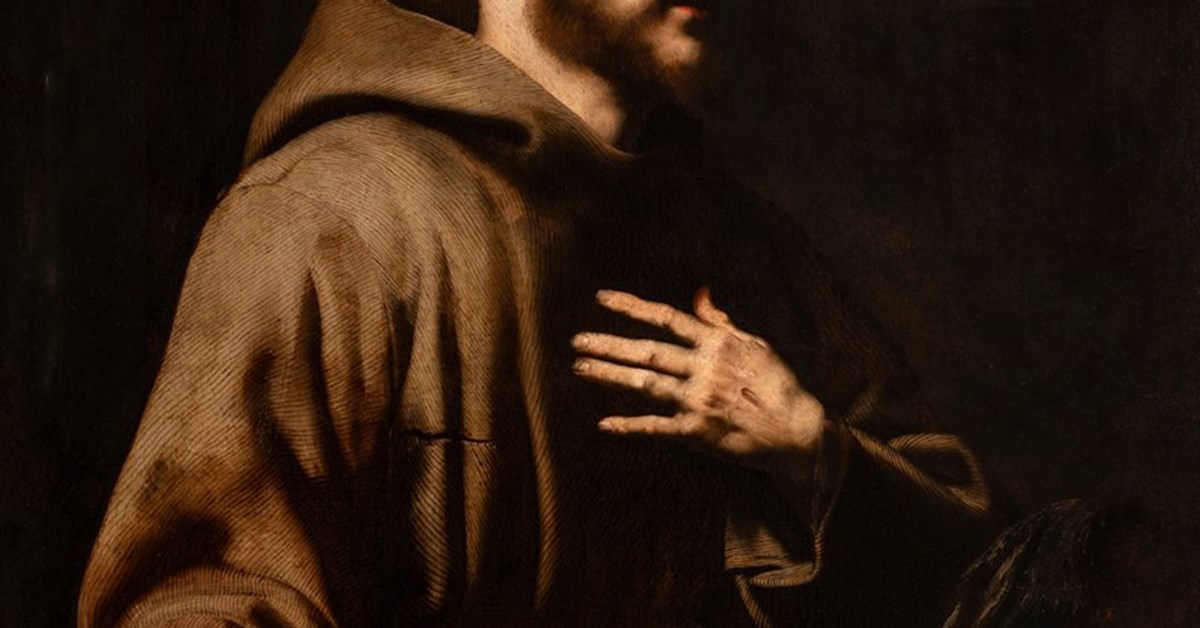
Ruffer delightfully encapsulates Francis’s simplicity of heart in his service of the marginalised, preferring “squirrels over squires, the hungry over the high born”. “Il Povero” in contemplation was painted four centuries ago by Jusepe de Ribera (1591-1652) and was acquired in 2021 from an Italian family in Genoa.
The saint, with his right hand held out, palm upwards, and his left on his breast, gazes at the light that, coming from the heavens, illuminates him. In front of him, set aside on a stone, are a skull, a scourge, and a simple wooden cross. It is as if the saint has now found the presence of the one who is the Son of God without the assistance afforded by earthly instruments.
Unusually, the artist has indicated the side wound of the stigmata, as his habit is neatly rent, and, I think uniquely, has placed a sunburst of a small ten-pointed (or is it 11?) gold star on his forehead. Like a Tiki or a Bindi, Francis now has a third eye with which to contemplate God.
The later portrait (and it most nearly is that) of Aquinas (c.1640-60) was acquired some years before the Covid pandemic, but is being shown for the first time. Alonso Cano (1601-67) has captured the tousle-headed youthful Dominican as the latter pauses to write. The scholar has found himself writing the word of God and is daunted by the prospect of encountering the Word of God more fully.
Although Aquinas was created a Doctor of the Church in 1567, three years after the final session of the Council of Trent, his cult never gained much alongside those of Sts Ambrose, Augustine, Gregory, and Jerome, except in Spain. There, he was championed by the Dominicans for showing that deep scholarship, underpinning theology, rather than the heart’s simple affection, could be a route to the Godhead.
Juan Bautista Maíno was born and raised in Spain. His mother came from Portugal, and his father was a silk merchant from Milan. It is is possible that, as a young artist, Maíno left the workshop in Toledo of El Greco for Madrid. He might have trained with Simon Peterzano, Caravaggio’s old tutor, in Lombardy before moving to Rome by 1604, as we now know that he had a natural son baptised there in 1605.
Caravaggio was the leading artist in Rome by the time he arrived, and Maíno quotes from him severally, most directly in the Apparition of the Christ Child to St Anthony of Padua, a work that was only recently recognised in a private Roman household and was not part of the Prado’s ambitious 2009 monographic exhibition.
In Caravaggio’s Supper at Emmaus (National Gallery, London), the startled Apostle stretches out his left arm, as if reaching into our world. Maíno has the surprised Franciscan saint throw out his arm in an identical pose, as the Christ Child appears in front of him, stepping from the pages of a book, the incarnate Word found in the words he has been reading.
In this painting, possibly dating to 1609, before he left Rome (1611) to enter the Dominican order in his native Spain (1613), Maíno can help us to reflect on God in both our seeing and thinking. The subject may have had a personal resonance for him, given that, like his mother, the saint was born in Lisbon.
St Anthony of Padua, too, was proclaimed a Doctor of the Church, but not until January 1946.
“800 Years of the Mendicant Orders: The Spanish Golden Age and the Contemplative Tradition” is at the Spanish Gallery, Market Place, Bishop Auckland, Co. Durham. Check website for opening times: aucklandproject.org