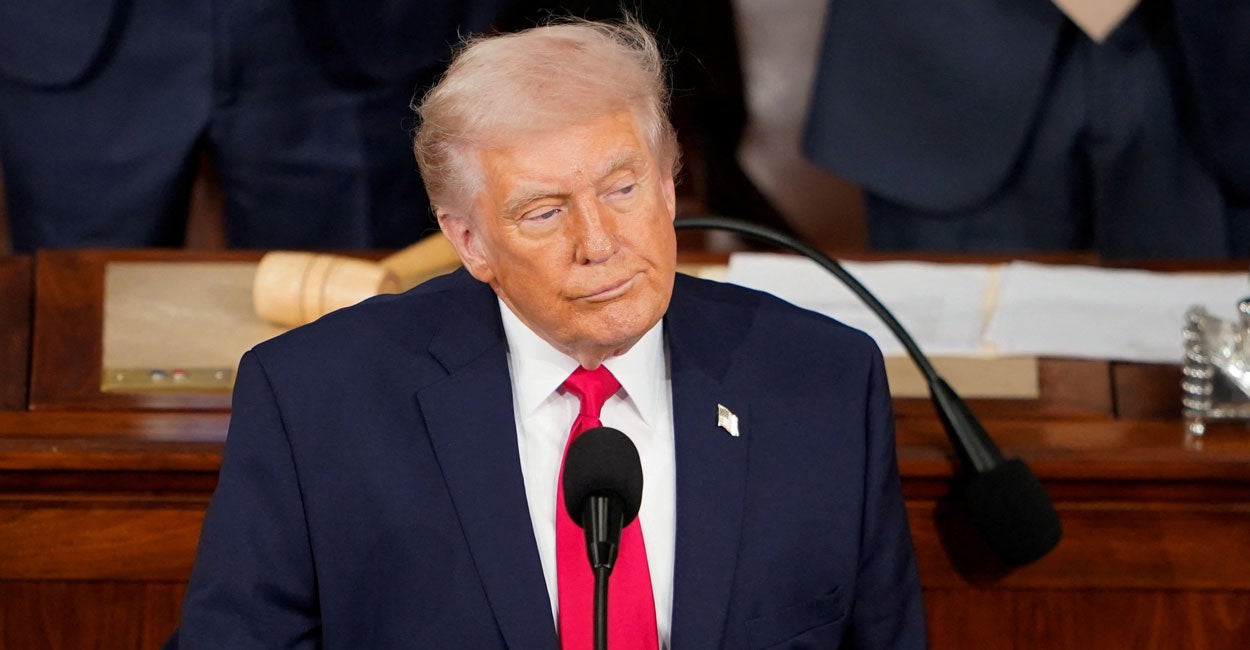
As President Donald Trump delivered a record-breaking 1 hour and 47 minute State of the Union address Tuesday night, political commentators were quick to dissect every line. Cable news panels lit up. News outlets published instant analysis. Lawmakers took to social media with quick takes.
But a more fundamental question has emerged in the days since the speech: Who was watching?
Fox News scored the highest ratings on TV, accounting for 67% of total cable viewers during the State of the Union, and securing the most viewers for Virginia Gov. Abigail Spanberger’s Democrat response. According to the final numbers from Neilsen, Fox’s TV channels had over 11.9 million viewers on cable and 1.9 million in 25-54 age demographic.
Overall, however, viewership was down for Trump’s speech. Nielsen reported that 32.6 million people watched the State of the Union address across 15 TV networks, down from 36 million last year.
By comparison, Trump’s 2017 speech had nearly 48 million viewers. President Bill Clinton holds the modern-day record with nearly 67 million viewers in 1993.
Veteran pollster Scott Rasmussen, founder of the Napolitan Institute, said the State of the Union speech simply doesn’t attract as much attention—or have as much impact—as it once did.
“In terms of its impact on public opinion and the midterm elections,” Rasmussen said, “I can say with a high degree of confidence, there won’t be any.”
A Vanishing National Audience
The numbers underscore a dramatic shift in how Americans consume political events.
In the 1970s, when a president addressed the nation, regular programming was suspended across the three major broadcast networks. If you were watching TV that night, then you’d be watching the president’s address.
The rise of cable television in the 1980s fractured that audience, but major presidential addresses still garnered widespread attention.
Today, the media environment is completely different.
Even though Trump’s address amassed fewer viewers this year, it’s still an notable turnout for a weeknight, nevertheless a drastic decline from Clinton’s numbers in the 1990s.
Streaming platforms, social media feeds, and on-demand programming have replaced the once-shared national moment. The internet offers constant options—and constant opinions from everyday Americans.
The Daily Signal is among the news outlets that streamed the speech live to its audience on “The Tony Kinnett Cast.” More than 100,000 viewers tuned in for Kinnett’s coverage, which featured four members of Congress, Daily Signal journalists, and other commentators.
When looking at the viewers, those who do tune in for the president’s speech tend to be highly engaged in politics: supporters eager to cheer, critics ready to rebut, and journalists searching for headlines. For many voters in the middle, according to Rasmussen, the speech simply does not register.
Policy in a Fragmented Age
That disengagement may carry broader political consequences—particularly on issues such as tariffs, where public opinion appears fluid.
Recent polling shows 38% of voters believe tariffs benefit the economy, while 50% say they are harmful—a sharp shift in sentiment over the past several months. The issue has exposed fault lines within the Republican coalition, where traditional free-market conservatives have expressed skepticism even as Trump’s core supporters remain energized.
Rasmussen argued that tariffs function more as political symbolism than as a detailed policy debate for most Americans.
“The issue of tariffs is really a political symbol more than substance,” he said. “People don’t sit around talking about the impact of tariff policy. In fact, most voters don’t see tariffs as a contradiction to free markets in any way, shape, or form. They just view it as a sales tax.”
The Electoral Equation
This dynamic presents a challenge for Republicans. Trump’s most loyal supporters are motivated and highly participatory, which rivals Democrat voters. More traditional Republican voters—many of whom are less enthusiastic about tariffs—are also the ones historically less inclined to turn out in midterm elections.
If major addresses like the State of the Union no longer reach beyond entrenched political camps, the president’s ability to reshape opinion on complex economic issues may be limited.
In a media landscape defined by factions, even a lengthy speech from the president of the United States may struggle to break through—leaving the political war over policy issues to play out among voters who may not even have been watching in the first place.