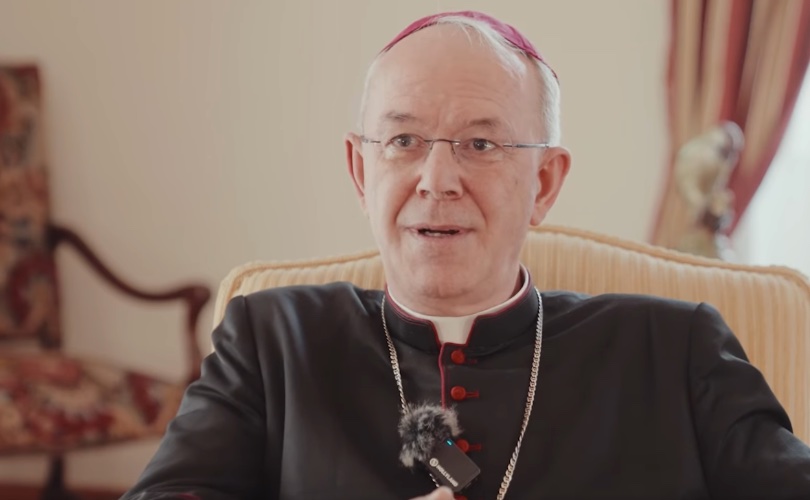
(LifeSiteNews) — In a recent interview, Bishop Athanasius Schneider confirmed that many bishops refuse assent to doctrines proposed by Francis in acts of his magisterium because they think his teaching was erroneous.
This refusal to assent undercuts the claim made by the defenders of Francis’ papal claims that he enjoyed the “universal and peaceful adherence” of the hierarchy.
As I have explained in an earlier piece, it is far from clear (to put it mildly) that peaceful adherence to a man as pope can be reduced to mere verbal recognition. If a bishop says he accepts a man as pope but simultaneously regard him as a heretic to whose teaching he cannot give assent, can it truly be said that he “peacefully adheres” to him as pope?
We will explore this question in more detail below, but first let’s look more closely at Bishop Schneider’s comments.
Bishop’s Schneider’s admission
In his interview with Robert Moynihan, Bishop Schneider stated:
When I ask them personally, off the record, could you accept the switching of your mind on Amoris Laetitia, and the communion for the divorced and so on, and they say ‘no,’ but publicly they don’t dare to say this.
In other words, Schneider is confirming that there is a body of bishops who do not, and will not, assent to the teaching of Francis in Amoris Laetitia, the interpretation of which was confirmed by a letter of the Argentinian bishops, published as an official act of the magisterium in the Acta Apostolicae Sedis.
Bishop Schneider indicates that there are more doctrines to which bishops refuse to give assent, such as the permissibility of blessing same-sex couples, which was authorized in Fiducia Supplicans.
One of the clearest examples of Francis teaching heresy in what purported to be an act of the magisterium was the addition to the Catechism of the Catholic Church of a statement that the death penalty is inadmissible in all circumstances. This directly contradicts divinely revealed doctrine.
Bishop Schneider, Cardinal Raymond Burke, Cardinal Janis Pujats, Archbishop Tomas Peta and Archbishop Jan Lenga rejected this false doctrine and professed instead their adhesion to the doctrine the Catholic Church has always taught. In fact, in their “Declaration of the truths relating to some of the most common errors in the life of the Church of our time,” they felt the need to reaffirm no less than 40 points of doctrine that they felt were under threat during Francis’ reign.
This declaration is a clear example of disunity on multiple points of doctrine, many indisputably concerning truths that must be believed by divine and Catholic faith. The implications of this disunity were discussed in some depth here and some of the key points made will be addressed again below.
The teaching of the pope as the proximate rule faith
God entrusted a revelation to His Church and charged her to transmit it intact to every generation until He comes again in glory.
The authority and responsibility of teaching the Catholic faith belongs to the Roman Pontiff and to those bishops who head the local churches in communion with him, that is, the ordinaries. This teaching authority is called the Sacred Magisterium. It is also referred to “the Church teaching” to distinguish it from all other members of the Church who are referred to as “the Church taught.”
The proposition by the Magisterium of the doctrine to be believed by divine and Catholic faith is called the proximate rule of faith.
The ordinary means by which the proximate rule of faith is proposed to the faithful is the continuous teaching of the Pope and the Ordinaries dispersed throughout the word. This is called the universal and ordinary magisterium.
An extraordinary means by which the proximate rule of faith is proposed to the faithful is the solemn judgment of a pope or Ecumenical Council on a particular question. This is called the extraordinary magisterium.
Both the universal and ordinary magisterium and the extraordinary magisterium are infallible, that is, they cannot err. The teaching of an individual bishop, or group of bishops, can err when it opposes that of the Roman Pontiff and the body of bishops in communion with him.
The Roman Pontiff is the supreme teacher of the Catholic faith. The pope and ordinaries have authority to teach the faithful, who must receive the truths of the faith from them. However, the ordinaries are themselves subject to the teaching authority of the pope.
The pope is not subject to any human ecclesiastical authority, but he is bound to transmit intact the revelation that he himself received from the previous generation of popes and bishops. (See here for more on how the pope receives the doctrine of the faith that he is to teach)
The entirety of the divine revelation has been transmitted, for nearly 2,000 years, by the universal and ordinary magisterium operating in this manner. Only a limited number of doctrines have been proposed by means of the extraordinary magisterium.
The pope, in his ordinary magisterium, (i.e. not by solemn extraordinary judgment), teaches that which is to be believed by divine and Catholic faith. The bishops receive this doctrine and teach it to the faithful, who assent to the teaching of their ordinary. (The pope can, of course, also teach the faithful directly.)
Let’s examine the implications of this in regard to the attempt by Francis to teach heresy to the universal Church through a universal catechism.
The purpose of the Catechism of the Catholic Church is set out in No. 12 of that text (my emphasis):
This work is intended primarily for those responsible for catechesis: first of all, the bishops, as teachers of the faith and pastors of the Church. It is offered to them as an instrument in fulfilling their responsibility of teaching the People of God. Through the bishops, it is addressed to redactors of catechisms, to priests, and to catechists. It will also be useful reading for all other Christian faithful.
In other words, the catechism is addressed primarily to bishops so that, on receiving its doctrine, they can it teach to the faithful. It is intended that the entire Church be united in professing the doctrine that it contains.
The amended edition of the catechism still opens with Laetamur Magnopere of John Paul II that refers to the catechism as a “sure norm for teaching the faith.”
Yet, if the entire Church were to receive the doctrine of this catechism, the entire Church would embrace heresy, and the entire Church would defect. This defection would have come about because the universal church had given its adherence to the universal and ordinary teaching authority of a pope.
This theoretical possibility is one reason why it is the more common opinion of theologians that the pope can never be a public heretic: A pope who taught heresy to the church through his universal ordinary magisterium would lead the church to defect. Hence, these theologians hold either that (i) a true pope could never fall into public heresy or (ii) a true pope could fall into public heresy but would cease to be pope if he did so.
The great ecclesiologist Cardinal Louis Billot wrote:
But whatever you finally think about the possibility or impossibility of the aforementioned hypothesis, (as to whether or not a true pope can fall into public heresy) at least one point must be maintained as completely unshaken and firmly placed beyond all doubt: the adherence alone of the universal Church will always be of itself an infallible sign of the legitimacy of the person of the Pontiff, and, what is more, even of the existence of all the conditions requisite for legitimacy itself. One need not fetch from afar proof of this claim. The reason is that it is taken immediately from the infallible promise of Christ and from providence. The gates of hell shall not prevail against it, and Behold I am with you all days. To be sure, for the Church to adhere to a false pontiff would be the same thing as if she were to adhere to a false rule of faith, since the Pope is the living rule which the Church must follow in belief and always follows in fact, as will be still more clearly apparent in what is to be said later.
If the Church were “to adhere to a false pontiff,” it “would be the same thing as if she were to adhere to a false rule of faith, since the Pope is the living rule which the Church must follow in belief and always follows in fact.”
If Francis were the pope, and the Church had adhered to his universal and ordinary teaching authority, she would have adhered to a false rule of faith and would have defected.
But, in fact, the Catholic Church did not adhere to Francis. Catholics refused, and still refuse, to assent to his heresies. But those who wish to adhere to Catholic truth cannot have it both ways. They cannot refuse assent to acts of his magisterium – and even publicly denounce them – and then say that the situation in the Church was one “of peaceful and universal adherence” to Francis as the living rule of faith.
Cardinal Billot writes “the adherence alone of the universal Church will always be of itself an infallible sign of the legitimacy of the person of the Pontiff.” But the adherence of the universal Church does not consist in merely saying that a particular person is pope.
If a bishop refuses to assent to the magisterium of a papal claimant, denounces it publicly as heresy, or encourages others not to assent to it, how can this be regarded as peaceful adherence to a man as “the living rule which the Church must follow in belief and always follows in fact”?
No greater accusation can be made against a papal claimant than that of heresy, schism or apostasy, because these three sins by their nature separate a man from membership of the Church, (as is explained here and here and here). The very fact that one judges a man to be a teacher of heresy seems to preclude offering adherence of intellect and will to his teaching.
Do as I say, not as I do
In the encyclical Singular Quadam, Pope St. Pius X taught:
We first of all declare that all Catholics have a sacred and inviolable duty, both in private and public life, to obey and firmly adhere to and fearlessly profess the principles of Christian truth enunciated by the teaching office of the Catholic Church.
Bishop Schneider, to his great credit, has spoken out publicly against many of the errors of Francis and has shown himself to willing to express disagreement with Leo too.
Unfortunately, many other prelates – including cardinals who once spoke out – have fallen silent under Leo. Others have never raised their voices at all.
“Conservative” bishops and cardinals who remain silent fail to observe the injunction of Pope St. Pius X in two ways:
- They keep their adhesion to Catholic principles private, acknowledging their dissent from Francis (and Leo) among themselves, rather than fearlessly defending the truth in public life
- They present those in power in the Vatican as “the teaching office of the Catholic Church” while repeatedly refusing assent to the doctrines taught teach.
When a bishop or cardinal presents a man to us as pope, they are, by that very act, presenting him to us as “the living rule which the Church must follow in belief and always follows in fact.”
To present Francis in this manner was, and remains, gravely scandalous. This is because millions of ordinary lay people will naturally seek to give adhesion of intellect and will to the teaching of a man being presented to them as pope, especially by pastors they trust.
This will lead to grave consequences. For example, members of the faithful who believe the doctrine in Francis’ catechism will be assenting to heresy and those who follow the teaching of Amoris Laetitia or Fiducia Supplicans may commit grave sin and separate themselves from God.
And, of course, not one of these apparent acts of the magisterium has been corrected by Leo.
It is good that there are bishops who refuse assent to these errors but is not good that they do so in private, among themselves, while leaving the faithful under the impression that Francis was a legitimate teacher of the Catholic faith.
Our Lord condemned the hypocrisy of the Pharisees saying:
The scribes and the Pharisees have sitten on the chair of Moses. All things therefore whatsoever they shall say to you, observe and do: but according to their works do ye not; for they say, and do not. (Mt 23:2-3)
In the case of “conservative” bishops and cardinals, it would be more accurate to say that we ought not to do what they say (take Francis as a rule of faith) but in fact do what they do (refuse assent to erroneous doctrines.) In any case, their actions do not match their words.
The second part of Our Lord’s words also ring true:
For they bind heavy and insupportable burdens, and lay them on men’s shoulders; but with a finger of their own they will not move them. (Mt 23:4)
“Conservative” cardinals and bishops lay upon the ordinary laity the burden of recognizing a public heretic as pope while they refuse to address the scandal caused by such a recognition or to take the necessary steps to secure the election of a legitimate pontiff.
May God raise up true shepherds for His Church!