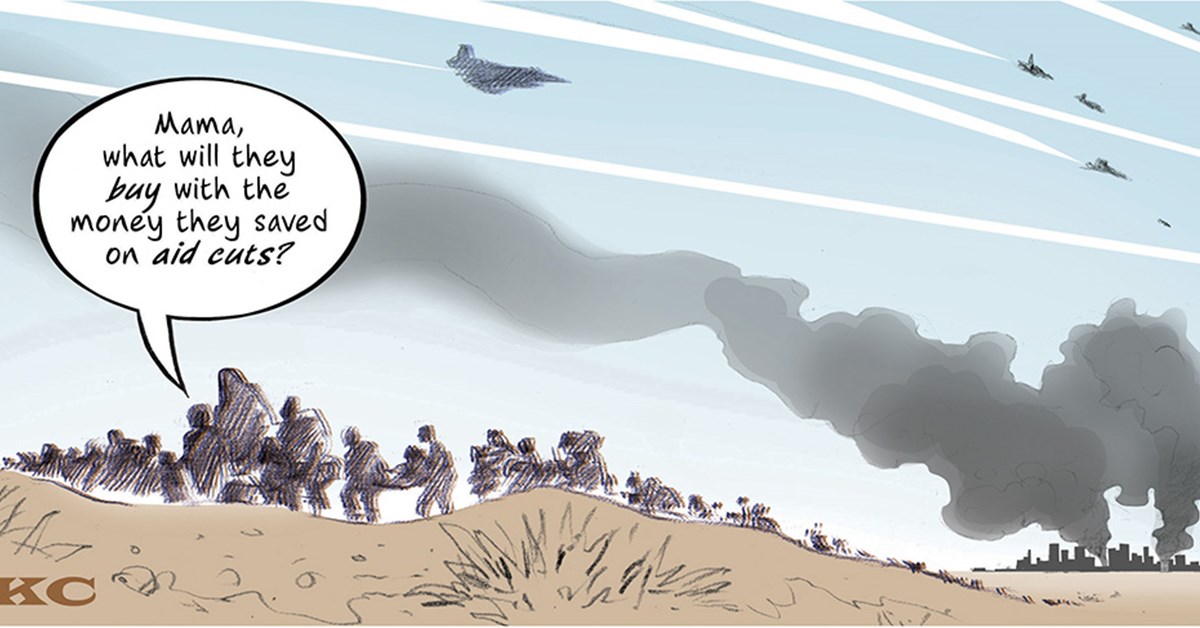
WHEN times are tight, sacrifices are made. But the question that needs to be asked is: By whom? The Government’s decision to slash foreign aid (News, 28 February 2025), on the heels of the US government’s cuts a year ago, threatens essential services, with life-and-death consequences for millions of people already in desperate need.
This month, we heard reports of yet more cuts to funding for those countries worst affected by the climate crisis — rowing back on promises made only last year by the UK to bolster climate finance. This is difficult to explain to people who are paying — in some cases with their lives — for crises that they did not create.
Christian Aid’s partners see first-hand the cruel choices foisted on communities as a result of extreme poverty: parents forced to choose between food or medicine for their children; farmers travelling miles on empty stomachs to find water for their crops; and families forced by conflict and disaster to abandon their homes for the uncertainty and dependency of refugee camps.
The past year has been a turbulent one, notable for the scale and intensity of emergencies around the world and also for the dramatic cuts in official aid funding, signalled by Elon Musk’s boast that he would put the US aid programme through a metaphorical woodchipper.
Decades of progress on global poverty are under threat. The poorest countries had already been hit hard by Covid-19 — a recent World Bank report shows that their economic recovery has lagged behind the rest of the world’s — and are increasingly under pressure from a crushing debt burden. Aid cuts will make a bad situation only worse.
THANKFULLY, Christian Aid has been able to sustain much of its life-changing work because of the commitment of our supporters, which continues to create hope in situations that might otherwise appear hopeless.
During the past 12 months, we have reached more than four million people directly through innovative and practical programmes, from community kitchens and urban gardens, to savings and loans schemes, and counselling for survivors of sexual violence. Every gift helps to make a genuine difference for families for whom hunger, sickness, and fear cast a shadow over their daily lives.
These include people such as Akech, from Sudan, whose life was thrown into turmoil when her husband and eldest son were killed trying to stop soldiers from raping her. Their sacrifice gave Akech time to hide her other children and herself, gather her wits, and run.
By the time she got her family to relative safety across the border in South Sudan, what little cash she had was gone. Thanks to the generosity of Christian Aid’s supporters, our partners working on the South Sudanese side of the border were able to provide cash assistance, allowing Akech to prioritise her needs and restore some control over her life after the profound trauma of her attack and flight. This is support that we are able to provide to thousands of other refugees fleeing the war in Sudan, in overstretched camps with densely packed makeshift shelters, which offer little protection from rain and sun.
But, around the world, donor funding cuts, coupled with rising costs, mean that donations are stretched further than ever in the face of intensifying demand. This is why Christian Aid is asking its supporters to help it to bridge the gap so that it can continue to step up for people such as Akech.
MEDIA coverage of crises can sometimes make it seem as though our efforts were making little difference. But global progress in health, education, and nutrition, over recent decades, tells a different story: that poverty is not inevitable. That positive change shows up in the data of United Nations reports. We see it at the community level in the work of our partners supporting families to rebuild their lives in the wake of disasters; in the women speaking out against violence; in farming communities’ finding new ways to protect their crops in a changing climate.
It follows that, if poverty is not inevitable, its continued impact on the lives of hundreds of millions of people should serve as an urgent call to action. For many of the people with whom we work, poverty is not simply the result of local circumstances. It reflects a world in which power and resources are held unequally; in which the created order is degraded and destroyed; and in which many people are denied opportunities because of who they are — women denied the ability to own land, indigenous people denied a political voice, refugees denied the ability to work.
This is why, since our foundation in 1945, we have worked on two fronts: to alleviate suffering in emergencies, and to tackle the underlying reasons for that suffering, through long-term work with communities on transformation, and through campaigning.
As the agency of the British and Irish Churches, our mission is grounded in the belief that love of neighbour transcends national borders. We know that our supporters believe in that mission and are generous in their support — often exceptionally so. When times are tight, Christian Aid continues to work alongside people who have already sacrificed too much. Will you stand with us?
Patrick Watt is the chief executive of Christian Aid.