I SHOULD have made a will 20 years ago. When I eventually got round to it, what shook me out of my complacency was the prospect of doing it theologically. By that, I don’t primarily mean leaving money for theological purposes (although there is some of that). I mean will-writing as an expression of faith. Since — I discover — this is “Update your Will Week”, it seemed a good time to revisit the fun that I had in writing my preamble.
Here is the first paragraph, adapted from several historical examples: “I die, as I have lived, a Christian. I commit my body to be buried in the earth, in hope of the Resurrection. My soul I commend to Almighty God, asking him to receive it in mercy, on account of the Incarnation, Passion, and Resurrection of my Lord, Jesus Christ. Of those I have wronged, I ask forgiveness; those who have wronged me, I forgive, and ask God to forgive them also.”
A will is a public document. It allows us to lodge something in the public record which attests to the goodness of God and which bears witness to his grace. As William Assheton put it, in his Theological Discourse of Last Wills and Testaments (1696), it is good to “declare your Christianity” and show the world the “reason of the hope that is in you”.
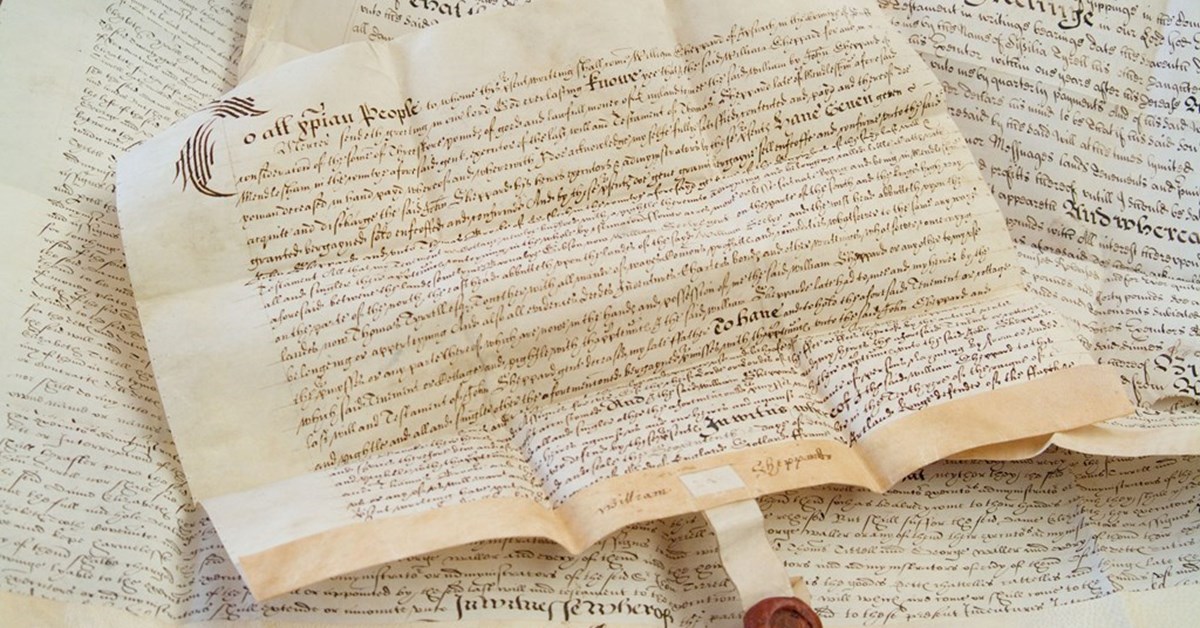
IT HAS been a while since wills typically began with such a preamble, but go back a few centuries, and it was the norm. From the high Middle Ages — at least since the 13th century — wills typically began by invoking God and committing the soul to him and to the prayers of the saints. Some further confession of faith often followed. If the testator was wealthy, provision might be made for masses to be said for his soul in purgatory.
As we would expect, aspects of that changed at the Reformation. From the perspective of our more secular age, however, it is the continuity that stands out. References to the saints and to masses for the dead were set aside, but explicitly religious terminology remained normal, now expressed in terms of Christ’s sole mediation before God. When there is mention of predestination, the influence of Calvinism can be discerned.
Consider this form of words, used and reused around Manchester between 1616 and 1646 (as discussed by R. C. Richardson in a 1972 paper in Local Population Studies): “First and principally I render and bequeath my soul unto my lord God and creator, firmly trusting that by the death and passion of his dearly beloved son Christ Jesus my saviour and redeemer and by his only mercy and mediation for me, I shall live and partake with his blessed saints in his heavenly kingdom of those celestial joys which of his eternal goodness he hath prepared for his Elect, of which number, through his infinite grace and mercy, I do confidently hope and believe that I am one.”
RELIGIOUS invocations became more formulaic — although they did not vanish — with the rise of the solicitor and the increased use of standard forms from the 17th century onwards. Responsibility for ruling on wills remained the business of ecclesiastical courts until the Court of Probate Act 1857. Since the end of the 19th century, the opening of a will has usually been about as flat and prosaic as one can imagine: “I, [Name], of [Address], revoke all former wills and testamentary dispositions and declare this to be my last will and testament.”
I think we can do better than that, whether we make use of some opening paragraphs before the legal material begins, or append a cover page. After my opening paragraph (reproduced above), my will turns to funeral and burial wishes, and only then to the formal legal wording.
“I wish my funeral Requiem to be conducted according to the rite and ceremonies of the Church of England, in traditional language, and in the spirit of the Oxford Movement. . . I wish to be buried in the churchyard of St Peter’s Church, Rowley, East Yorkshire — since that is where I was baptised — according to the Book of Common Prayer of 1662, with such additions in the spirit of the Oxford Movement as the Rector or priest taking the service sees fit to add.”
IF WE want a good Church of England justification for paying attention to will-making, we need look no further than the Book of Common Prayer and its service for the Visitation of the Sick.
There, the parson is charged with the following responsibilities: “If [the sick person] have not before disposed of his goods, let him then be admonished to make his Will, and to declare his debts, what he oweth, and what is owing unto him; for the better discharging of his conscience, and the quietness of his Executors.”
We are also told that parishioners “should often be put in remembrance to take order for the settling of their temporal estates whilst they are in health”, and that the minister “should not omit earnestly to move such sick persons as are of ability to be liberal to the poor”. All excellent advice.
The Prayer Book’s rubrics also offer advice here which, I think, backs up what I put in my will concerning moral and spiritual debts: “exhorting him [the sick person] to forgive, from the bottom of his heart, all persons that have offended him; and if he have offended any other, to ask them forgiveness; and where he hath done injury or wrong to any man, that he make amends to the uttermost of his power”.
If the Church mentions wills today, it is probably to encourage us to be generous to Christ’s body on earth, which is fair enough. Also important, however, is the opportunity to let our final words bear witness to our Saviour — words that are read even after our last breath has left us: “I die, as I have lived, a Christian. . .”
The Revd Dr Andrew Davison is Regius Professor of Divinity in the University of Oxford and a Canon Residentiary of Christ Church.