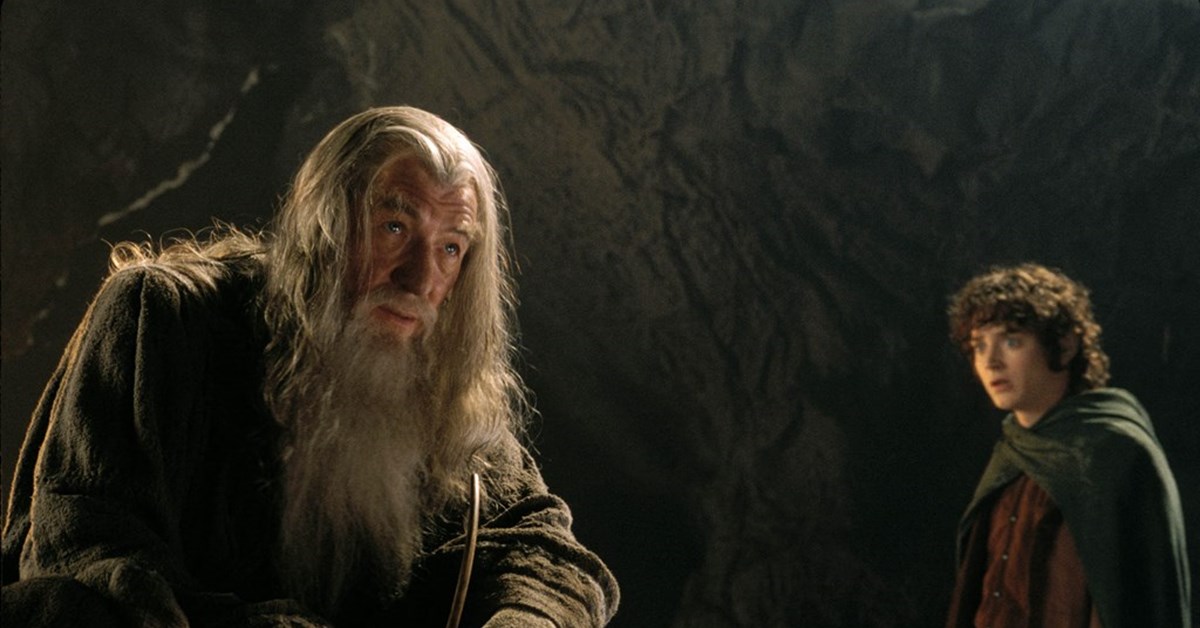
Frodo and Gandalf — All We Have to Decide Is. . .?
J. R. R. Tolkien, The Fellowship of the Ring and The Battle of Maldon
YOU would not be alone in thinking that we are living at a moment when things seem to be in the balance, perhaps tipping in the wrong direction. Many of us find ourselves echoing Frodo’s plea: “I wish it need not have happened in my time.” Frodo has just found out the very bad news that he is in possession of the ultimate weapon and prize of the enemy — the Ring. Gandalf’s answer is very wise and resonates with so many of us. He advises acceptance as we can’t change what is given our generation, saying, “So do all who live to see such times. But that is not for them to decide.” He goes on, “All we have to decide is what to do with the time that is given us.”
Not many remember past that to the next sentence, but he says, “Already . . . our time is beginning to look black.” He doesn’t tell Frodo, “Don’t worry, you’ll get your happy ending”; he is trying to help his friend face impossible odds with resilience and courage.
ALMOST every generation — some very particularly — have felt they were living in dark times. The rapid pace of change, pandemics such as Covid-19, the impact of the changing climate, war and the rumours of war: these are familiar and stressful prospects.
One of the greatest fears of a parent is our country going to war and adult children being sent off to fight — something many mothers and fathers around the world are facing now. It once might have seemed far off; now it doesn’t feel unimaginable. It would be great to have a delete button to get rid of such threats, but that doesn’t lie in our power.
WHAT can we do? This is where Tolkien can help. He faced at least two occasions when the skies turned black — the First World War and the Second World War Two — for himself and then for his sons. He wrote this sentence in the late 1930s as he saw countries gearing up for war against the forces of Nazism. Having passed through the Somme, the bloodiest battle for British troops in the First World War, he knew such times could not be wished away, no matter how hard you tried.
What he offers in response is a Stoic philosophy with a Christian twist. It is how you fight the battle, not whether you win. As Galadriel later tells Frodo, she and Celeborn have been fighting “the long defeat”, not expecting victory but prepared to diminish and go into the West. Here Tolkien is nodding to the idea of Ragnarök, the end times, from his favourite Norse myths. In this final battle, the point is not being on the winning side, but on the right side. You fight alongside gods and men, not on the giants’ team.
Or, as one of Tolkien’s favourite Anglo-Saxon poems, The Battle of Maldon, puts it, in Tolkien’s own translation that he was working on at this time: “Each mind shall be the sterner, heart the bolder, each our spirit greater as our strength lessens!” (The Battle of Maldon together with The Homecoming of Beorhtnoth, edited by Peter Grybauskas, HarperCollins, 2003).
BUT before we leave ourselves in grim Stoic acceptance, let us remember the Christian twist of eucatastrophe — the sudden joyous reversal. It is there in Gandalf’s words: the time that is “given” to Frodo. He hints that there is another hand behind events, giving us the moment. With this hope, you can hope for the best.
Gandalf later muses that, though the encounter of Frodo with Gollum seems bad news: “Let us remember that a traitor may betray himself and do good that he does not intend. It can be so, sometimes.” It proves to be true. And Elrond offers an empowering notion: “Yet such is oft the course of deeds that move the wheels of the world: small hands do them because they must, while the eyes of the great are elsewhere.”
Reflection
As we gear up for spiritual battle in our present day, what kind of warrior should we be?
Be merciful, have pity, be courageous — these are the lessons of The Lord of the Rings. When in doubt, stick to those values, and you win even if you lose.
In the light of that, what do you have to decide to do with the time you have been given? What can your “small hands” do to change things for the better?
Read Hebrews 12.1-2.
Julia Golding is a multi-award-winning novelist and director of the Oxford Centre for Fantasy, a small educational charity established to honour the life, work, and faith of the Inklings.
Malcolm Guite is a Life Fellow of Girton College, Cambridge; priest, poet, writer, and singer-songwriter; and an expert on the Inklings, Tolkien, and C. S. Lewis.
Professor Simon Horobin is Fellow and Tutor in English at Magdalen College, Oxford, holding the position that C. S. Lewis held at the college, and has lectured and published widely on C. S. Lewis and J. R. R. Tolkien. His latest book is C. S. Lewis’s Oxford (Bodleian Publishing).
This is an extract from Wardrobes and Rings: Through Lenten lands with the Inklings, published by Canterbury Press at £12.99 (Church Times Bookshop £10.39); 978-1-78622-690-7.