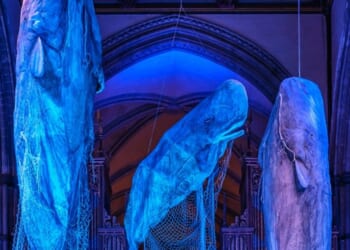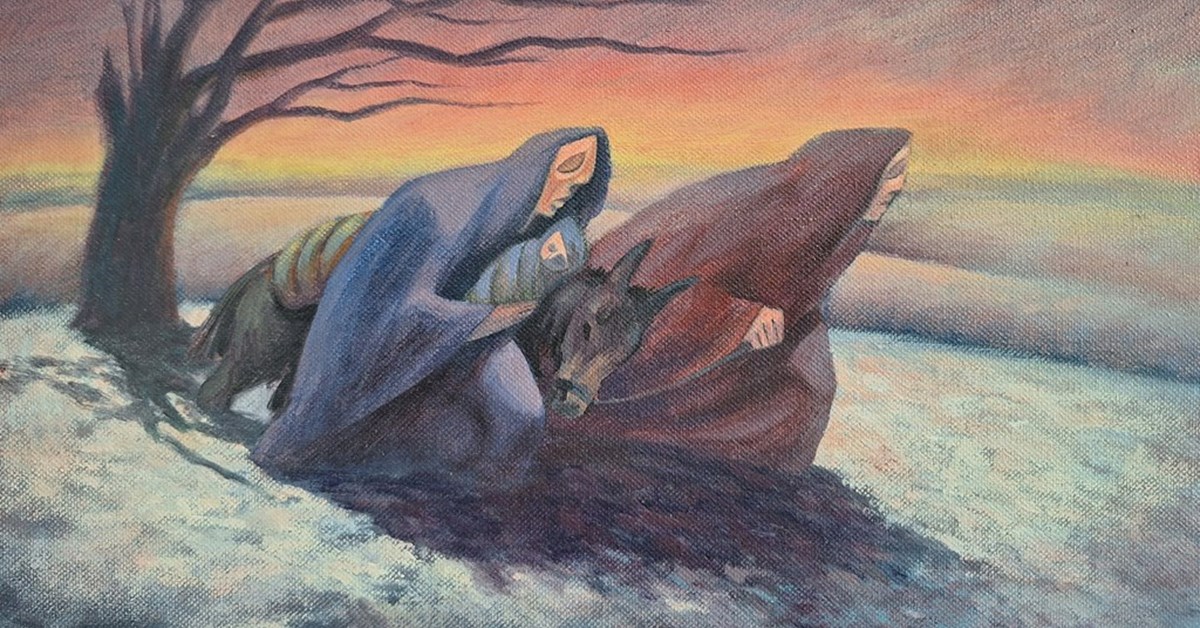
THE exhibition “Sanctuary” tells a story as it unfolds through paintings and sculptures surrounding the nave of Portsmouth Cathedral. The story that it tells is one that equates the flight into Egypt — which, in the Coptic Orthodox Church’s tradition, involved travel by boat along the Nile — with the experience of contemporary refugees: Mynheer notes that 117 million people in the past ten years have been refugees or internally displaced.
The story begins with the event that triggers the need to flee. In this story equating biblical events with contemporary, that event is The Massacre of the Innocents, the violence of which has been revisited in both “Hamas slaughtering the innocents of Israel” and “Israel wreaking terrible unmeasured vengeance on the people of Gaza”. In this striking image, the violence of the event is explosively contained on the left-hand side, while the fleeing family are hidden by the enveloping wings of a protective angel. The contrasting sides of this image raise the question why some die and others survive, but it has ever been thus when the desires of human beings have resulted in violent intent and actions.
Throughout “Sanctuary”, those who rescue and help others are portrayed as angels. Alongside the flight to Egypt, there are also images of the baby Moses being found and of Peter being rescued from Lake Galilee. Mynheer states that those “who rescue others in distress act for, and as, Christ”. This includes the brave men and women of the RNLI, who appear in The Rescue as ministering angels pulling refugees from the sea. When I met Mynheer as the exhibition was being hung, he commented on the contemporaneity of this image, as the weekend newspapers had carried reports of demonstrators spitefully accusing the RNLI of acting as a “taxi service for asylum-seekers”, although the RNLI was simply doing what it was set up for.
The Rescue comes towards the end of the story that “Sanctuary” tells. In it, the living are rescued while the next in the sequence, Michael Row the Boat, depicts the gathering up of “those who have perished in the attempt to cross the waters”, with St Michael rowing them on “one final journey to Paradise”. The story ends with Sanctuary, in which a family of three peacefully pick olives from a tree in safety. “With Peace comes Sanctuary”; and this is Mynheer’s prayer for all forced to flee violence, especially, at this time, the people of Gaza.
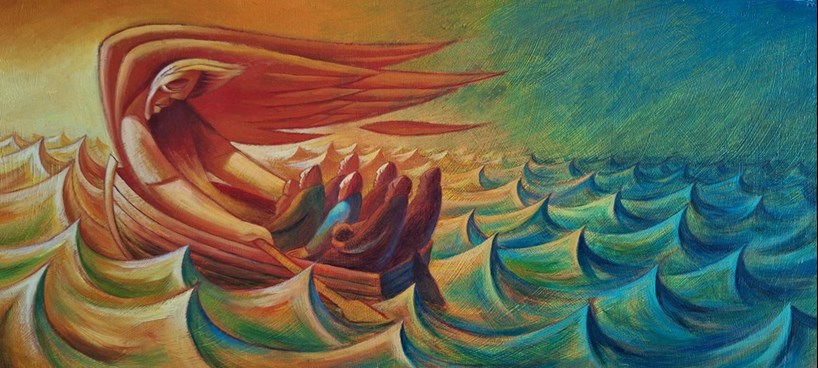 © the artistMichael Row the Boat (2024), oil on wood, by Nicholas Mynheer
In Sanctuary, the child depicted has planted a sapling, its growing leaves being a symbol of regeneration and of hope for the future. The olive tree carries resonances of the Tree of Life, an image that appeared early on in this sequence when the Holy Family were shown on the flight into Egypt with the great heavenly host floating above them and guarding the Tree of Life. Recovering access to the Tree of Life is where the story of the flight into Egypt finally ends, and this is prefigured in The Flight to Egypt (2009), an image that originally came to Mynheer in a dream.
Mynheer’s stylistic depiction of human figures complements both the violence that he depicts and the sanctuary that is eventually found. In The Massacre of the Innocents, the stylised images of trauma endured by those experiencing genocide will remind viewers of the horrors that Picasso depicted in Guernica. In a piece such as Boat Family (2022), the ovals of the faces mirror the ovoid bundle of the swaddled Christ-child, while the overlapping of the faces with the cradled child emphasises the togetherness of the family unit in the face of the challenges that they confront.
Supplemented by several movingly relevant poems, “Sanctuary” invites us to reflect on difficult and urgent questions. What would we do if our home were no longer safe? How would we respond if our faith, culture, or identity placed us in danger? What does it mean to hope for a better life when the risks are so great? These questions are not posed from a distance, but with humility and compassion, encouraging each viewer to consider their own response.
Alongside the exhibition, Portsmouth Cathedral is offering a programme of events, including a Lent course and artist talk, that provide different ways to engage with themes of refuge, displacement, compassion, and hope. The exhibition itself, however, provides a profound and poignant opportunity to pause, to reflect, and to consider what sanctuary truly means, not only as a place, but as a way of seeing and responding to one another.
“Sanctuary” is in Portsmouth Cathedral until 12 April. portsmouthcathedral.org.uk