“Why, I can smile, and murder whiles I smile” — Shakespeare
TO ACT with impunity is to act without fear of consequences. Like Richard III, we imagine that we can wound, deflect, distort — and carry on untouched. Ours is an age increasingly tempted by that fantasy.
Outrage now travels faster than reflection. Social media reward immediacy. News cycles feed on escalation. Algorithms amplify what is sharp and emotionally charged (whether true or not). Fear hums beneath it all — surfacing as suspicion, conspiracy, and a slow erosion of trust. Add power to that mix, and harm multiplies.
We see people behaving as though their actions had no impact: lashing out, blaming others, escalating conflict, or simply disconnecting from the hurt that they cause. Some of this is true impunity: power insulated from consequence. But some behaviour that looks like indifference is something else: it is dysregulation.
Our reactive culture keeps our nervous systems on constant alert. When overwhelm floods the body, the reflective parts of us go offline. We are no longer imagining anyone else’s inner world. We are no longer weighing consequences, but are anaesthetised from them. At its most extreme, we are like a person locked in solitary confinement — trapped inside our own alarm system and at the mercy of our own impulses.
With alarm, our wish to fight dominates. Anger becomes intoxicating. Blame is frictionless and culturally rewarded. It relieves us of the intolerable work of self-examination. Public affirmation, applause, and algorithmic reward strengthen the reflex. Yet, beneath the certainty is often something fragile: fear of humiliation, exposure, inadequacy, and failure. For some, “I made a mistake” collapses into “I am fundamentally bad.” If shame feels annihilating, we deflect from it through the shield of impunity.
Flight is fight’s twin. If fight says “attack”, flight says “escape”. We are surrounded by escape routes: alcohol, overwork, scrolling, distraction. Addictions promise relief, but the solution so often becomes the trap. When someone is caught in flight, they may be a wrecking ball. Stillness feels dangerous. To stop would mean to feel — grief, abandonment, fear. What looks like carelessness may in fact be desperate avoidance.
Understanding these responses does not excuse harm. A trauma lens does not nullify responsibility. But it shows why accountability requires steadiness — a steadiness that lets us truly register what is happening. Without regulation, we risk skimming past impact, anaesthetised from the consequences.
I first saw this in a jury room. For days, we listened to evidence of a violent crime. The defendant had lived for a time as if consequences did not apply. When the verdict was delivered and the judge said, “You go down,” there was a palpable exhalation in the courtroom. This was not vindictiveness: it was relief. A boundary had held, and reality had reasserted itself. Saying “no” to harm — calmly and lawfully — restored moral weight to the room.
Years earlier, in my psychotherapy clinic, I gently asked a client spiralling into blame, “Do you have any part in this?” She later told me that it felt as though a police officer had placed a steady hand on her arm and said “Stop.” She was not offended. She was relieved. The steady arrest made sight possible.
ONE antidote to our age may be what has been called “slow looking”: a practice increasingly highlighted in galleries and heritage spaces. Research shows that sustained, deliberate observation — whether of art, nature, or an ordinary object — calms the nervous system measurably. Our heart rate slows, our attention steadies, and the body registers safety. Physiological arousal decreases. The prefrontal cortex — the part of us capable of perspective and proportion — comes back online. In a culture of instant judgement, slow looking is quietly defiant. It creates space between stimulus and response. It makes humility possible.
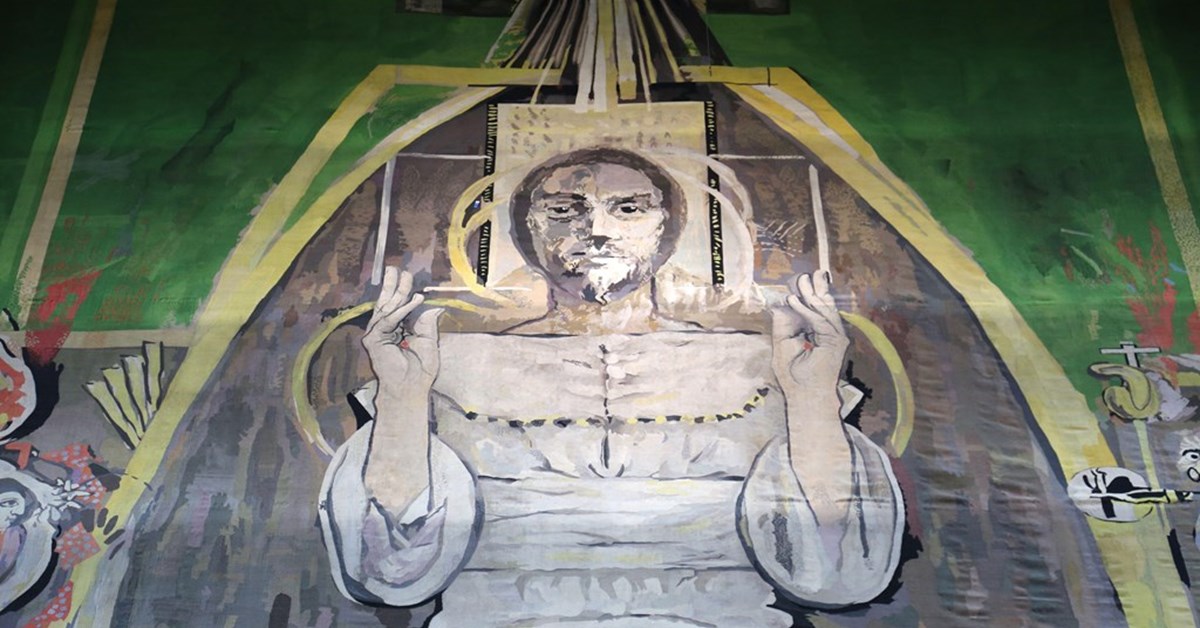
Standing in Coventry Cathedral before Graham Sutherland’s vast tapestry Christ in Glory in the Tetramorph (Arts, 20 July 2018), one encounters a gaze that cannot be scrolled past. It is unflinching, searching, compassionate — and judging. We are seen. What am I avoiding? What harm have I minimised? What grief have I disguised as distraction? Perhaps those who act with impunity are cut off from their own goodness and from any secure sense of being loved. I cannot imagine that they are truly happy.
What looks like hardness is often fear. What looks like certainty may be overwhelm.
What looks like indifference may be disconnection from impact. Recognising these patterns does not remove responsibility — but it reframes behaviour so that accountability becomes possible. Responsibility requires regulation; without it, we cannot fully see what we are doing.
Consider Jacob Dunne. As a teenager, in 2011, he threw a single punch at a young paramedic, James Hodgkinson, in a drug-fuelled frenzy. The blow killed James. Prison followed, but Dunne came out more lost and disenfranchised.
Only in an 18-month restorative-justice process, sitting with Mr Hodgkinson’s parents, did something change. Seeing their faces, Dunne could no longer blame the drugs, the group, or the moment. He had to look. In that steady encounter, responsibility became real — not annihilating shame, but grief; not performance, but accountability.
SOME impunity is structural: power shielded from consequence. Some is psychological: a nervous system so flooded that consequence barely registers. Both are dangerous. Jacob Dunne’s story shows that psychological impunity can be overturned by steadiness, presence, and confrontation with the effects of behaviour.
We can see these dynamics beyond individual lives. At the level of nations, agreements once regarded as solemn are treated as flexible. Laws designed to protect civilians are applied unevenly, if at all. When restraint weakens, it is always the vulnerable who absorb the shock. Impunity at this scale is not only about the audacity of those who break the rules, but the fatigue — or hesitation — of those who are meant to uphold them. Civilisations, like nervous systems, can lose the capacity for regulation.
If responsibility requires regulation, then our task is not merely to condemn wrongdoing, but to cultivate steadiness — in ourselves, our institutions, and our public life. Without steadiness, accountability becomes theatre. With it, accountability becomes possible.
In an age that monetises outrage and rewards speed, the radical act may be to slow down, to look carefully, and to remain steady enough to say “No” when harm is done: not to excuse, not to soften truth, but to hold the boundary, to stay in the room, and to insist that actions have weight. That quiet and disciplined steadiness may prove stronger than impunity ever was.
That quiet, disciplined steadiness may prove stronger than impunity ever was.
Philippa Smethurst is a trauma-specialist psychotherapist. Her latest book, 20 Ways to Break Free from Trauma, is published by Jessica Kingsley. philippasmethurst.com