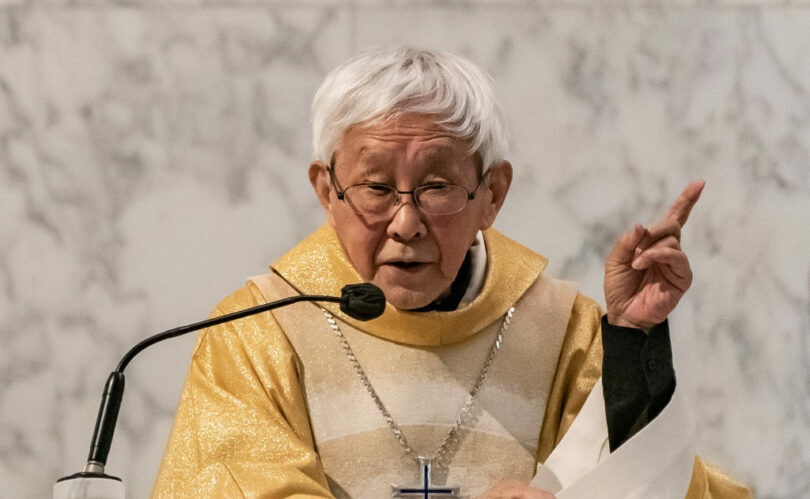
(LifeSiteNews) — Cardinal Joseph Zen has compared the Society of Saint Pius X to the biblical Joseph, son of Jacob, while commenting on tensions surrounding the priestly fraternity’s planned episcopal ordinations and its stalled dialogue with the Vatican.
On Friday, Zen, bishop emeritus of Hong Kong, published a message on the social platform X in which he reflected on the current situation involving the Society of Saint Pius X (SSPX) following the announcement that the priestly fraternity intends to carry out five episcopal ordinations on July 1 and in the context of its dialogue with the Vatican’s doctrinal office, headed by Cardinal Víctor Manuel Fernández.
“Reflecting on the first reading and the responsorial psalm of today’s Mass,” Zen wrote, “it seems one can see it like this: Joseph [figures the] SSPX; Joseph’s brothers, Cardinal Tucho [Fernández]; Ruben, Pope Leo.”
READ: Vatican envoy says ‘almost 400 million Christians worldwide face persecution’
In the post, Zen framed present tensions within the Church through a biblical analogy drawn from the account of Joseph in the Book of Genesis. Joseph, the son of Jacob who was rejected by his brothers but later recognized by them, is presented by Zen as a figure representing the SSPX.
The cardinal suggested that divisions among conservative and traditional Catholics regarding the Society are understandable because two concerns are involved. On the one hand, he wrote that “every effort should be made to avoid a schism,” which he described as something that would cause “serious and lasting damage to the Church.” On the other hand, he argued that a “significant issue of conscience must also be respected,” asking how anyone could be “compelled to accept teachings that clearly contradict the Church’s sacred Tradition.”
Zen referred directly to the ongoing dialogue between representatives of the SSPX and the Dicastery for the Doctrine of the Faith. The cardinal questioned whether there is “a minimum of hope” that such discussions will lead to a resolution.
In the biblical parallel proposed in his post, Zen compared Fernández to Joseph’s brothers who opposed him. “Tucho who intends to dismantle the traditions of the Church,” Zen wrote, “how can he not hate the SSPX? He will probably be happy to see them excommunicated!”
At the same time, the cardinal introduced another figure in the comparison: the brother Reuben, whom he described as the “good brother.” Zen associated this role with “Pope Leo,” whom he called “the good father,” suggesting that the Pope’s concern is the unity of the “family of God.”
According to Zen’s interpretation, the Pope is willing to listen and may help clarify disputes that have arisen in the decades following the Second Vatican Council. He wrote that certain practices carried out in the name of the so-called “spirit of the Council,” but contrary to the Church’s Tradition, should not be attributed to the council itself.
Zen also referred to the debate surrounding the Traditional Latin Mass. In the post he described attempts to eliminate the older form of the Roman Rite as “an error,” while arguing that the liturgical reform following the Second Vatican Council did not fully respect the intentions of the conciliar fathers.
In this context he mentioned the works of Bishop Athanasius Schneider, auxiliary bishop of Astana, who has collected evidence supporting the view that the post-conciliar liturgical reform diverged from what the council fathers had envisaged.
Zen further cited the position of Benedict XVI, recalling the former pope’s concept of a “reform of the reform” and his idea that the two forms of the Roman Rite could mutually enrich one another.
The cardinal concluded his reflections by encouraging confidence in Pope Leo XIV, noting that the Pontiff has begun a series of catecheses dedicated to the documents of the Second Vatican Council and stating that “all Catholics should return to those texts.”
READ: Why are American Catholic influencers silent about attacks on Christians in Gaza?
In the Genesis narrative, Reuben plays a precise role in the story of Joseph: although he belongs to the group of brothers plotting against him, he intervenes to prevent his killing and proposes throwing him into a cistern with the intention of rescuing him later and returning him to their father. In this sense, the parallel drawn by Zen suggests the figure of an internal mediator who, while not denying the existing conflict, seeks to avoid the most drastic solution and to preserve the possibility of a future reconciliation.
Applied to the ecclesial situation evoked in the post, the reference therefore implies the idea of the Pope intervening to prevent an irreversible rupture – such as a schism or a new excommunication – while keeping open the space for restoring unity within the Church.