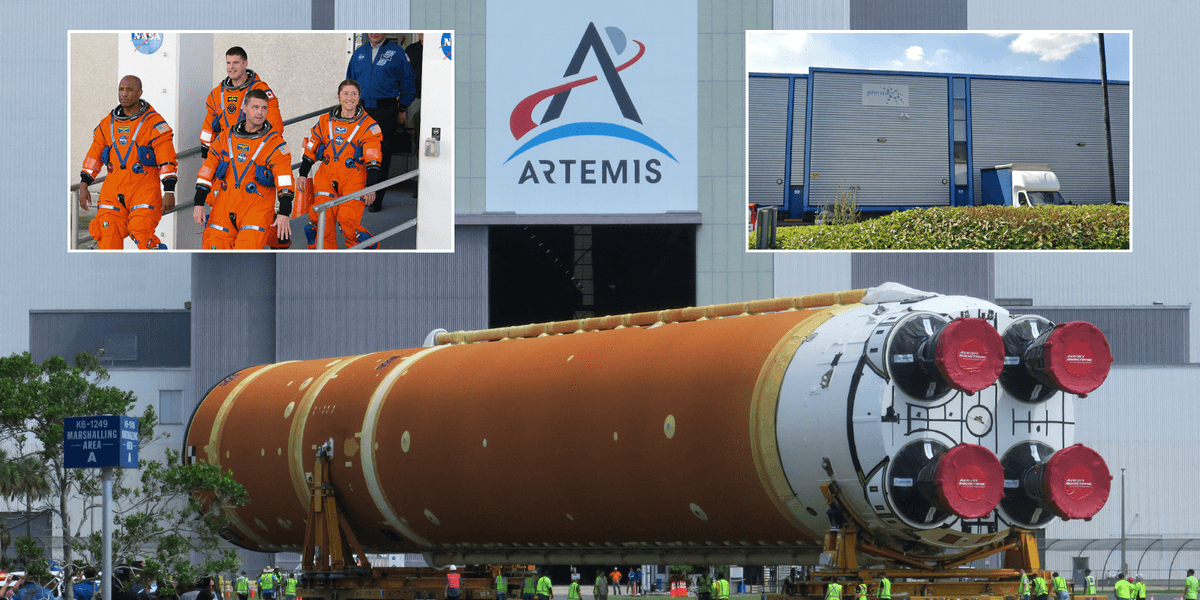
Dozens of science and technology firms based in the United Kingdom are making significant contributions to Nasa’s first crewed Moon mission in more than half a century in a triumph for British engineering.
The Artemis space programme, which was first established by the National Aeronautics and Space Administration (Nasa) in 2017, aims to put humans on the Lunar for the first time since Apollo 17 in 1972.
Following the success of the uncrewed Artemis I mission in 2022, Artemis II will send four astronauts — Reid Wiseman, Victor Glover, Christina Koch and Jeremy Hansen — on a 10-day flyby around the Moon to test life support systems.
Artemis II was scheduled for its first instalment in early March, although it is unlikely to lift off before April at the earliest.
Despite the delays and setbacks, companies with headquarters in the UK have told GB News they are optimistic about being part of scientific history.
One group involved in the process is Thales Alenia Space, which is responsible for the primary structure of Orion — the spacecraft that will carry crews beyond Earth’s atmosphere.
In January 2025, Thales Alenia Space signed a £750million contract with the European Space Agency (ESA) to contribute towards the Artemis programme.
Its scientists, based in Harwell, Oxfordshire, are designing the propulsion solution for the Lunar Gateway — more commonly known as “Gateway”.

Thales Alenia Space said it was a ‘privilege and an honour’ to be part of the mission
|
GETTY
Gateway — a planned space station to be assembled in orbit — will act as a communications hub between Earth and the Lunar surface. It will also have a science laboratory and habitation module.
Thales Alenia Space claims to be the largest industrial contributor to Gateway, which will be a vital step for future lunar operations, with the system being built in Belfast, Northern Ireland.
The British team is also responsible for the design and construction of the Lunar Lander’s propulsion module, allowing it to descend and deliver cargo, infrastructure and instruments to the Moon’s surface.
Richard Thorburn, chief executive of Thales Alenia Space UK, told GB News: “Our world-class Thales Alenia Space experts will design the propulsion solution for the European Argonaut Lunar Lander in Harwell, Oxfordshire, and we will build the system in our advanced space manufacturing facility in Belfast Northern Ireland. It is a privilege and an honour to be trusted to contribute to this flagship European Lunar exploration and scientific mission.”
 John Crane has developed and produced specialist components destined for Nasa’s upcoming Artemis II mission | GOOGLE
Another firm helping with the Artimus programme is John Crane, whose core engineering is based at its headquarters in Slough, Berkshire.
Jeroen Huizinga, the company’s Senior Director for Auxiliary Products and New Energy Solutions, highlighted his staff’s work on filtration sieves, which are designed to keep propellant tanks required to manoeuvre Orion free of gas bubbles.
He told the People’s Channel: “It’s actually our heritage. I mean, even though we operate around the world, we are a UK engineering company by nature. We’re truly pioneering, doing something which has not been done before. I think if you talk to any engineer, I think that’s really what gets them excited – to find new solutions.”
Mr Huizinga said there was a level of personal excitement to contribute towards Artimus, saying: “On an evening with a clear sky, you see the moon, and you actually can imagine that someone goes around the moon in a rocket. I mean, how truly exciting is that? I’m not of the age to have seen it; I’ve not experienced it ever, but I’m looking forward to that moment. We’re humble. We supply a mission-critical part to the system, but the part of it absolutely makes us proud.”

Goonhilly Satellite Earth Station near Helston broadcast images during the Apollo mission
|
PA
Most British contributions to next month’s mission are through ESA partnerships or commercial contracts, as the UK is not a direct bilateral partner to Nasa on the Artemis programme.
Based at the Westcott Venture Park in Aylesbury, Buckinghamshire, Nammo UK was selected last November to supply the main descent engine for ESA’s Argonaut lunar lander.
Meanwhile, Goonhilly Earth Station in Cornwall — which is most famous for distributing live pictures of the Apollo 11 moon landing in 1969 — tracked Artemis I and is now the world’s only commercial facility qualified to provide lunar communications services.
In London, Imperial College is building a magnetometer for the European Radiation Sensors Array aboard the Gateway, while the Open University built the Peregrine Ion-Trap Mass Spectrometer (PITMS) to study the Moon’s thin atmosphere.

The Artemis Scheme will be the first manned moon mission since the 70s
|
GETTY
And in Sheffield, Metalysis is working on ESA-backed technology to extract oxygen from lunar soil — a breakthrough that could allow astronauts to “live off the land” on the Moon, thus reducing reliance on costly Earth supply trips.
Space commentator Andrew Lound hailed Britain’s involvement in the Artemis programme, suggesting participation in space exploration was “always” something the nation could take pride in.
Pointing to the international corporation over the programme, the public lecturer and public speaker told Britain’s News Channel there were political and scientific benefits of having a heavy involvement in Artemis.
He said: “If you develop your engineering and technologies, you’re sharing this with other countries, and they’re sharing their knowledge with you as well, which always benefits Britain. I think one American astronaut in the 1960s pointed out that the whole benefit of the space program is a form of ‘technical life insurance’. As we’re a technical species, we need to develop our new technologies, and the space programme is a very good way of doing that. So I think Britain being involved is both economically critical and technologically vital.”

Artemis II crew Reid Wiseman, Victor Glover, Christina Koch and Jeremy Hansen
|
GETTY
Last week, Nasa confirmed it was shaking up the Artemis programme amid mounting delays and a modern space race between nation states.
A 2027 mission involving lunar landers from Elon Musk’s SpaceX and Jeff Bezos’ Blue Origin will see Orion demonstrate its ability to dock with one or both of its lunar landers in low-Earth orbit.
It comes as China inches closer to fulfilling its 2030 crewed moon landing goal.
And American safety experts have warned more testing is needed before Nasa attempts to land a vessel on the moon during the Artemis IV mission scheduled for 2028.
A hydrogen leak occurred during a launch rehearsal of Artemis II earlier this month.
That technical malfunction was followed by an issue involving Orion’s upper stage that forced Nasa to roll the rocket back for repairs.
This announcement of the delay was hailed by Mr Lound as a “relief”.
He said immediately going for a landing flight without previously testing docking systems was an “unusual way of doing things”.

A hydrogen leak occurred during a launch rehearsal of Artemis II earlier this month
|
GETTYMr Lound said: “Although I’m very excited with Artemis, it hasn’t had the same movement of flow that I would have expected with a normal program. Usually you do a mission; if there’s a problem with it, you simply repeat the mission. So it actually works very well, much in the same way the space sector tests their large booster. It’s a small, incremental step each time. So I’m pleased they’ve done that.”
Mr Lound was also quick to highlight the diplomatic elements of the flight, highlighting a “second space race” between the West and China competing for natural resources on the Moon.
He said: “You see alliances going into space, which is competitive to a certain degree. Although they do generally share scientific knowledge. But for the economic side, this is really important that people need to focus on the fact that a lot of going into space now is an economic issue regarding rare earth metals and resources for the planet. We’re seeing two blocks developing. The United States with its Artemis group, with its allied nations and China with its group of allied nations. So politically, there’s quite an interesting battle going on.”
Our Standards: The GB News Editorial Charter