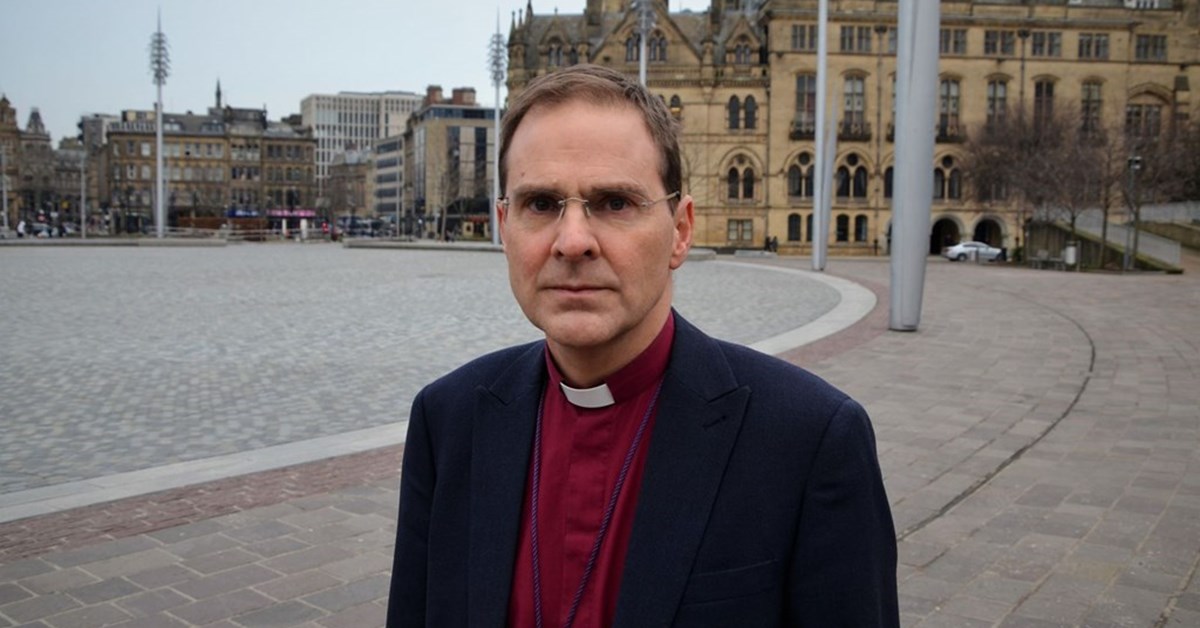
A NEW, non-statutory, government definition of hostility to Muslims has been welcomed by the Bishop of Bradford, Dr Toby Howarth, who said that it would help people to love their neighbours.
The new definition, which does not mention “Islamophobia”, is aimed at tackling record levels of hate crime against Muslim people themselves while allowing for criticism of the religion of Islam.
“I’m glad that, after years of debate and delay, we finally have this official definition of anti-Muslim hostility,” Dr Howarth said; he has an MA in Islamic studies from the University of Birmingham and researched Islamic preaching for a Ph.D. from the Free University of Amsterdam.
“It is seeking to protect people — Muslims and those targeted because they are perceived to be Muslims — rather than trying to close down debate or criticism of Islam as a religion,” he told the Church Times. “We need to remember that this is not just an academic discussion. Muslims are being attacked, vilified, and intimidated simply for being part of a religious community. The focus now needs to be on delivery. Jesus called us to love our neighbours. This definition helps us to do just that.”
The Communities Secretary, Steve Reed, unveiled the three-paragraph definition on Monday. The Government set up a working group last year, chaired by the former Conservative minister Dominic Grieve, to establish a definition of anti-Muslim hatred or Islamophobia.
The initial consultation closed last July. It asked for: advice on terminology; the need for a definition; whether racism should be a component of any new definition; and examples of anti-Muslim hatred or Islamophobia.
The Church of England’s response to the consultation was written by the Bishop of Willesden, the Rt Revd Lusa Nsenga-Ngoy, who chairs the Church’s Presence and Engagement Task Group.
“I agree that a clear and thoughtful definition of anti-Muslim hatred would be helpful in addressing the very real and persistent hostility experienced by many in our communities,” he wrote.
“However, such a definition must be crafted with great care. But what must never be tolerated is the incitement of hatred or hostility against individuals or communities because they are, or are perceived to be, Muslim. . . For this reason, the term Islamophobia can be problematic, as it risks conflating the legitimate critique of religion with the unacceptable targeting of people.”
 AlamyAn installation on a house at Observation Point, on the South Bank in London, with blue and yellow doors, part of IKEA’s “Iftar At Ours” initiative during Ramadan
Mr Reed told MPs this week that the Government had a duty to act against record levels of hate crime against Muslims, and that “you can’t tackle a problem if you can’t describe it.”
According to official figures, hate crimes against Muslims reported to police in England and Wales rose by almost one fifth in the year ending March 2025, to 3199 offences. This does not include incidents reported to the Metropolitan Police amid changes in its recording system.
But Jews experienced the highest rate of hate crime, according to the official figures: 106 incidents per 10,000 of the population. Muslims were subject to the second-highest level: 12 per 10,000.
The new definition comes alongside a wider government strategy for social cohesion, and an accompanying text says that freedom of speech and expression are protected by law. This allows for the criticising or ridiculing of a belief, including an Islamic one. “Portraying it in a manner that some of its adherents might find disrespectful or scandalous,” is legal, the document says.
The new definition states: “Anti-Muslim hostility is intentionally engaging in, assisting or encouraging criminal acts — including acts of violence, vandalism, harassment, or intimidation, whether physical, verbal, written or electronically communicated — that are directed at Muslims because of their religion or at those who are perceived to be Muslim, including where that perception is based on assumptions about ethnicity, race or appearance.
“It is also the prejudicial stereotyping of Muslims, or people perceived to be Muslim including because of their ethnic or racial backgrounds or their appearance, and treating them as a collective group defined by fixed and negative characteristics, with the intention of encouraging hatred against them, irrespective of their actual opinions, beliefs or actions as individuals.
“It is engaging in unlawful discrimination where the relevant conduct— including the creation or use of practices and biases within institutions — is intended to disadvantage Muslims in public and economic life.”
The Shadow Communities Minister, Paul Holmes, said that the definition risked “hindering legitimate criticism”.
Mr Reed responded: “We will not do what [the Conservatives] did and stand by and simply watch while Muslim communities face targeted abuse in ways that any decent country would consider to be absolutely intolerable.”
The word “Islamophobia” was first used in the UK in the 1997 Runnymede Trust report Islamophobia: A challenge for us all, which defined it as “an outlook or worldview involving an unfounded dread and dislike of Muslims, which results in practices of exclusion and discrimination”.
In 2018, the All-Party Parliamentary Group on British Muslims defined Islamophobia as “rooted in racism and is a type of racism that targets expressions of Muslimness or perceived Muslimness”.