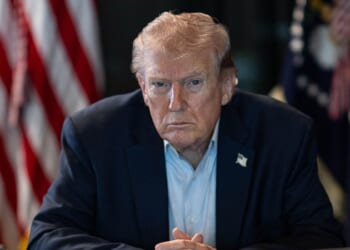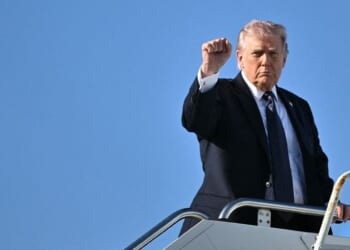
Hours before President Donald Trump traveled to Dover Air Force Base on Saturday to pay his respects to six service members killed in the Iran war, he announced another plan for foreign intervention, this time in the Western Hemisphere.
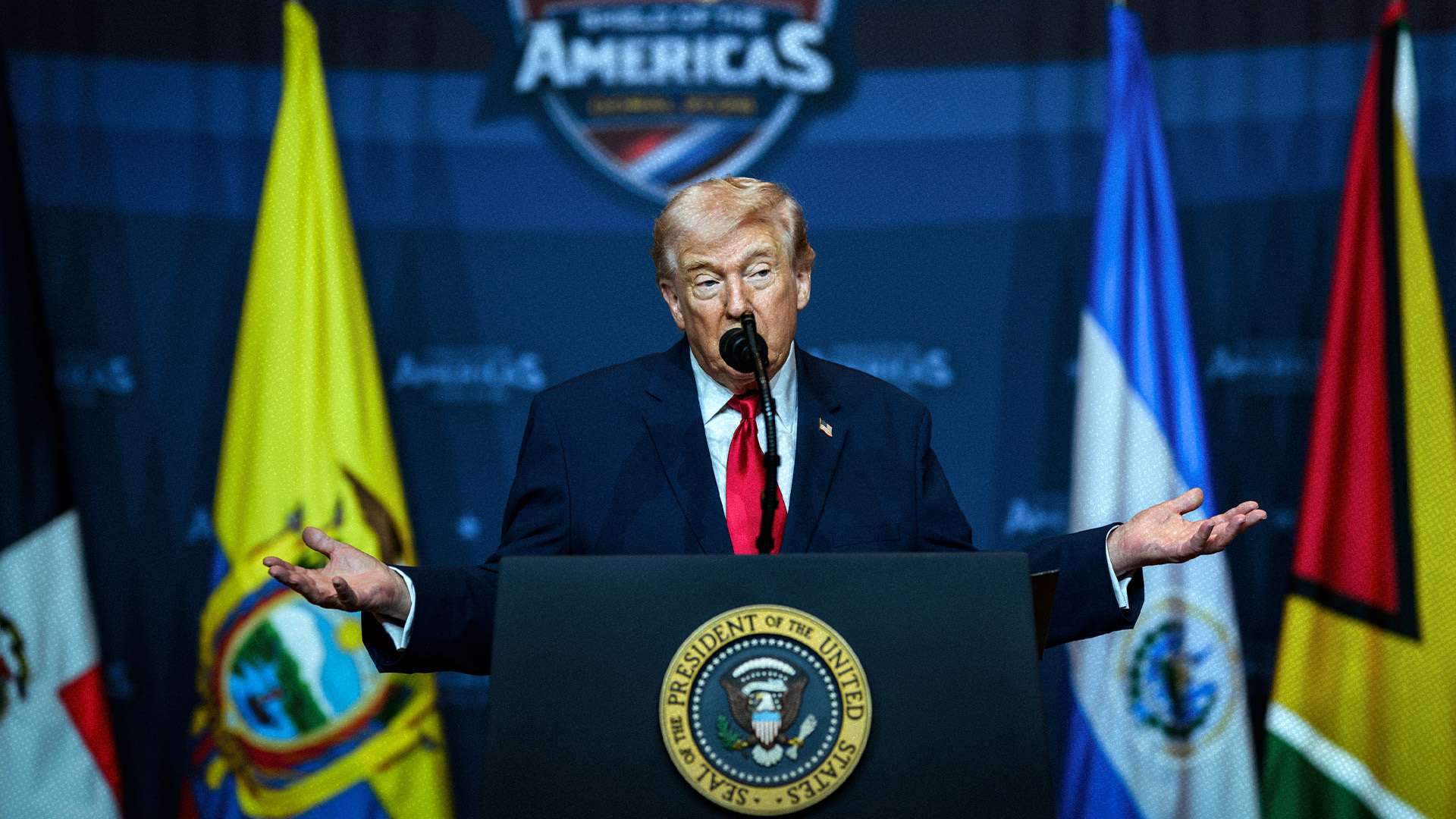
At the “Shield of Americas” summit hosted at Trump’s golf resort outside of Miami, the president celebrated the creation of the “Americas Counter Cartel Coalition,” a U.S.-led group of 16 Latin American countries committed to eradicating drug cartels.
“The heart of our agreement is a commitment to using lethal military force to destroy the sinister cartels and terrorist networks,” Trump told the 12 Latin American leaders in attendance, before offering the coalition’s signatories U.S. firepower to help eradicate violent drug gangs.
“We’ll use missiles. If you want us to use a missile, they’re extremely accurate. Pew, right into the living room,” Trump said. “That’s the end of that cartel person.”
Even if launching missiles at cartels could hypothetically stop cartel violence, there is a major problem with this plan.
During his remarks, Trump called Mexico “the epicenter of cartel violence,” but Mexican President Claudia Sheinbaum was notably absent from the summit. Trump said that she refused U.S. military assistance, which Sheinbaum confirmed during a press conference on Monday. Sheinbaum has also blamed cartel violence on the “flow of illegal weapons from the United States into Mexico,” according to the Los Angeles Times.
Colombia, too, was not represented at the summit, and like Mexico, it has yet to sign onto the joint security declaration.
The absence of both of these countries is sure to get in the way of Trump’s plan to eradicate cartels “once and for all.” As the Drug Enforcement Agency’s 2025 National Drug Threat Assessment noted, the Mexican Sinaloa and the Jalisco New Generation cartels are the “primary groups producing the illicit synthetic drugs driving U.S. drug poisoning deaths and trafficking these drugs into the United States. The cartels produce fentanyl and methamphetamine in clandestine laboratories in Mexico using precursor chemicals and pill presses sourced from companies in China.” That same report lists cocaine as a “serious drug threat in the United States” and calls Colombia “the primary source country for cocaine entering the United States, followed by Peru and Bolivia.”
Without the cooperation and full participation of Mexico and Colombia, it is unclear how the coalition would eradicate the cartels without launching an attack inside the nonparticipatory states, and thus violating Mexican and Colombian sovereignty.
But it’s not just this lack of participation that stands in the way of eradicating drug cartels. The coalition’s militaristic and interventionist approach echoes the failed strategy of the war on drugs.
The decades-long campaign has come at a great cost to taxpayers. Between 2015 and 2024 alone, the U.S. spent $13 billion on international “counternarcotics” activities alone, according to Harm Reduction International. And not only have the war’s campaigns not stopped the flow of illegal drugs, but in many cases, they have accelerated trafficking. This includes Plan Colombia, a Clinton-era initiative to combat drug trafficking, terrorism, and coca cultivation in Colombia with military force.
As Javier Osorio, a professor of political science at the University of Arizona, told Reason‘s Fiona Harrigan, coca cultivation has “skyrocketed” since a 2016 peace agreement between the Colombian government and the Revolutionary Armed Forces of Colombia, a guerrilla group.
Meanwhile, the use of military force to target and kill drug kingpins has often failed to eliminate the drug cartels. In many cases, it has created more violence and competition among remaining gang members. After Mexico’s military killed the Jalisco New Generation Cartel (CJNG) leader Nemesio Oseguera Cervantes, aka “El Mencho,” in February, the cartel quickly mobilized and violently revolted, blocking roadways throughout the country and torching businesses.
The “Shield of the Americas” coalition will not mark the end of the drug empires in Latin America; it is just the latest salvo in America’s decades-long war on drugs. The failures of that war are enough for Americans to be dubious of Trump’s new coalition. And with the U.S. spending at least $5.6 billion in a war of choice against Iran, Americans should oppose another military campaign abroad altogether.