WHENEVER there is a conflict, or a threat of conflict, particularly in the Middle East, cries are heard for “de-escalation” and a scaling back to ensure that the war does not “widen”; so that when, in Iran, the war really did widen, as the Islamic Republic launched a barrage of missiles towards its neighbours, much of the media seemed almost relieved to be able to report on it.
But while, as the US Secretary of War, Pete Hegseth, puts it, “war is always hell,” is it not also true that, in some circumstances it is justifiable, or even necessary?
It should not be forgotten that, earlier this year, tens of thousands of Iranians were massacred in the space of just two days by their own security forces — the same security forces as are now the target of the US and Israel’s aerial assaults (News, 16 January).
We should not support “regime change from the skies”, Sir Keir Starmer tells us; but, in the context of Iran, if regime change was the aim, but boots on the ground were anathema, how else could it be achieved?
Among those to add their voices to the debate have been several Christian leaders. The British-Iranian Bishop of Chelmsford, Dr Guli Francis-Dehqani, has said that she shares the concern of those who believe the war to be “neither legal nor necessary”, and that “peace is best secured by returning to the negotiating table.” The Archbishop in Jerusalem, Dr Hosam Naoum, went further, calling on leaders of the US, Israel, and Iran to “recognise the futility of this bloodshed and turn back from the precipice of a global catastrophe” (News, 6 March).
On the other side of the debate are Iranian Christians, such as my colleague Mansour Borji, who has argued that there is a “profound ethical necessity to confront and ultimately end a regime that has systematically tormented not only the Iranian people but much of the region”. Meanwhile, the exiled Crown Prince of Iran, Reza Pahlavi, recently claimed that 715 Christians from inside the country had signed a letter backing him to lead the change that many long for.
It is not only religious leaders and Western media and politicians who struggle to know best how to respond at times of war. Human-rights activists, too, can find themselves in a confusing position.
DURING the 12-day war last June, many Iranians at home and abroad were understandably concerned about the safety of their loved ones as Israel bombarded Tehran, while the messaging from both Israel and the US seemed slightly confused, as they called for both evacuation and protest, neither of which seemed appropriate in the midst of war.
Activists at the time, rather than latch on to the potential for regime change, focused instead on civilian casualties — a not unworthy focus, but, at the same time, one that was hardly likely to foster enthusiasm among the attackers to carry on their campaign.
This time, the messages to the Iranian public from Washington and Jerusalem have been much more sensible: that Iranians should stay inside their homes as the bombs fall, and wait until the moment arises to take to the streets again.
The context this time is also markedly different from last June’s, and explains why fewer Iranians, of all faiths and none, have denounced the strikes. The truth is that, after President Trump promised protesters that “help [was] on its way,” and then tens of thousands were murdered, there was simply a desperation among many Iranians for any kind of help to arrive.
“I think this might be one of the few instances in modern history where a greater percentage of the society being bombed was supportive of military action than the society doing the bombing,” Karim Sadjadpour, an Iran analyst, said.
Indeed, Iranians at home and abroad have been filmed dancing in the streets and whooping for joy at the news of the killing of the Supreme Leader, Ayatollah Ali Khamenei, even if some Western liberals have seemed less inclined to welcome his demise.
THERE remains great uncertainty about what will follow at the end of this conflict. This, ultimately, will likely shape people’s views of whether the offensive, Operation Epic Fury, can be justified or not.
Should the dream scenario unfold — that the mullahs are removed, the Islamic Revolutionary Guard Corps are disarmed, and Iranians are finally able to decide on the type of government that they want — then, surely, the operation will be viewed as a success, even by objectors to the way in which the change was wrought.
Alternatively, should the regime stay in power, only with another Khamenei — Ali’s son Mojtaba, this time — still leading the calls for the death of Israel and the West, it would be less easy to make such a case.
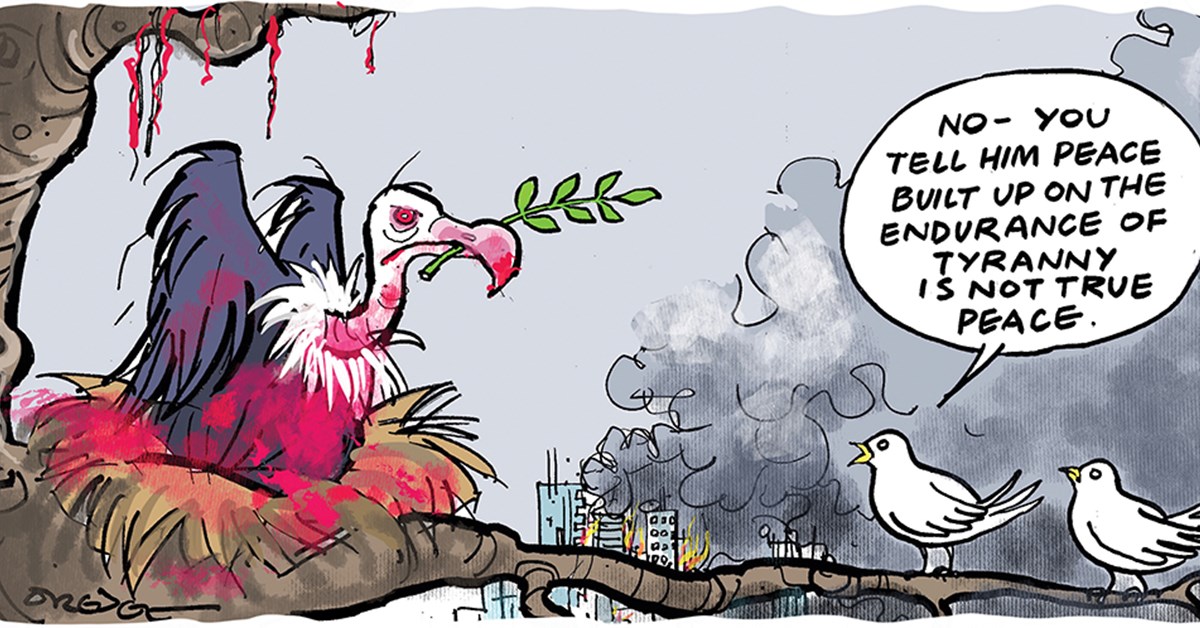
As for those who consider that war is an evil which should be avoided at all costs, I would encourage them to consider these words from my colleague Mansour: “Peace built on the endurance of tyranny is not true peace; it is merely prolonged suffering. Sometimes, the difficult path towards justice is the only path that can lead to a lasting and genuine stability.”
Steve Dew-Jones is News Director for Article18, a London-based non-profit organisation that is an advocate for religious freedom in Iran.