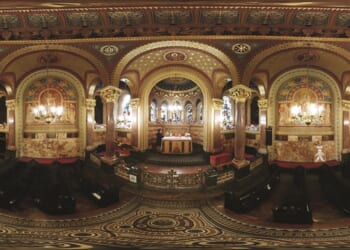
IT IS All Saints’ Day, a damp and misty November morning that inclines itself to reflection and remembrance. A band of pilgrims, we turn up with our rucksacks at St John the Baptist, Tideswell, in Derbyshire, a church known locally as the Cathedral of the Peak for its size and majesty.
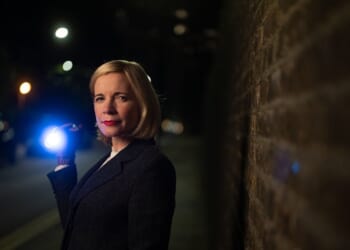
We are assembling here to walk the near nine miles of “Mills and Martyrs”, a guided pilgrimage through some of the White Peak’s loveliest limestone scenery, and an opportunity to reflect, if we choose, on grief and loss. Faye Smith, the leader and founder of Hope Walking, knows a great deal about that, but you wouldn’t know it from the spring in her step and the light in her eyes and the visible energy that she exudes.
We each pocket a tea-light and a linen pouch of the sort carried by pilgrims, receive a warm blessing from the Vicar of Tideswell, the Revd Fiona Kouble, and, in the quiet of the Lady chapel, “set our intentions”: our goals for the pilgrimage. The chapel breathes the history of the Padley Martyrs: two local priests, Fr Nicholas Garlick and Fr Robert Ludlum, arrested on charges of being Roman Catholic, and executed in July 1588.
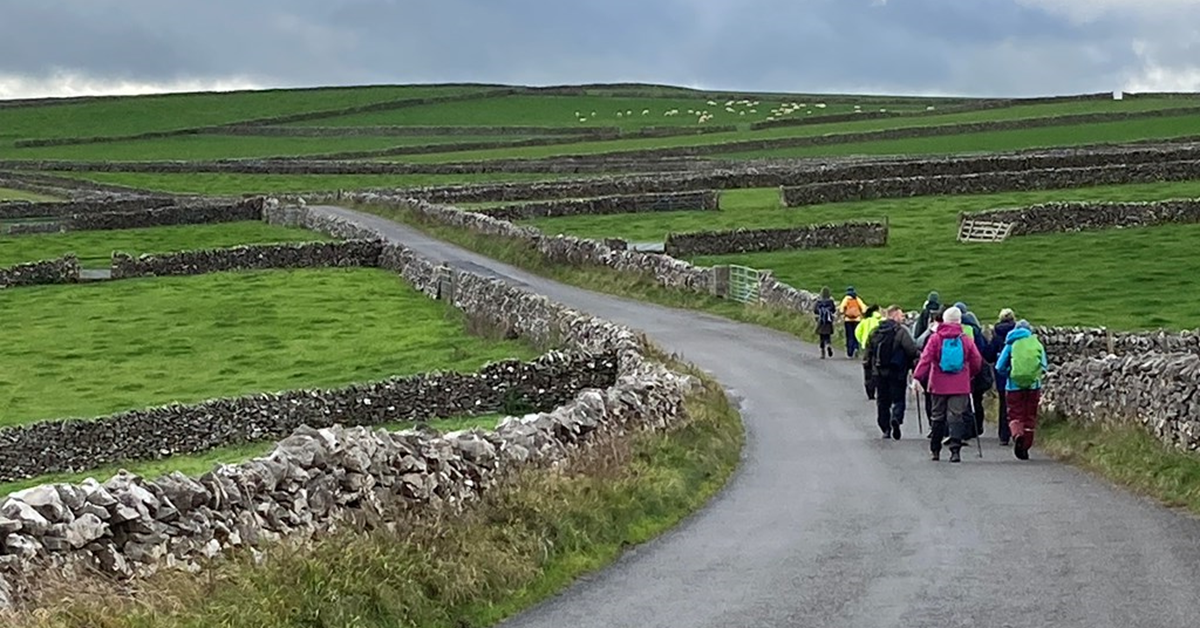
They remain in our minds as we cross the village and ascend a flight of steps to a vantage point where we can look down on the tower. We get into our stride on a narrow country road flanked by dry-stone walls and smelling of damp grass; we pause for refreshment in Christ Church, Litton, and are assailed on the open road by driving rain.
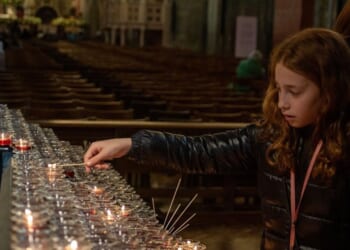
But the wind dies, the sky clears, and lo, there is a rainbow. Ms Smith pauses at intervals to drop in nuggets of history that intrigue. We light candles, if we choose, in St John the Evangelist, Cressbrook. And now we descend to the valley, breathing and walking at our own pace, taking in the sweep of the valley side.
With few buildings in sight, it feels miles from anywhere — except for the mighty Litton Mill which stands by the river. The original owner, Ellis Needham, relished an isolation that meant that no one could witness the plight and the myriad deaths of the orphans that he took from the workhouses in 1782, and set to work for 16 hours a day. Hungry, beaten, ill-clad, and lice-ridden, half of those who died were buried in Tideswell parish, and half in Taddington, so as not to attract undue attention.
One, Robert Blincoe, famously survived to write the defiant memoir that would ultimately lead to reform, and which is believed to have inspired Charles Dickens. The focus on history in Faye’s walks puts life and death, justice and injustice, even one’s own loss, into context, as we follow the Wye through Cressbrook Dale and into Millers Dale, to share our lunches on the sunny platform of the disused station, and replenish our flasks with hot tea from the café.
It is a long haul out of the valley, a steady but unremitting ascent. The reward is the gem of a village church that is St Margaret of Antioch, at the top of the hill: an oasis to be enjoyed before summoning up strength for the walk back to Tideswell and completion of the pilgrimage.
I give heartfelt thanks for today. I have been in good company. My body is grateful for the exercise, and my mind is de-cluttered. All is well with my soul. All the aspects of the walk play into its healing properties, but the beauty of it is subtle: it’s very much what you make of it, what you can apply to your own circumstances, and where you are on your life journey.
MILLS and Martyrs is one of a range of Hope Walking journeys. Sheffield-born Ms Smith came late to the physical, mental, and spiritual benefits of walking and pilgrimage, about which she is so enthusiastic. Her own life journey has been inordinately hard: there have been many times when she has felt “like a one-woman soap opera”, she says, wryly.
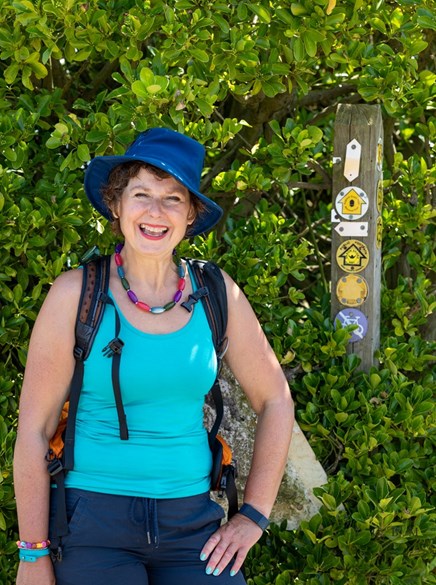 Faye Smith, founder of Hope Walking
Adopted as a baby, she had a difficult marriage to an alcohol-dependent man which ended in divorce. Her ex-husband subsequently died at 48. Two years to the day later, her beloved 12-year-old daughter died in an accident. Her father died. An engagement ended. The communications business that she had built up over 15 years fell apart, and so did she. By 2019, “tragically addicted to work and performance”, her life measured in “billable hours”, and with no network of support, she was at rock bottom.
In desperation, and with resources enough to last for six months, she rented out her house and joined a Christian trauma-recovery community on the Kent coast. The onset of the pandemic extended that period to two years — an enforced “sabbatical by the sea”, she says, during which she “walked, and walked, and walked”, often without seeing another human being for miles, and later, when the rules were relaxed, with others.
She discovered not only the healing power of walking in nature, but the ability to be alone while still feeling supported: walking side by side with others, but “having a mind space where you can be alone with your thoughts”.
“We need the tribe, but can learn to be independent within it,” she says with conviction, confessing to having previously had an addiction to people. “I surrounded myself with people as a distraction. If we cannot be alone with ourselves, we are for ever addicted and at the mercy of other people.”
With the help of Visit Kent and Kent Downs, she set up Hope Walking, initially as walking breaks for women, later as “inclusive journeys of intention, to connect, reflect, and restore”.
The health benefits of walking are well proven: it improves heart and sleep quality; eases pain, regulates blood sugar, boosts the immune system, eliminates toxins, and increases endorphins — all of which can otherwise be “knocked for six by grief”, she says.
Her personal journey of faith gives her much to reflect on: moving, after a very challenging experience, away from the orthodox Evangelical faith in which she grew up, to become what she describes as “an inclusive progressive pilgrim”. She makes no apology for being a Christian, and brings Christian elements into the walks, but welcomes people of all faiths and none.
WALKING your way back to health works, she says with conviction. “I know this because I am walking, talking proof of its healing powers. Experiencing nature, reconnecting with yourself, walking with purpose and intention, sharing the experience with others got me back on my feet — literally — and set me on the road to recovery.”
St Augustine of Hippo is credited as the source of the Latin phrase solvitur ambulando, which translates as “It is solved by walking,” and has come to mean a problem solved in a practical way. “We are in a sedentary society,” Ms Smith reflects. “Most of our diversions are seated. We’ve got used to doing two things: sitting and diverting ourselves.
“Walking requires we do neither of those things. It requires that we move and get healthy enough to move long distance. We don’t distract ourselves other than by nature, and our surroundings, and the odd person we might meet. On pilgrimage, you have to be prepared to be alone with yourself, which is quite hard sometimes if you’re not in that mind space.
“You can be alone with your own thoughts, go back over your life, your mistakes, your traumas, your tragedies, your mistreatments, your unforgiveness, your resentments, your bitterness. I could weep with gratitude for what I found in walking in this way.”
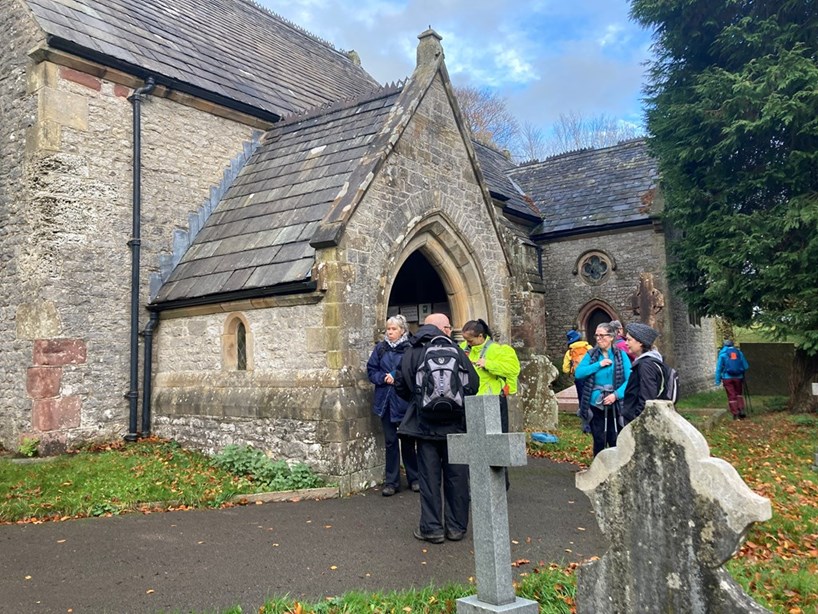 Pat Ashworth healMills and Martyrs pilgrims at St Margaret of Antioch, Wormhills, in Tideswell parish
She has developed a whole range of walks, many of them in the Peak District, where Hope Walking is now based. A linear, one-day, 11-mile Padley Martyrs pilgrimage takes pilgrims from urban Sheffield to rural Grindleford. The seasons of the year also offer a focus: Janus pilgrimages, with life coaching, provide an opportunity to burn the past of the old year and look to new beginnings of the year ahead.
History is interwoven into all of the walking routes. Pilgrims can walk a leisurely 19 miles from Ramsgate to Canterbury; a three-day “weekend journey of purpose”, on St Augustine’s Way; or from Folkestone to Dover on the Via Francigena, along a stunning section of the Kent Downs. There are two versions of a Catherine of Aragon pilgrimage, taking pilgrims from the ancient St Kyneburgha’s, in Caistor, to Catherine’s tomb in Peterborough Cathedral. There is an African Adventure, too: an “adventure and community development journey of a lifetime”, she promises.
She concludes: “After years of various forms of often painfully reflective therapy, I’m the happiest I’ve ever been with my quiet, simple life, because I am the most content I have ever been within myself.
“I like the person the hardships have made me: more empathetic, less judgemental, more reflective, more understanding. I have more questions than answers these days.”
Hope Walking’s next Mills and Martyrs Pilgrimage run on 12 September and 31 October (the All Souls’ Eve walk is particularly suitable for those who have experienced grief)